Castel Sant'Angelo in Culture
The castle in novels, film, opera, video games, and the visual arts
Castel Sant'Angelo is a building that has refused to stay in the past. Long after it stopped being a fortress, a treasury, or a prison, it has continued to live in the imagination of the world — as the climactic setting of novels, the stage of operas, the backdrop of films, and a recurring location in video games. Its cylindrical silhouette is one of the most recognisable in Rome, and that recognisability has made it irresistible to artists for four centuries.
The reason is geography. The castle sits at the very edge of the Vatican, separated from St Peter's by a single bridge of Bernini angels and a hidden papal corridor. It looks like what a castle is supposed to look like — round, fortified, fronted by a river. And it has 1,900 years of real history that fiction has rarely needed to embellish: a Sack of Rome, a daring jailbreak, a notorious execution, an alchemist locked in a luxury cell.
The page below collects the major appearances of the castle in popular culture. Some are full long-form pieces; others are short notes that will grow into full stories as we publish them.
The castle in the global imagination
In opera, the castle has its most enduring moment in Giacomo Puccini's Tosca, premiered at the Teatro Costanzi in Rome on 14 January 1900. The third and final act is set explicitly on the Terrazza dell'Angelo, beneath the bronze statue of the archangel cast by Peter Anton Verschaffelt in 1752. Cavaradossi sings “E lucevan le stelle” as he waits for execution; Tosca learns the firing squad was real, and leaps from the parapet with the cry “O Scarpia, avanti a Dio!” It is one of the most famous endings in the history of musical theatre. Read the full story of Tosca and the castle.
In the visual arts, the castle is inseparable from the bridge that leads to it. Gian Lorenzo Bernini redesigned Ponte Sant'Angelo for Pope Clement IX between 1667 and 1669, drawing the programme of ten angels each carrying an instrument of the Passion of Christ. Bernini personally sculpted only two of them; the other eight were executed by his students. The result is one of the most photographed bridges in Europe — and the foreground for almost every modern painting and engraving of the castle, from Piranesi's eighteenth-century vedute to contemporary cinema.
In literature and film, the castle's biggest twenty-first century moment came with Dan Brown's Angels & Demons (2000) and the Ron Howard film adaptation (2009). The castle serves as the fictional “Church of Illumination” — the climactic location in the Path of Illumination that the protagonist Robert Langdon races to find. The novel uses real Roman locations throughout, including Santa Maria del Popolo, St. Peter's Square, Santa Maria della Vittoria, and Piazza Navona, but rearranges several details for dramatic effect. Read the full breakdown.
In cinema, beyond Angels & Demons, the castle has appeared in Mission: Impossible III (2006) as part of a Vatican-area sequence, and in numerous Italian films of the twentieth century — most memorably Federico Fellini's Roma (1972), where the castle is part of the filmmaker's lyrical reconstruction of the city. The castle also appears in Catch-22 (1970), The Talented Mr. Ripley (1999), and dozens of Italian period dramas set in papal Rome.
In video games, the castle is one of the central landmarks of Assassin's Creed Brotherhood (2010), set in Renaissance Rome during the Borgia papacy. The game reproduces the cylindrical structure, the spiral ramp, the courtyards, and parts of the Passetto di Borgo with architectural fidelity. For many players, it is the first encounter with the castle's geometry — which makes seeing it in person, years later, a strangely familiar experience.
The thread connecting all of these is the castle's ability to function simultaneously as a real building and as a symbol. Tosca dies on a real terrace; Robert Langdon runs through real courtyards; Ezio Auditore climbs a real cylinder. The fiction works precisely because the geography is accurate. Fiction lives easier inside a building that does not need to be invented.
Long-form stories
In-depth pieces on the castle's appearances in culture, with location-by-location breakdowns and what each work gets right or wrong.
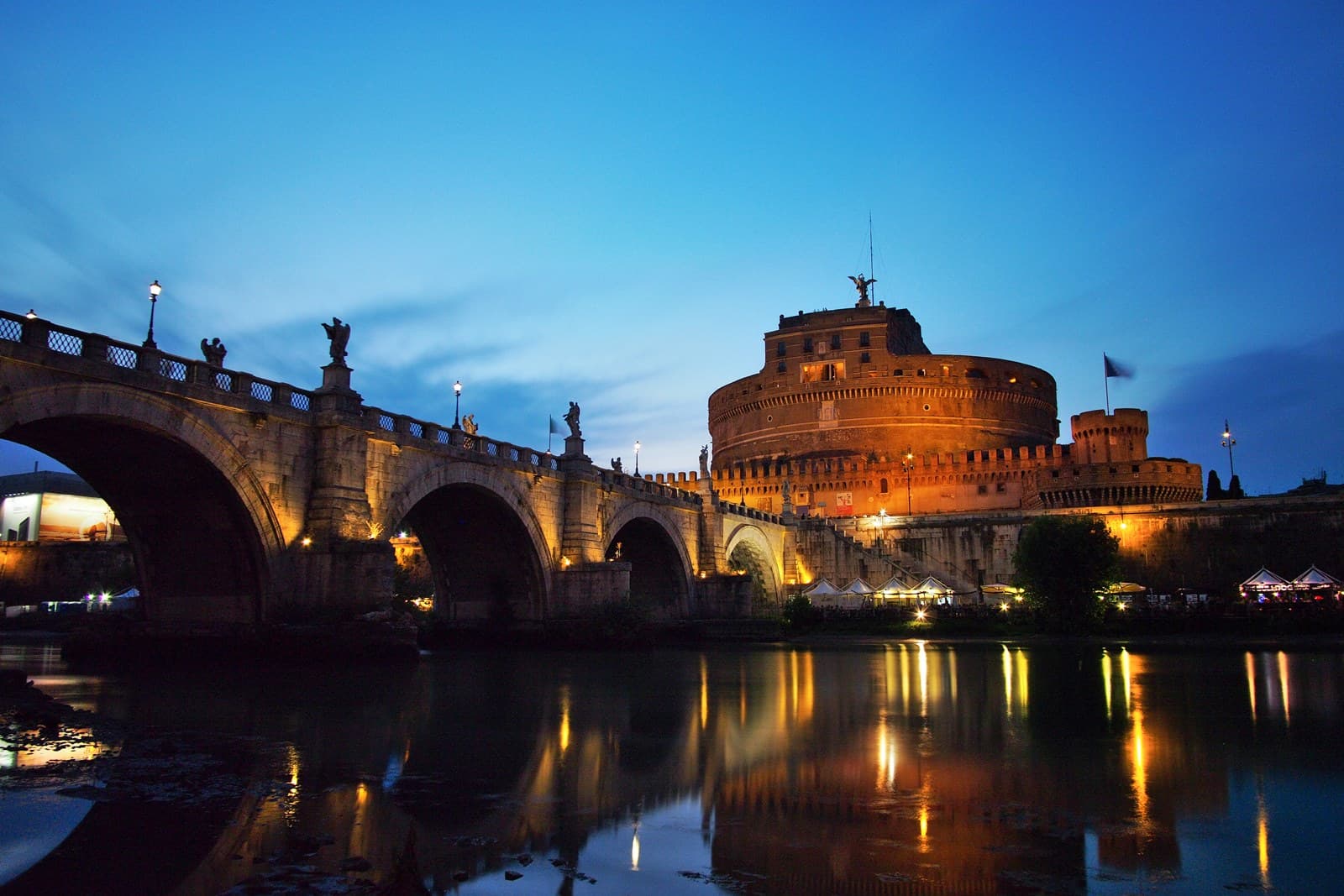
Tosca
Puccini's opera ends on the rooftop of Castel Sant'Angelo. Cavaradossi sings "E lucevan le stelle" before the firing squad; Tosca leaps from the battlements at dawn. The full story of why Puccini chose this castle, and how he stitched the actual sound of its bells into the score.
Read the story →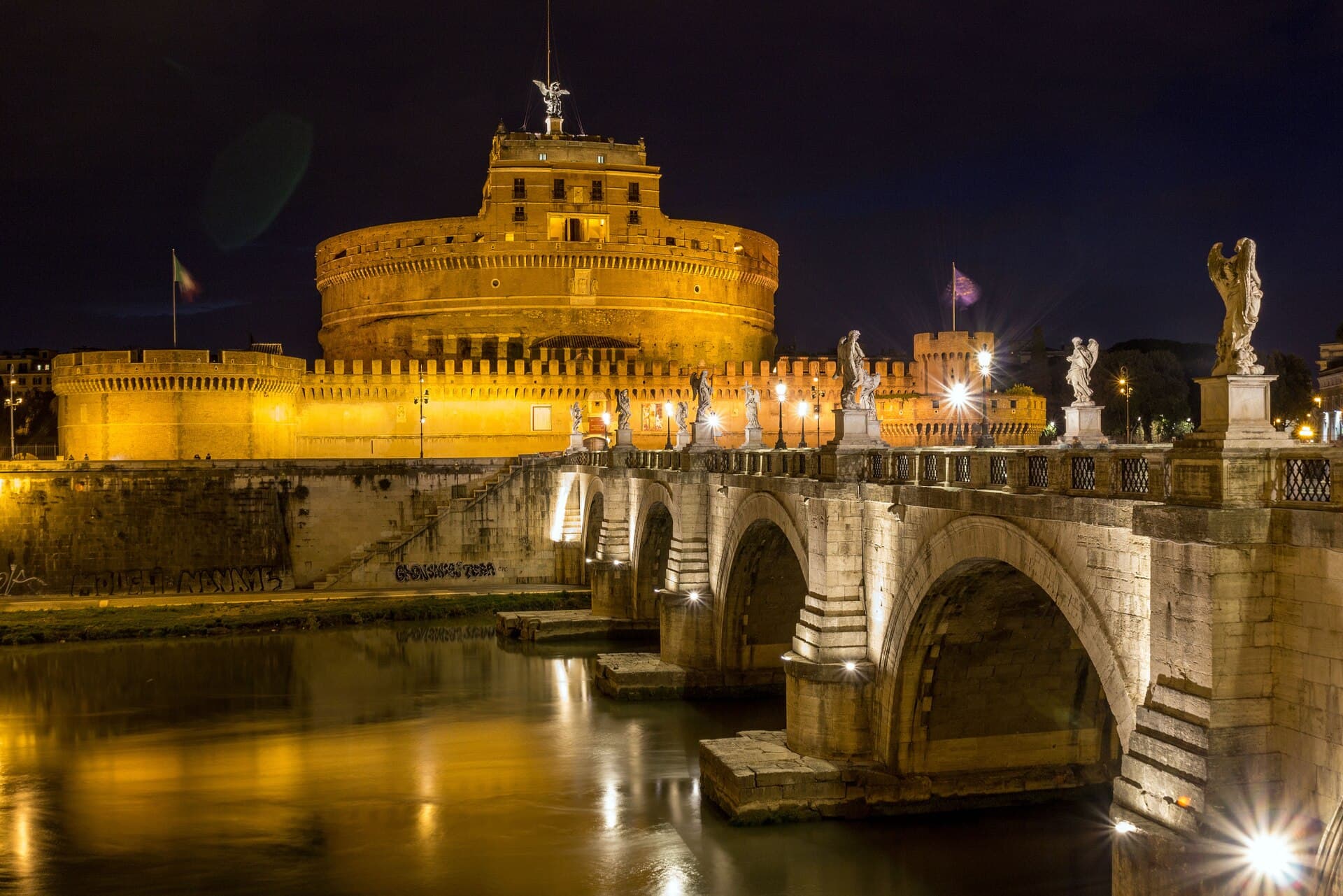
Angels & Demons
Dan Brown's thriller and the 2009 Ron Howard film climax at the castle — the "Church of Illumination." A guide to every real Roman location in the Path of Illumination, and what the novel changes.
Read the story →Frequently asked questions
Is Tosca's third act really set at Castel Sant'Angelo?▾
Where exactly does Tosca jump from?▾
Is Castel Sant'Angelo in Angels & Demons a real place?▾
Does Castel Sant'Angelo appear in Mission: Impossible?▾
Is the castle in Assassin's Creed video games?▾
Who designed the angel statues on the bridge?▾
Which other operas reference Castel Sant'Angelo?▾
Why does the castle inspire so much fiction?▾
See these places in a real visit
The Terrazza dell'Angelo where Tosca leaps, the courtyards Robert Langdon runs through in Angels & Demons, the spiral ramp climbed in Assassin's Creed, and the bridge of Bernini's angels — they are all part of the same modern museum visit. You walk through cinema and opera at the same time as you walk through 1,900 years of Roman history.
Practical resources to plan a visit anchored in this cultural geography:
- All tours of Castel Sant'Angelo — guided, private, skip-the-line. Tours that include the Passetto di Borgo let you walk corridors recreated in video games and films.
- History stories — the documented historical episodes that inspired most of the fiction.
- The Terrace of the Angel — the rooftop where Tosca leaps and Verschaffelt's bronze stands.
- Tickets and prices — official entry costs and reduced fares.
- Opening hours — the castle is closed on Mondays.
More cultural pieces coming
We're working on long-form pieces on Bernini's ten angels of Ponte Sant'Angelo, on the castle in Assassin's Creed Brotherhood, on Mission: Impossible III, and on the Italian opera repertoire beyond Tosca. Each one will get its own location-by-location breakdown and a guide to what to look for in person.
About this page
Edited by Gabriel G, a Google Maps Local Guide (Level 8) who has contributed reviews, photos, and corrections to Rome's cultural heritage sites over several years.
Cultural and historical references are verified against published sources: original libretti and scores for the operatic material (Casa Ricordi for Tosca), original novels and screenplays for the literary and cinematic material, and the official brochure of the Direzione Musei Nazionali di Roma for architectural details and dates of the structures referenced.