Explore · Level 3 · Highlight
Sala della Biblioteca
The Library Hall of the Farnese Apartments — Frescoes 1544–1545
Quick answer: The Sala della Biblioteca is the largest hall of the north wing of Pope Paul III's apartments at Castel Sant'Angelo. Decorated by Luzio Luzi between 1544 and 1545 with stuccoes, grotesques and ten scenes of ancient Rome, it is one of the six rooms marked as a highlight in the official brochure of the Direzione Musei Nazionali di Roma. The name “Library” is modern (twentieth century) and reflects its proximity to the Treasury Room, which once housed part of the Papal Secret Archive. Access is included in the standard museum ticket.
The hall was never really a library.
It is the principal antechamber of the north wing of the papal apartment built by Paul III Farnese in the 1540s — the largest room on this side of the castle, and the gateway to the Treasury, the Sala dei Festoni and the Sala dell'Adrianeo. The name Biblioteca was attached to it only in the twentieth century, by association with the adjacent rooms where the papacy kept its written memory.
What made the room significant in its own time was something else: the frescoes. Paul III commissioned the entire decorative campaign from Luzio Luzi of Todi, who had also worked on the Sala Paolina and the Cagliostra upstairs. Documentary records of payments for stucco, painting and gilding work in this room are dated to 1544 and continue through 1545.
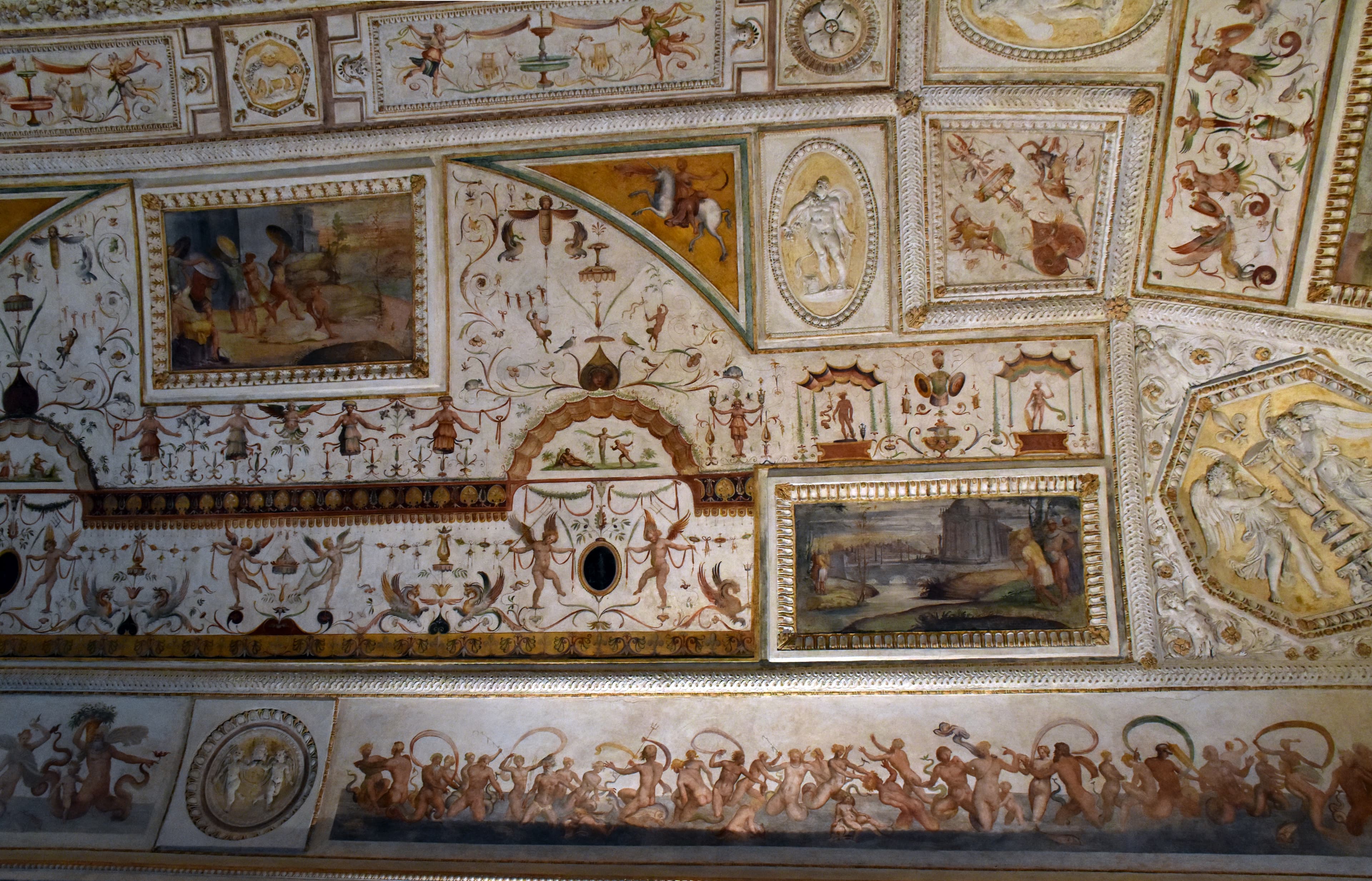
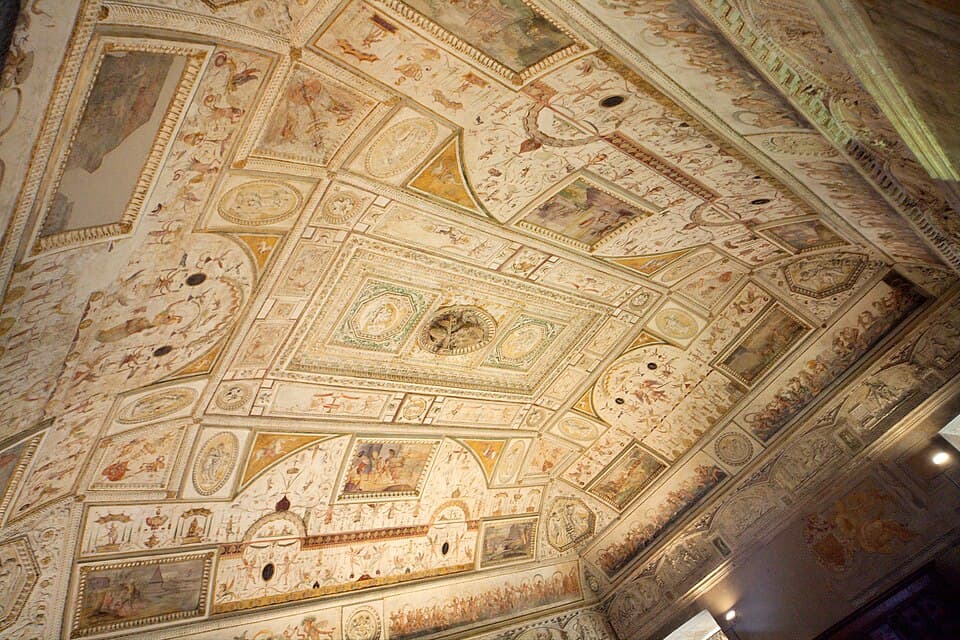
The result is one of the most ambitious decorated ceilings in the whole castle — five concentric registers of grotesques, ten scenes of ancient Rome, a frieze of twenty-eight relief lunettes, and the Farnese coat of arms at the very centre.
What you see when you enter
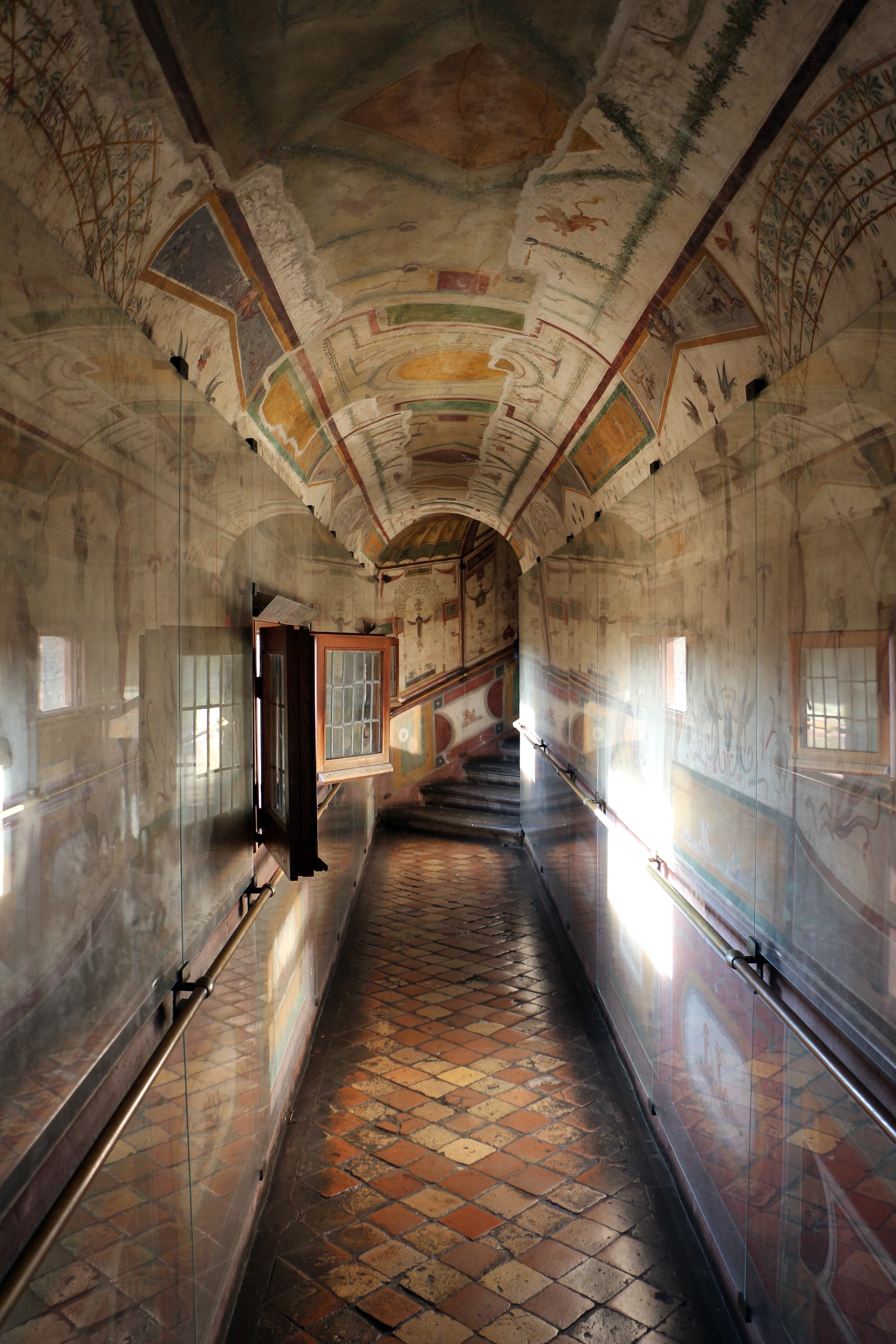
You arrive at the Biblioteca through the Corridoio Pompeiano, a narrow passage decorated in the antiquarian taste of the late Renaissance. The corridor opens directly into the room. The first thing that pulls the eye is the vault.
On the eastern wall, opposite the entrance, sits the great fireplace. Above it, two monumental allegorical figures — the Church and Rome — flank the Farnese papal coat of arms at the centre. The pairing is deliberate: in this room, papal authority and Roman heritage are presented as two sides of the same idea.
Below the vault, two continuous friezes circle the entire room. The lower one is in stucco relief; the upper one is painted. Between them, the walls are punctuated by stucco medallions at the centre of each side.
The ceiling itself is divided into five concentric registers, with grotesques against a white ground alternating with ten figurative scenes from the history of ancient Rome. At the short ends of the room are portraits of Saint Michael the Archangel — the patron of the castle — and the Emperor Hadrian, builder of the original mausoleum.
The two figures at the short ends are not decoration. They are a thesis statement about the building itself: Hadrian is the origin, Michael is the protection. Everything in between — emperors, popes, treasure, prison — happens under that frame.
Why it is called “Library”
The name is modern. It does not appear in any sixteenth-century document.
Through the Renaissance, the room was simply the principal hall of the north wing of the papal apartment — a representation room, used for audiences and receptions, not a deposit of books. It acquired the name Biblioteca only in the twentieth century, and the reason is purely topographical: the next room over, the Sala del Tesoro, kept books, registers and documents.
In particular, the Sala del Tesoro held part of the Archivum Arcis, the papal archive of the castle. Wooden cabinets along its walls, sealed with iron locks, contained registers, briefs and bulls. Adjacent storage cabinets in the rooms above — including the Sala Rotonda — were added under Clement VIII to expand the holding.
By the twentieth century, when the castle had become a museum and the rooms needed names that visitors could find on a map, “Library” was the closest available label for the antechamber to all of that. It stuck.
The decoration of Luzio Luzi (1544–1545)
The painter responsible for the entire decorative scheme was Luzio Luzi of Todi, sometimes called Luzio Romano — the same artist who frescoed the Cagliostra upstairs. He had trained alongside Perin del Vaga and was the lead specialist in grottesche working on the Farnese site.
Documentary records of payments to Luzi for stuccatura, pittura et indoratura work in this room are dated to 1544 and continue through 1545, in parallel with payments for the Loggia of Paul III and the Cagliostra.
The vault, register by register
The vault is organised in five concentric registers, framed above and below by two continuous friezes:
- The lower frieze consists of twenty-eight relief lunettes in stucco, alternating pagan scenes — sacrifices, ancient deities — with Farnese heraldic emblems.
- The upper frieze, painted, runs slightly higher and is populated with sea creatures. Stucco medallions interrupt it at the centre of each wall.
- The vault itself, divided into its five concentric registers, alternates grotesque ornament against a white ground with ten Histories of Ancient Rome.
The grotesques are not random ornament. They are quotations — the late Renaissance vocabulary of antique-style decoration that Roman painters had been studying since the rediscovery of Nero's Domus Aurea in the late fifteenth century. By 1544 the style was no longer a curiosity: it was the standard idiom for prestige rooms in the papal court.
The centre of the vault
At the centre of the ceiling, the Farnese coat of arms is flanked by two emblems: the Virgin with the Unicorn and the Lily of Justice. Both were personal devices of Paul III, painted onto the vault as a signature of the patron.
The papal archive that lived next door
The room next to the Biblioteca, the Sala del Tesoro, was the working strongroom of the Papal States.
From the mid-fifteenth century onwards, popes used Castel Sant'Angelo as a fortified treasury and archive. By the late sixteenth century, the Sala del Tesoro housed the so-called Sanction Treasury — a reserve fund secured by six locks held by the Treasurer and the Cardinal Dean — alongside large iron chests installed by Pope Sixtus V in 1586.
Equally important were the papal archives: registers, bulls, briefs, contracts. Part of what would later be called the Archivio Segreto Vaticano was kept here for centuries. Under Clement VIII, additional storage cabinets were installed in the Sala Rotonda directly above, accessed through a narrow Roman stair that starts in the Biblioteca itself.
The contents of these archives were transferred to the Vatican between the late eighteenth and early nineteenth centuries, after the disruption of the French occupation of Rome. What remains in the Tesoro today are the original wooden cabinets and the iron chests — an empty vault that still says everything about the building's function.
From the visitor's point of view, the result is unusual. The Biblioteca is the antechamber to a vault. You read its decoration as a Renaissance representation room; you read its position in the floor plan as a security perimeter.
Where it leads in the castle
The Sala della Biblioteca is a node, not a destination. From it, four other rooms are accessible:
- The Sala dell'Adrianeo — a small chamber decorated with views of ancient Roman monuments (the Mausoleum of Hadrian itself among them) and scenes from the Dionysian world. Frescoes by Luzio Luzi's workshop, 1544–1545.
- The Sala dei Festoni — named for its painted festoons of fruit and flowers. Decorated under Paul III and reworked in the early twentieth century by Duilio Cambellotti.
- The Sala del Tesoro — the strongroom and archive described above, with its original iron chests.
- The Cagliostra — the small upper apartment that was walled up in the eighteenth century to become a luxury cell of the Inquisition. Entrance is on the right side of the Biblioteca. Read the full article on the Cagliostra.
A narrow Roman stair at the back of the Biblioteca leads up to the Sala Rotonda directly above the Sala del Tesoro. This is the route to the upper levels and, eventually, to the Terrace of the Angel at the top of the castle.
How to find the Sala della Biblioteca
The Biblioteca is on Level 3 of the castle, at the northern end of the papal apartments.
From the entrance, the most direct route follows the standard visiting circuit:
- Through the Dromos and the Atrium at ground level.
- Up the helical ramp of Hadrian and across the diametral ramp.
- Past the Sala delle Urne, the original burial chamber.
- Up the stairs of the Cortile dell'Angelo to the Loggia of Julius II.
- Across the Sala Paolina and along the Corridoio Pompeiano.
- The corridor opens directly into the Sala della Biblioteca.
Opening hours
The Sala della Biblioteca follows the general opening hours of the National Museum of Castel Sant'Angelo: Tuesday to Sunday, 9:00 to 19:30, with last admission at 18:00. Closed on Mondays, 1 January and 25 December.
The room is part of the standard museum route. The entrance ticket gives access — no separate booking is required, and no official guide is needed. The Biblioteca is also occasionally used for cultural events, including the Sotto l'Angelo di Castello performance series, during which access may be restricted or controlled.
For the current status before your visit, see the opening hours page or check the official Direzione Musei Nazionali di Roma and CoopCulture websites.
Frequently asked
What is the Sala della Biblioteca at Castel Sant'Angelo?
The Sala della Biblioteca is the largest hall of the north wing of Pope Paul III's apartment at Castel Sant'Angelo. It is one of the six rooms marked as a highlight in the official brochure of the Direzione Musei Nazionali di Roma. Decorated by Luzio Luzi between 1544 and 1545 with grotesques, stuccoes and ten scenes of ancient Rome, it served as the antechamber to the Treasury and the papal archive.
Why is it called “Library”?
The name is modern, attached to the room only in the twentieth century. It reflects the room's proximity to the adjacent Sala del Tesoro, which kept books, registers and part of the Papal Secret Archive. In the sixteenth century the room was simply the principal antechamber of the north wing of the papal apartment, used for audiences and receptions.
Who painted the frescoes inside the Sala della Biblioteca?
The frescoes were painted by Luzio Luzi (also called Luzio Romano) in 1544–1545, working with the same Farnese workshop that decorated the Sala Paolina, the Sala dell'Adrianeo and the Cagliostra. The decorative style is grottesche, inspired by the antique frescoes of Nero's Domus Aurea.
What can you see on the ceiling?
The vault is divided into five concentric registers and framed by two continuous friezes: a lower frieze of twenty-eight relief lunettes alternating pagan scenes and Farnese emblems, and an upper painted frieze with sea creatures and stucco medallions. The vault itself shows ten Histories of Ancient Rome alternating with grotesques. The Farnese coat of arms sits at the centre, flanked by the Virgin with the Unicorn and the Lily of Justice.
Is the Sala della Biblioteca included in the standard ticket?
Yes. The Biblioteca is part of the standard museum route and the standard museum ticket gives access. No separate booking and no official guide are required. Access may be restricted during cultural events.
How do you get to the Sala della Biblioteca inside the castle?
From the entrance, follow the standard route: through the Dromos and Atrium, up the helical ramp, past the Sala delle Urne, up the stairs of the Cortile dell'Angelo, across the Sala Paolina and along the Corridoio Pompeiano. The corridor opens directly into the Sala della Biblioteca.