Beatrice Cenci — The Execution at Ponte Sant'Angelo
Quick answer: Beatrice Cenci (1577–1599) was a young Roman noblewoman executed on the morning of 11 September 1599 in front of Castel Sant'Angelo, on the bridge that crosses the Tiber beside the fortress. She was convicted, along with her stepmother and her elder brother, of the killing of her father Francesco Cenci, a violent and widely hated man who had subjected his family to years of mistreatment. The case attracted extraordinary attention in Rome, the defence was led by the famous jurist Prospero Farinacci, and Pope Clement VIII refused every petition for clemency. After her death Beatrice became a lasting figure in Roman memory, celebrated across three centuries by Shelley, Stendhal, Artaud, and Moravia. The most famous portrait associated with her, long attributed to Guido Reni and now to Ginevra Cantofoli, hangs in Palazzo Barberini.

On the morning of 11 September 1599, a procession set out from the Tor di Nona prison and crossed the short distance to the foot of Castel Sant'Angelo. At its head walked a young woman of twenty-two: Beatrice Cenci, condemned to die by beheading for the killing of her father. Her stepmother Lucrezia Petroni had already been executed minutes earlier on the same scaffold. Beatrice's older brother Giacomo would follow: he was to be struck on the head with a mallet, drawn and quartered. Their youngest brother Bernardo, only twelve years old, was forced to watch every step of it before being sentenced to the galleys for life.
The execution took place on the Ponte Sant'Angelo, the bridge that crosses the Tiber directly in front of the castle. The scaffold stood at its centre, in full view of anyone who cared to look. Hours earlier, a crowd had filled the piazza, the bridge, and the approaches along both sides of the river. Contemporary reports speak of Romans on rooftops and at windows. The castle itself had been the Cenci family's place of detention and interrogation during the preceding months.
What had brought Beatrice to that scaffold was a case that had absorbed the city for nearly a year. It would absorb Europe for the next three centuries.
The Cenci family
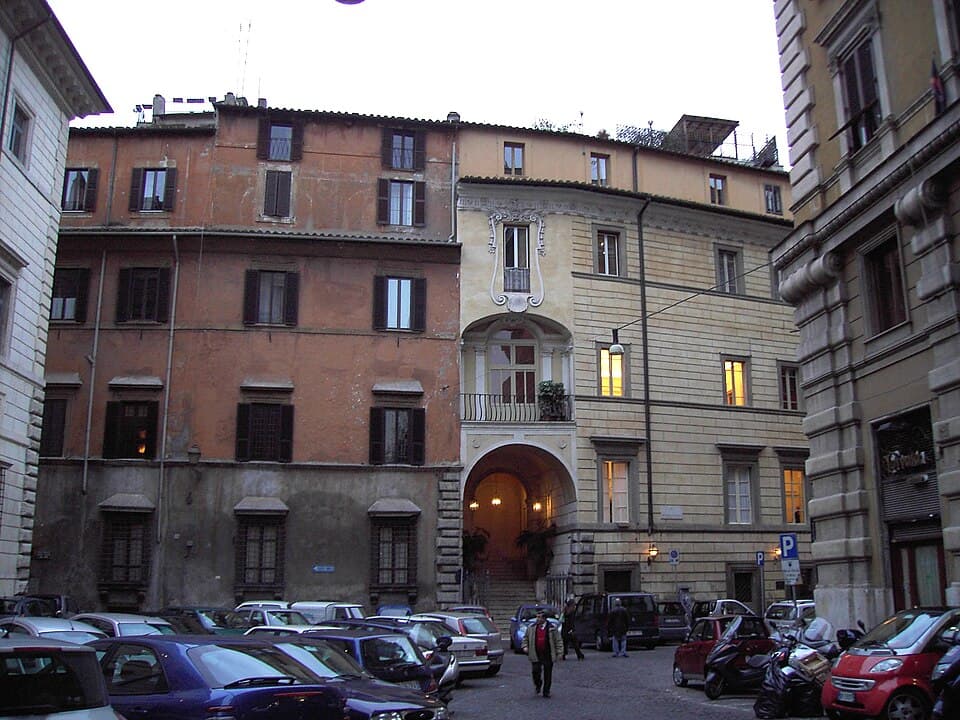
The Cenci were a wealthy Roman noble family. Their main residence, Palazzo Cenci, stood in the rione Regola, on the edge of the Jewish ghetto, a short walk from the Tiber. Francesco Cenci, the head of the household, had inherited an enormous fortune from his father Cristoforo, a Vatican treasurer. He spent a significant portion of it on lawsuits, sexual scandals, and the repeated bribery of papal officials.
Francesco's violent disposition was public knowledge. He had been prosecuted more than once for assault, for a homicide, and — in the 1590s — for sexual offences involving young male servants. On every occasion he had been fined, briefly imprisoned, and released. The papal exchequer profited more from reconciliation with Francesco than from his conviction.
By 1598, Francesco lived in the family's fortified castle of La Petrella del Salto, in the mountains north of Rome, with his second wife Lucrezia Petroni, his daughter Beatrice (then about twenty), and his young son Bernardo. His older sons Giacomo and Cristoforo remained in Rome. The decision to take Beatrice and Lucrezia to the remote castle was generally understood in Rome as an attempt to isolate them from any outside intervention.
The conflict inside the household
The accounts given during the subsequent trial, and the later Roman memorials, agree on the broad outlines. Francesco's conduct toward his wife and daughter had been, in the words used at the trial, "intolerable." The mistreatment encompassed physical violence, imprisonment inside the castle, and the denial of basic correspondence with the outside. Beatrice had attempted to inform papal authorities of the situation and received no response; Francesco retained more influence at the Curia than his children did.
Whether the mistreatment extended to sexual abuse was asserted by the defence at the trial and has been asserted ever since. Contemporary Roman rumour took it as given. Modern historians have been more cautious, pointing out that the charge served the defence's strategy and is not independently documented. What is not in dispute is that the household had become, by the summer of 1598, a place from which the women wanted desperately to escape and could not.
In September of that year, Beatrice, Lucrezia, and Giacomo — the older brother, consulted by letter from Rome — agreed on a plan. Two servants of the castle, Olimpio Calvetti and Marzio Catalano, were recruited. Olimpio appears to have been Beatrice's lover.
The death of Francesco Cenci
On the night of 9 September 1598, Olimpio and Marzio entered Francesco's bedroom in the castle of La Petrella and killed him. The body was then thrown from a balcony onto the rocks below, to make the death appear an accident.
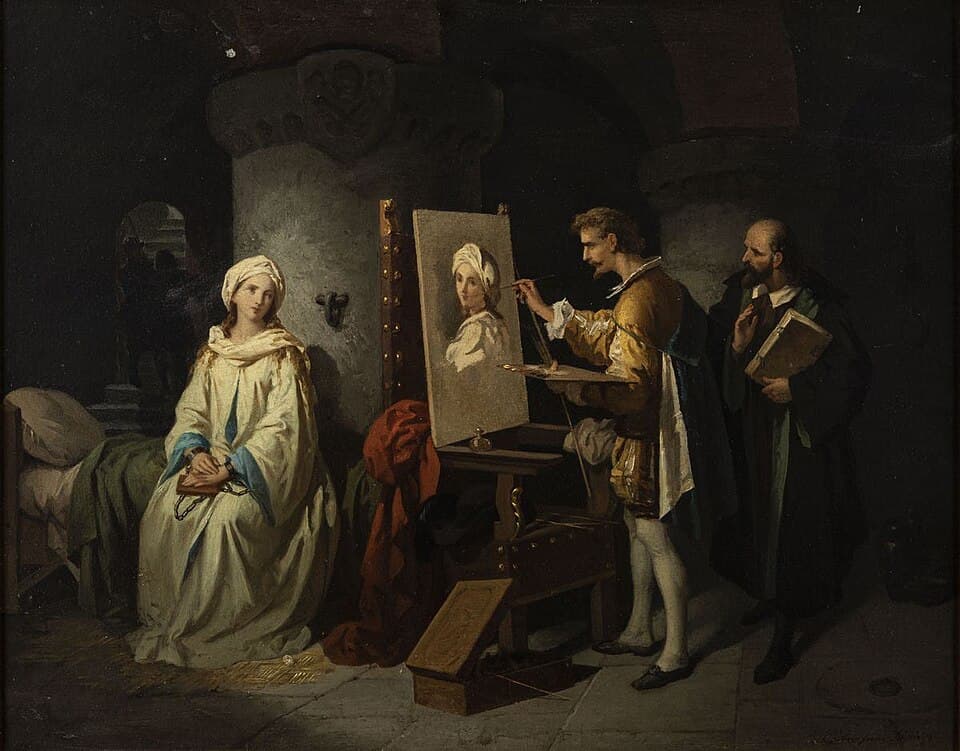
The staging was not convincing. Rural neighbours noticed that the wounds on the body did not match the fall. Rumour reached Naples within days and Rome within weeks. By February 1599, Pope Clement VIII had ordered an investigation. Olimpio was killed before he could be arrested; Marzio was captured and, under torture, implicated the whole family. Beatrice, Lucrezia, Giacomo, and the twelve-year-old Bernardo were brought to Rome and held in the Tor di Nona prison and, for a portion of their detention, in Castel Sant'Angelo itself.
The trial and the defence of Farinacci
The trial that followed took place under the direct supervision of Pope Clement VIII. The Cenci estate was enormous, and Roman observers noted from the start that a conviction would allow the papal treasury to confiscate the family's lands. Clement's interest in the case was correspondingly close.
The defence was led by Prospero Farinacci, one of the most celebrated jurists of late sixteenth-century Italy. His argument centred on the principle of provocation: that Francesco Cenci's conduct toward his family had been so extreme as to constitute, under the legal doctrine of the time, sufficient cause for the killing. He cited the record of prior prosecutions, the testimony of servants, and the fact that every appeal to papal authority during Francesco's lifetime had been ignored.
Farinacci's defence was, by the standards of the day, brilliant. It persuaded much of educated Rome. It did not persuade the pope. Clement delivered the sentences on 10 September 1599: execution for Beatrice, Lucrezia, and Giacomo; confinement for life for Bernardo. There was no delay for appeal.
One contextual factor weighed heavily against clemency. Only weeks earlier, in August 1599, another prominent Roman household had been devastated by a parricide, in the Santacroce case. The pope appears to have decided that a second noble family could not be seen to kill its father and escape. Beatrice Cenci paid, in part, for a crime committed by someone else.
11 September 1599: the execution
The procession left the prison at dawn. Lucrezia Petroni was led to the scaffold first, struggling in her black dress; she was beheaded. Beatrice followed. According to contemporary accounts, she walked to the block composedly, prayed aloud, and placed her neck on the wood without assistance. She was twenty-two years old.
Giacomo was executed last and with greater brutality: struck with a mallet, his body was then drawn and quartered. Bernardo was forced to watch the death of every member of his immediate family before being sent to the galleys. (He would be released years later, under a new pope, after the Cenci estate had been absorbed into the holdings of the Aldobrandini, Clement VIII's own family.)
The scaffold had been erected at the foot of Ponte Sant'Angelo, on the bridge itself, with the cylindrical mass of the castle rising on the far side of the Tiber. It was a location already associated with papal execution; the hangman Mastro Titta and his successors would continue to use this spot for two and a half centuries. For Romans watching that morning, the composition of the scene — the bridge, the castle, the river, the scaffold — must have been unforgettable. It was preserved by the city's collective memory long after the scaffold itself was removed.
The afterlife of the case
The Cenci case entered popular Roman memory immediately. Within months, Beatrice was spoken of as a martyr. Within a generation, her story was being repeated as a folk tragedy. The painting now in Palazzo Barberini — then, as now, attributed by legend to Guido Reni — came to be identified with her, and by the eighteenth century it was an object of organised pilgrimage. Foreign visitors on the Grand Tour routinely asked to be taken first to see the portrait.
The literary afterlife of the case is extraordinary for its length and range. Percy Bysshe Shelley wrote The Cenci in 1819 as a five-act tragedy, believing it to be the finest work of his career. Stendhal included it in his Italian Chronicles in the 1830s. Nathaniel Hawthorne built a central plot of The Marble Faun (1860) around it. In the twentieth century Antonin Artaud turned it into a theatre of cruelty piece in 1935; Alberto Moravia adapted it as a novel in 1958; Alberto Ginastera set it as an opera (Beatrix Cenci) in 1971. David Lynch placed the Guido Reni portrait on the wall of a pivotal scene in Mulholland Drive in 2001.
The persistence of the case has a simple cause: almost everyone who has encountered it has believed that Beatrice was more sinned against than sinning, that Clement VIII was at least partly interested in her estate, and that the Roman court system under the late sixteenth-century papacy was unable to protect a woman from a violent father without her having to kill him first. All three judgements may be harsh, and the historical record supports each of them in part.
Traces of Beatrice in Rome today
Several sites in central Rome retain some connection to the Cenci case:
- Castel Sant'Angelo and Ponte Sant'Angelo. The bridge in front of the castle was the site of the execution. The castle had held members of the family during the investigation. Standard entry to the fortress includes the ramparts from which the bridge is clearly visible.
- Palazzo Cenci, rione Regola. The family seat still stands in Piazza Cenci, on the edge of what was the Jewish ghetto. Not open to the public — it is now the Rome campus of the Rhode Island School of Design — but visible from the street. A ten-minute walk from Castel Sant'Angelo.
- Palazzo Barberini (Galleria Nazionale d'Arte Antica). The portrait long called Beatrice Cenci, now attributed to Ginevra Cantofoli rather than to Guido Reni, hangs here. It remains one of the most-visited single paintings in the collection.
- San Pietro in Montorio, Janiculum hill. Tradition holds that Beatrice was buried in front of the altar of this church. The grave was disturbed during the Napoleonic occupation and the remains lost. The church itself — and Bramante's tempietto in its courtyard — are independently worth visiting.
The case in the history of the castle
Castel Sant'Angelo had served as a papal prison since the late Middle Ages, and would continue to do so until the unification of Italy in 1870. Beatrice Cenci was only one of its many prisoners, most of them now forgotten. Four decades earlier the sculptor Benvenuto Cellini had escaped from the castle by descending its outer wall on knotted sheets. Seventy years after Cenci, Giordano Bruno would be held here before his execution. Two centuries later the adventurer Cagliostro would die inside its cells.
The castle's role in the Cenci case was not, in fact, the most celebrated event of its sixteenth century. That distinction belongs to the Sack of Rome in 1527, when it sheltered Pope Clement VII through seven months of siege. But the Cenci execution became the single most reproduced image of the castle's outward face: the bridge, the scaffold, the cylindrical fortress in the middle distance. For two and a half centuries, executions on Ponte Sant'Angelo were part of the ordinary life of Rome. It was the Cenci execution that turned the view into a symbol.