Explore · Level 1 · Highlight
Sala di Apollo
The Oldest Hall of the Papal Apartments — Frescoes 1547–1548
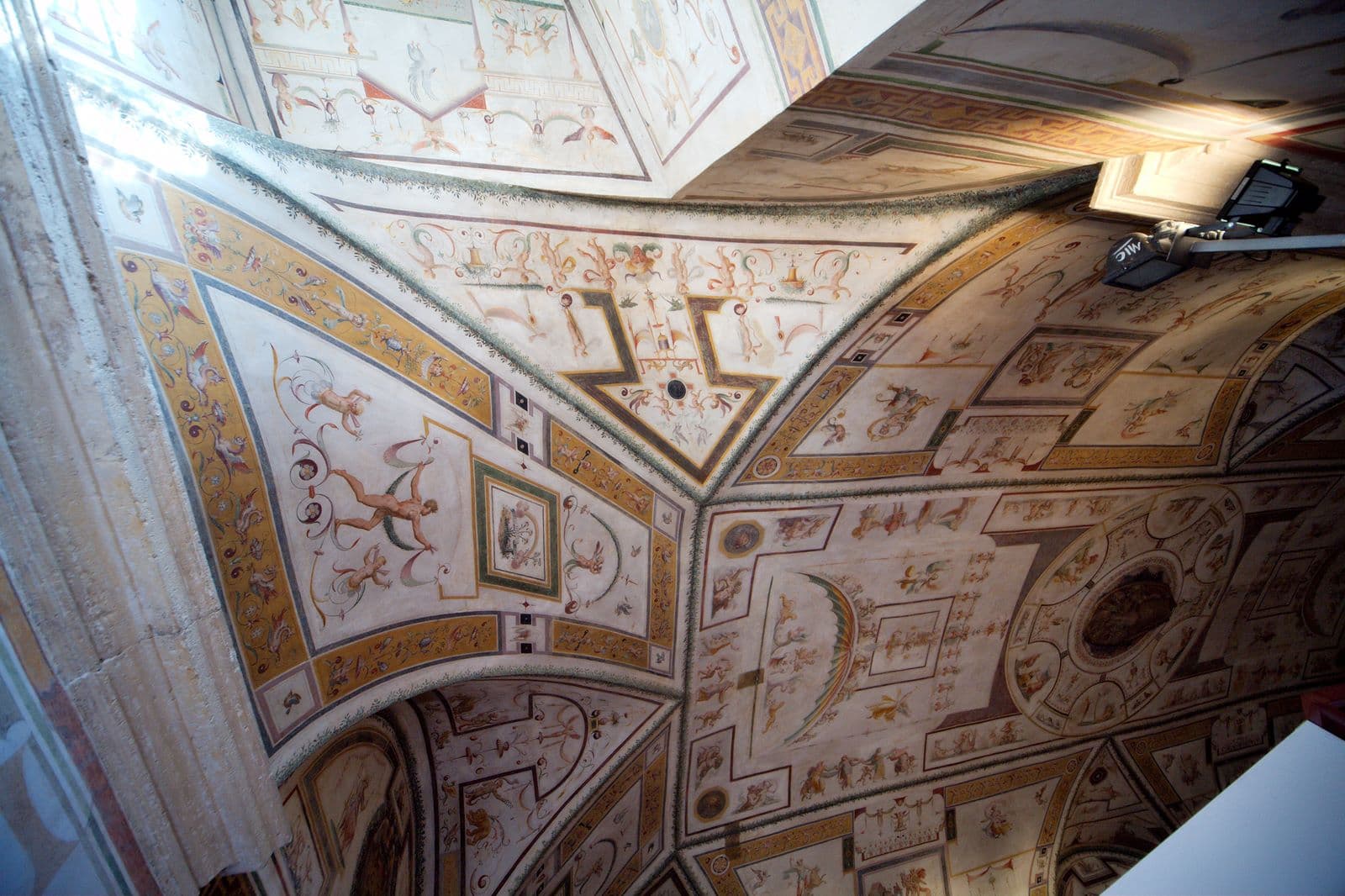
Quick answer: The Sala di Apollo is the oldest hall of the papal apartments at Castel Sant'Angelo, built under Pope Niccolò V (1447–1455) and originally used as the papal dining room. Pope Paul III Farnese commissioned its decoration in 1547. The work began with Perin del Vaga and was completed after his death by Domenico Zaga and Pellegrino Tibaldi between October 1547 and March 1548. The vault carries grotesques on a white ground and ten scenes from the myth of Apollo; the lunettes show the Liberal Arts. The Sala di Apollo is one of the six rooms marked as a highlight in the official Direzione Musei Nazionali di Roma brochure, and access is included in the standard museum ticket.
The Sala di Apollo is the room where the papal apartments at Castel Sant'Angelo really begin.
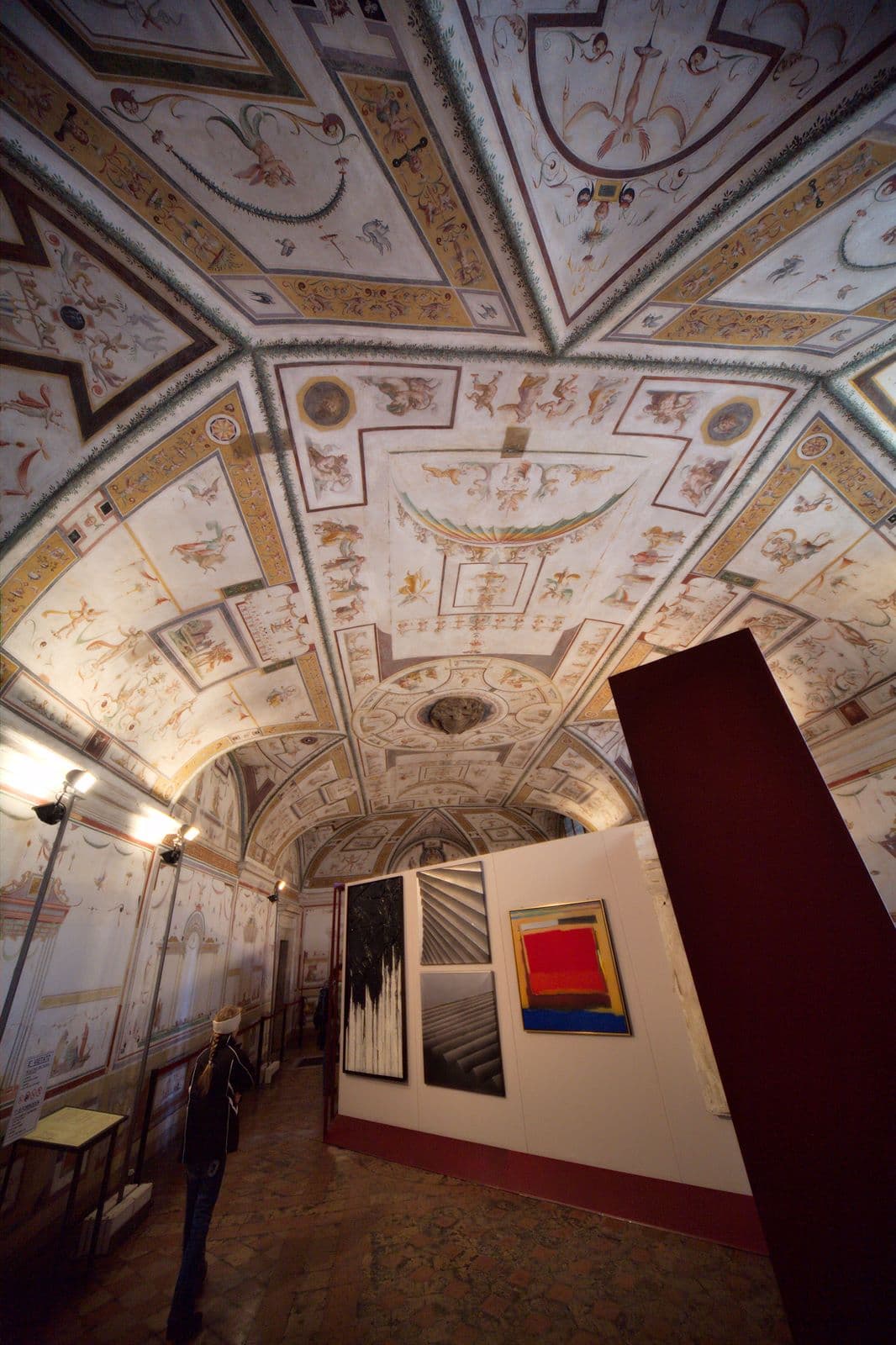
Almost a hundred years before Paul III commissioned the Sala Paolina directly above it, Pope Niccolò V had already built this great barrel-vaulted hall on the upper level of Hadrian's mausoleum. It was, at that point in the mid-fifteenth century, the largest and most important room of a papal residence that did not yet exist anywhere else inside the castle. The popes used it as a dining hall and a reception space; the documents of the time call it simply la sala vecchia — “the old hall” — once a more modern apartment was built above it.
What you see today is the result of two distinct campaigns separated by a century. The room itself, with its long barrel vault and rectangular plan, is fifteenth-century. The decoration that gives it its current name — the grotesques, the ten scenes from the myth of Apollo, the lunettes with the Liberal Arts — was painted between October 1547 and March 1548 by a team led briefly by Perin del Vaga and continued, after his death, by Domenico Zaga and Pellegrino Tibaldi.
The result is a room that holds together two ambitions: a fifteenth-century dining hall, and a sixteenth-century manifesto about Apollo as the protector of the arts and of papal authority.
Why it is the oldest hall in the apartments
When Pope Niccolò V Parentucelli (1447–1455) decided to move the working residence of the papacy from the Lateran to the Vatican, he wanted a fortified retreat next door — somewhere a pope could withdraw to, in the days when Rome was still a politically unstable city. Castel Sant'Angelo, the converted Roman mausoleum on the right bank of the Tiber, was the obvious choice.
Niccolò's building campaign on the castle was the first to convert the upper levels of Hadrian's cylinder into proper Renaissance rooms. The most ambitious of those rooms is the one we now call the Sala di Apollo: a long rectangular hall with a barrel vault, oriented along the diametral axis of the mausoleum, immediately above the Roman burial chamber. In its original form it had no mythological cycle on the ceiling; it was decorated more soberly and used as the dining room of the papal apartment.
For nearly a century the Sala di Apollo was the principal hall of any papal stay at Castel Sant'Angelo. The popes who slept here in moments of crisis — Alexander VI Borgia, Leo X de' Medici, Clement VII during the Sack of Rome of 1527 — all dined and received in this room.
Why it became known as “the old hall”
That changed when Paul III Farnese decided in the 1530s to add an entire upper floor to the existing apartment. He commissioned a new, more modern reception hall directly above the Sala di Apollo — the Sala Paolina — and rebuilt the rest of the second floor around it. From that moment, the Sala di Apollo stopped being the principal hall of the apartment. It became, in the surviving documents, la sala vecchia: the old hall, the original one, the one downstairs.
But Paul III did not abandon the Sala di Apollo. He saw it as a chance to do something the upper apartment could not do: give the lower entrance to the residence a complete iconographic programme of its own. The work to renovate and reconnect the room with the new apartment above began in 1546. The decoration began in 1547.
The myth of Apollo, told on the ceiling
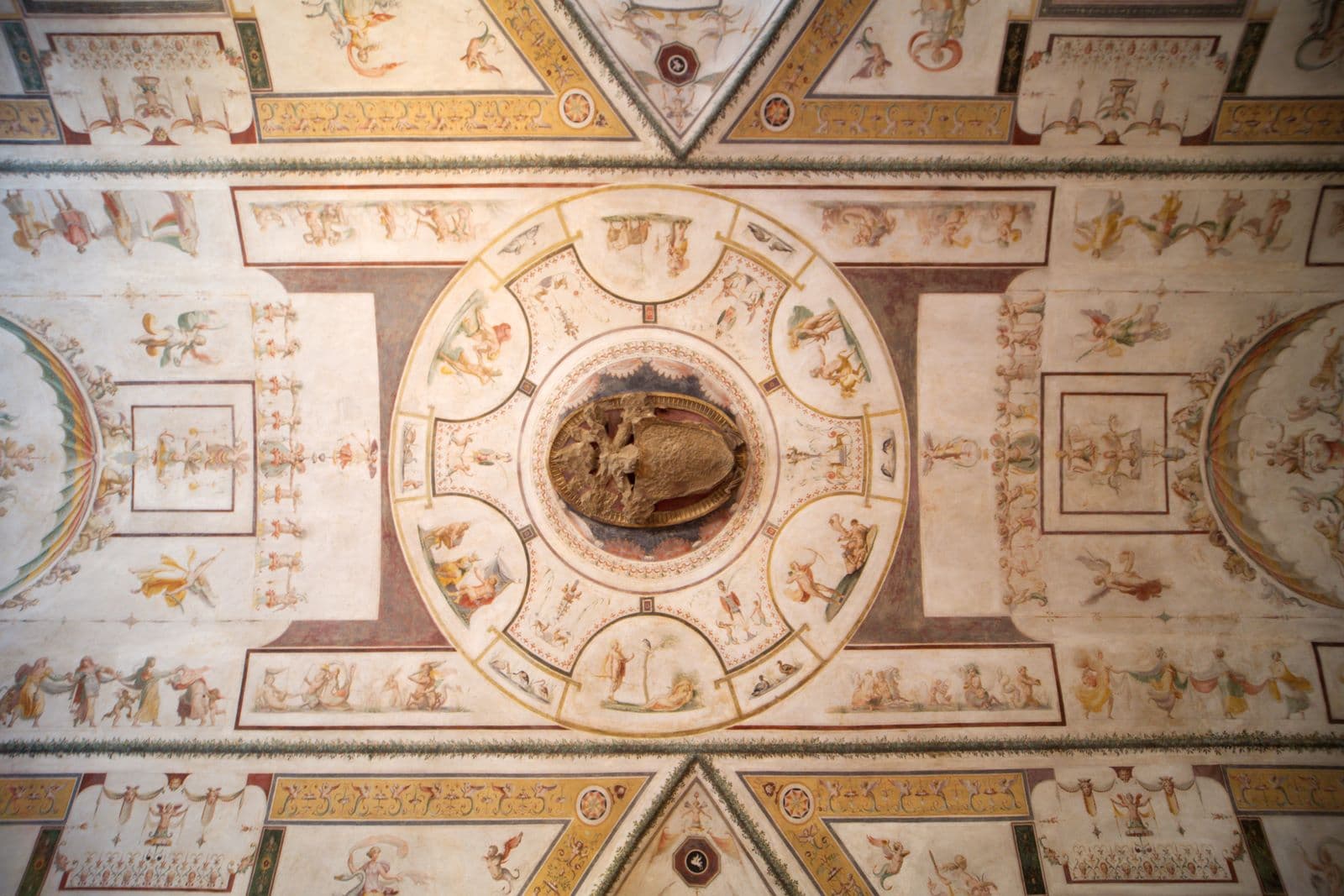
The vault is decorated in a style called grottesche — the antique-inspired ornamental vocabulary that Renaissance painters had been studying since the rediscovery of Nero's Domus Aurea in the late fifteenth century. Against a white background, hybrid creatures, festoons, mythological figures, and small architectural frames cover the entire surface.
At the centre of the vault, set into the ornament, are ten figurative scenes from the myth of Apollo. Together they form a complete narrative cycle of the god's story:
- The death of Coronis — Apollo's mortal lover, killed by his sister Artemis after a raven brought Apollo news of her infidelity. The scene focuses on the moment of regret.
- Apollo entrusting Asclepius to the centaur Chiron — the infant son saved from Coronis's body and given to the wise centaur to be raised. Asclepius would become the god of medicine.
- Apollo killing the Cyclopes — vengeance for the death of his son Asclepius, who had been struck down by Zeus with a thunderbolt forged by the Cyclopes.
- Apollo as shepherd of Admetus — the punishment Zeus imposed on Apollo for killing the Cyclopes: a year of servitude tending the herds of King Admetus of Thessaly.
- The flaying of Marsyas — the satyr who challenged Apollo to a musical contest, lost, and was punished with the most terrible death in classical mythology. The scene shows the contest itself rather than its aftermath.
- The contest of Apollo and Pan — the second musical contest, judged by King Midas. Apollo won; Midas voted for Pan; Apollo punished Midas by turning his ears into those of a donkey. The scene shows the moment of judgment.
- Four further scenes complete the sequence, including the births of Asclepius and the founding myth of the temple at Delphi.
The cycle is read as a single argument. Apollo punishes those who challenge him (Marsyas, the Cyclopes), rewards those who serve him (Chiron), accepts punishment from his father when he goes too far (Admetus), and presides over the founding of his cult (Delphi). The choice of episodes presents the god as just executor, civilizer, and source of wisdom — a deliberately curated portrait, not a complete one.
Apollo, protector of the Liberal Arts
The lunettes around the room, set just below the springing of the vault, show the figures of the Liberal Arts — the seven disciplines that organised humanist education in the sixteenth century. Each art is personified by a female figure with her traditional attribute: Grammar with her book, Rhetoric with the open scroll, Logic, Arithmetic, Geometry, Music with her instrument, and Astronomy with her armillary sphere.
On the walls themselves, in larger figurative panels, are the Muses standing in their temples. Each Muse presides over a specific art (Calliope over epic poetry, Erato over love poetry, Polyhymnia over sacred hymn, and so on), and the cycle places them where the visitor entering the room could read them as a continuation of the Apollonian narrative on the ceiling above.
The argument is unmistakable. Apollo is presented not only as god of the sun and of justice, but specifically as the patron of intellectual and artistic disciplines — the same disciplines that the humanist papacy of the Renaissance was actively cultivating in Rome. The pope who commissioned this decoration is the same pope who, a few years earlier, had commissioned Michelangelo's Last Judgment for the Sistine Chapel and convened the Council of Trent.
Why this room, and why this argument
The choice was deliberate. By 1547, the visitor route through Castel Sant'Angelo had been reorganised. After climbing the helical ramp out of the Roman mausoleum and crossing the Cortile dell'Angelo, an honoured guest would be brought into the Sala di Apollo before being taken upstairs to meet the pope in the more sumptuous Sala Paolina.
The Sala di Apollo, in other words, was the threshold — the room that prepared the visitor for what was coming. By staging the meeting around a god who personified justice, civilisation, and the arts, Paul III was advertising the cultural programme of his pontificate before a single word had been exchanged. The frescoes were a manifesto, painted overhead.
Painted by three artists in five months
The decorative campaign of the Sala di Apollo is one of the best-documented sixteenth-century projects at Castel Sant'Angelo. The accounts of the Apostolic Camera record payments month by month from October 1547 to March 1548.
The first commission went to Perin del Vaga (1501–1547), the Florentine painter who had been Raphael's most distinguished collaborator and was the lead artist of all the Farnese decoration at Castel Sant'Angelo. Perin had also designed the iconographic programme of the Sala Paolina upstairs, and was the natural choice for this room as well. The first payment to him for the painting of the vault is dated October 1547.
He died less than three weeks later, in October 1547, before he could carry out more than the preparatory work. The project was inherited by his collaborators, who continued the painting through the autumn and winter.
The continuators
The principal artist who took over the Sala di Apollo was Domenico Rietti known as Zaga (circa 1510–1568), a member of Perin's workshop who had been working on the Cagliostra and the upper apartment in parallel. The accounts show payments to him from late October 1547 through March 1548. Zaga is the painter responsible for most of the figurative scenes on the vault.
Working alongside Zaga was Pellegrino Tibaldi (1527–1596), the Bolognese painter who had also been a member of Perin's workshop and would go on to become one of the leading figures of the Italian late Renaissance and Mannerism. In the Sala di Apollo, Tibaldi was responsible for parts of the grotesque ornament and probably for some of the lunettes.
The fact that the project changed hands twice during a single short campaign — from the master to two younger collaborators — explains the slight stylistic unevenness across the room. Some of the figurative panels are tighter and more classicising; others are looser and more decorative. The grotesque framework, which is the most coherent element, was probably the part most directly designed by Perin before his death.
The three openings on the floor
Visitors who pay attention to the floor will notice three openings cut into the pavement of the Sala di Apollo. They are not symmetrical, and they are not modern.
The first opening, near the window, is a vertical shaft nine metres deep. Its original function is debated. Two hypotheses circulate. The more dramatic reading is that it was a trabocchetto — a trap door used to dispose of unwanted guests. The more sober reading is that it was a drainage well for rainwater, with the same nine-metre shaft connecting to lower drainage channels of Hadrian's original mausoleum.
Neither hypothesis can be definitively proved or disproved from the surviving documents. The room dates from the fifteenth century, when papal residences did include trap doors of various kinds, but it is also true that any building constructed on top of a Roman mausoleum needed to manage water carefully. The shaft is probably both at once, in different periods.
The eighteenth-century lift shaft
The second opening, on the side of the room near the Chapel of Leo X, has a clearer history. It is the arrival point of a private papal lift commissioned in 1734 by Zenobio Savelli, vice-castellan of Castel Sant'Angelo and Duke of Palombara. To install the lift, the engineers cut a vertical shaft twenty-four metres deep through the original Roman concrete of Hadrian's mausoleum.
The lift was decommissioned long ago, but the opening is still visible in the floor of the Sala di Apollo. Cutting twenty-four metres through second-century Roman concrete was a significant engineering feat in 1734.
The Roman vent
The third opening, on the opposite side of the room, is the simplest to explain. It is a Roman ventilation shaft belonging to the diametral ramp that cuts through Hadrian's mausoleum directly below the Sala di Apollo. The shaft has been part of the building since the second century AD. The Renaissance simply preserved it.
All three openings together are a small archaeological cross-section of the building's history: a Roman vent shaft from the second century, a fifteenth-century well or trap door, an eighteenth-century lift opening. The Sala di Apollo is the only room where you can see all three layers in the same floor.
Where the room sits in the castle
The Sala di Apollo is on Level 1, immediately above the Roman burial chamber and immediately below the Sala Paolina. The two rooms share the same rectangular footprint but were never directly connected: the visitor moves between them through a side staircase, not through the floor opening.
On the same level as the Sala di Apollo are several other historically important rooms:
- The Sala della Giustizia — the courtroom where many of the most famous trials of the Papal States were held, including those of Pomponio Leto, Beatrice Cenci and Giordano Bruno.
- The Sale di Clemente VII — two private rooms decorated under Clement VII, with a small connecting bathroom (the Bagnetto di Clemente VII) and access to a small interior courtyard known as the Cortiletto di Leone X.
- The Cappella di Leo X — the small chapel dedicated to Saints Cosmas and Damian, with its facade attributed to Michelangelo, opening onto the Cortile dell'Angelo.
- The Sale di Alessandro VI — built around the rooms of the courtyard of Alexander VI, today housing a small permanent exhibition on the history of Castel Sant'Angelo.
In the standard visitor route, the Sala di Apollo is reached after the Cortile dell'Angelo and before the climb up to the Sala Paolina. It is the moment in the visit where the route enters the papal apartment proper.
How to find the Sala di Apollo
The Sala di Apollo is on Level 1 of the castle. From the entrance, the route is straightforward:
- Through the Dromos and the Atrium at ground level.
- Up the helical ramp of Hadrian.
- Across the diametral ramp through the burial chamber.
- Past the Sala delle Urne and up the final flight of stairs.
- Out into the Cortile dell'Angelo.
- Take the doorway on the left side of the courtyard. The route passes through the Sale di Clemente VIII and the Sala della Giustizia before arriving in the Sala di Apollo.
Opening hours
The Sala di Apollo follows the general opening hours of the National Museum of Castel Sant'Angelo: Tuesday to Sunday, 9:00 to 19:30, with last admission at 18:00. Closed on Mondays, 1 January and 25 December.
The room is part of the standard museum route. The entrance ticket gives access — no separate booking is required, and no official guide is needed. Because the Sala di Apollo is one of the central rooms of the apartment route, it is almost always open during museum hours, with very rare closures for maintenance work.
For the current status before your visit, see the opening hours page or check the official Direzione Musei Nazionali di Roma and CoopCulture websites.
Frequently asked
What is the Sala di Apollo at Castel Sant'Angelo?
The Sala di Apollo is the oldest hall of the papal apartments at Castel Sant'Angelo. It was built under Pope Niccolò V in the mid-fifteenth century as the dining room of the papal residence, and decorated almost a century later, between October 1547 and March 1548, with grotesques and ten scenes from the myth of Apollo. It is one of the six rooms marked as a highlight in the official Direzione Musei Nazionali di Roma brochure.
Why is it called Sala di Apollo?
The name comes from the cycle of frescoes on the vault, which depict ten scenes from the myth of Apollo — the death of Coronis, the entrustment of Asclepius to Chiron, the killing of the Cyclopes, the servitude with Admetus, the flaying of Marsyas, the contest with Pan, and four other episodes. The lunettes show the Liberal Arts and the walls show the Muses, presenting Apollo as the protector of intellectual and artistic disciplines.
Who painted the frescoes inside the Sala di Apollo?
The frescoes were begun in October 1547 by Perin del Vaga, the lead artist of the Farnese decoration at Castel Sant'Angelo, who died less than three weeks after starting the project. The work was continued by his collaborators Domenico Zaga (also called Domenico Rietti) and Pellegrino Tibaldi between October 1547 and March 1548. The archives of the Apostolic Camera document the payments month by month.
When was the Sala di Apollo built?
The room was built under Pope Niccolò V Parentucelli between 1447 and 1455. It is the oldest hall in the papal apartments at Castel Sant'Angelo and was originally used as the dining room of the papal residence. After Paul III added an upper floor with the Sala Paolina almost a century later, the Sala di Apollo became known as la sala vecchia — “the old hall”.
What are the openings on the floor?
Three openings are visible on the floor of the Sala di Apollo. The first, near the window, is a nine-metre vertical shaft — possibly a fifteenth-century trap door, possibly a drainage well. The second, near the Chapel of Leo X, is the arrival point of a private papal lift commissioned by vice-castellan Zenobio Savelli in 1734, which required cutting twenty-four metres of vertical shaft through the Roman concrete of Hadrian's mausoleum. The third is a Roman ventilation shaft of the diametral ramp directly below.
Is the Sala di Apollo included in the standard ticket?
Yes. The Sala di Apollo is part of the standard museum route and the standard museum ticket gives access. No separate booking and no official guide are required. Because the room is one of the central rooms of the papal apartment route, it is almost always open during museum hours.
How do you get to the Sala di Apollo inside the castle?
From the entrance, follow the standard route: through the Dromos and Atrium, up the helical ramp, across the diametral ramp through the burial chamber, past the Sala delle Urne, and up the final flight of stairs into the Cortile dell'Angelo. Then take the doorway on the left side of the courtyard: the route passes through the Sale di Clemente VIII and the Sala della Giustizia before arriving in the Sala di Apollo.