Explore · Level 2
The Sala Paolina
Inside the Pope's Audience Hall — Frescoes 1545–1547
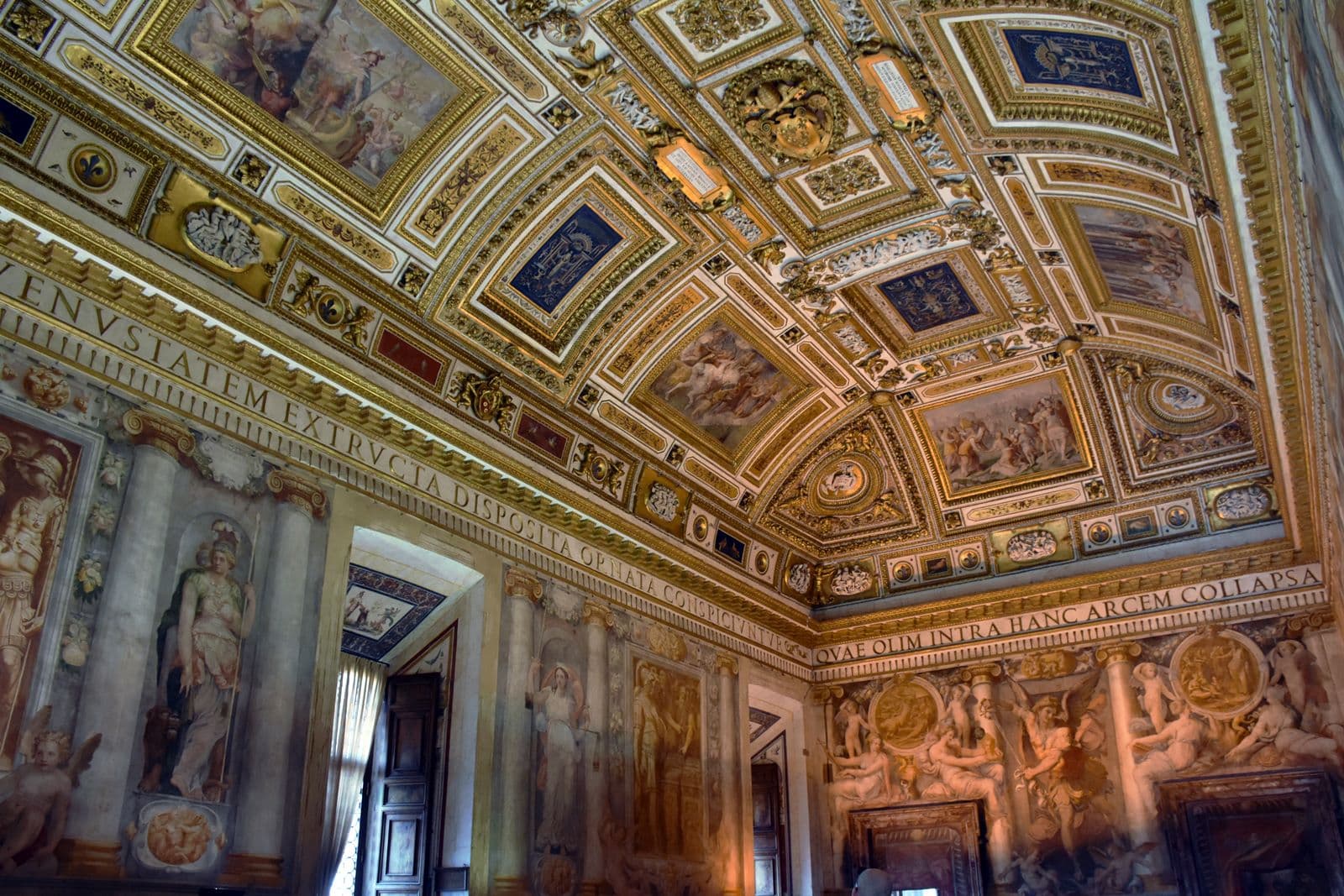
Quick answer: The Sala Paolina is the grand audience hall of Pope Paul III Farnese, located on Level 2 of Castel Sant'Angelo. Decorated between 1545 and 1547 by Perin del Vaga and a team that included Pellegrino Tibaldi and Marco Pino, it is the most lavish room in the castle. Visitors can enter the hall with the standard museum ticket. The famous painted figure stepping out of a fake door — a Renaissance trompe-l'œil by Tibaldi — is on the wall opposite the windows.
The room was built to impress.
When ambassadors, kings and cardinals were received at Castel Sant'Angelo in the middle of the sixteenth century, the Sala Paolina is what they walked into.
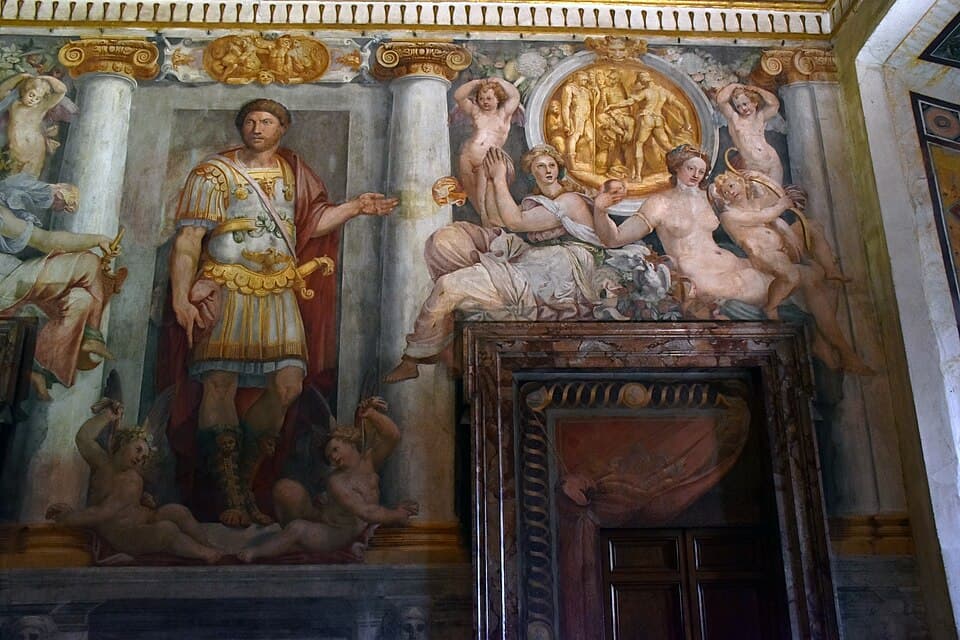
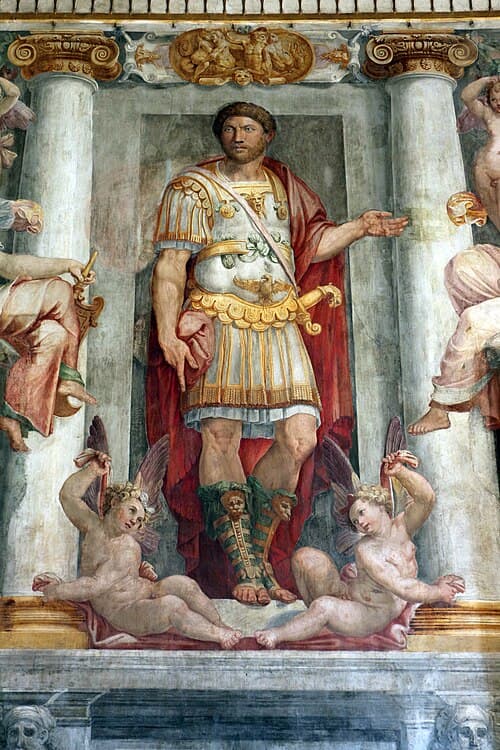
Every surface is painted. The coffered ceiling glows with gold and small mythological scenes. The walls carry full-length figures of Alexander the Great and the Emperor Hadrian. A painted courtier appears to step out of a wall, fooling the eye. Latin inscriptions run along the cornice celebrating the strength, usefulness and grace of the pontiff who commissioned it all.
That pontiff was Alessandro Farnese, who took the name Paul III when he was elected in 1534. The Sala Paolina — the "Paolina" comes directly from his papal name — is what survives of a much larger Farnese decorative project that turned the upper floors of the castle into a Renaissance papal residence.
Today the room is open to visitors with the basic museum ticket. It is one of the highlights of the standard route, reached after the helical ramp, the Cortile dell'Angelo, and the Loggia of Julius II. For the full layout of the castle, see the floor plan or the broader highlights of the castle.
Why this room exists
Paul III had a problem that every Renaissance pope had: how to look powerful.
Castel Sant'Angelo had been a papal fortress and refuge since the late Middle Ages, but during the Sack of Rome in 1527 it had played a decisive role. Pope Clement VII had survived the sack precisely because he managed to lock himself inside the castle while the city was burning. The lesson was not lost on his successors.
When Paul III became pope in 1534, he ordered the upper floors of the castle to be turned into a fully decorated papal apartment — not a hideout, but a parallel residence to the Vatican Palace. The Sala Paolina was the centrepiece of that project: the audience chamber where the pope could receive visitors with the same ceremonial weight as if they had been brought to Saint Peter's.
The team
The work was given to Perin del Vaga, a Florentine painter who had trained in the workshop of Raphael and survived the Sack of Rome. Perin coordinated a team that included Pellegrino Tibaldi, Marco Pino, Domenico Rietti, Luzio Luzi and Giacomo Bertucci.
They worked from 1545 to 1547. Perin del Vaga died shortly after, in 1547, and the project was finished under the direction of his collaborators.
What the frescoes say
The decorative programme is unusually coherent for a room of this period. Nothing is decorative for its own sake.
Alexander the Great
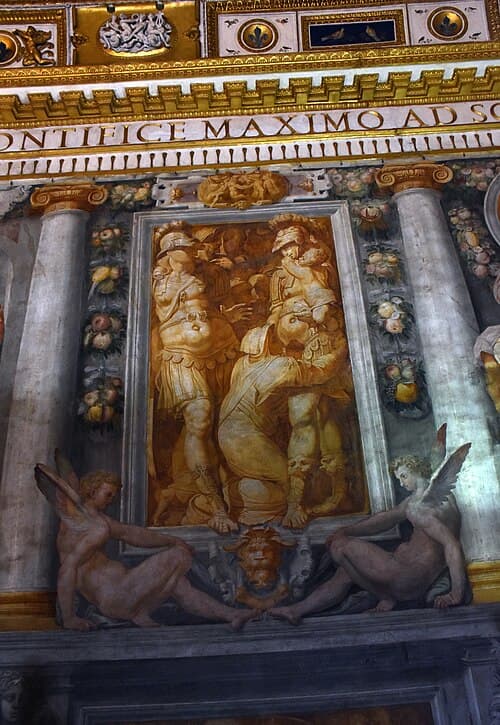
Most of the wall scenes depict episodes from the life of Alexander the Great: his coronation, his cutting of the Gordian knot, his protection of Homer's manuscripts, his clemency toward the family of Darius.
The choice was not accidental. Before becoming Paul III, the pope's baptismal name was Alessandro Farnese — the Italian form of Alexander. The frescoes are a sustained visual argument that Paul III is to the Church what Alexander was to the ancient world: a unifier, a strategist, a patron of learning.
Saint Paul
On the long walls, scenes from the life of Saint Paul run parallel to those of Alexander. The pope's chosen apostolic name is paired with his birth name. Conversion of Saul on the road to Damascus. Paul preaching at Athens. Paul shipwrecked at Malta.
It is the same visual argument made in religious terms: this pope is the inheritor of two great traditions, classical and Christian.
Hadrian and the Archangel
On the two short walls, two monumental figures face each other: the Roman emperor Hadrian, who built the original mausoleum that became the castle, and the Archangel Michael, who, according to legend, appeared above the building in 590 AD and gave the place its current name. The bridge below the castle — today's Ponte Sant'Angelo — was also Hadrian's work.
Pagan emperor and Christian archangel, set in deliberate dialogue across the room. The point is reconciliation: Rome before Christ, Rome after Christ, in the same papal hall.
The painted door
The single most photographed detail in the Sala Paolina is a man stepping into the room.
On one of the long walls, painted full-length and life-size, a courtier in Renaissance dress is shown coming up a flight of stairs through a doorway. The figure is by Pellegrino Tibaldi.
There is no doorway. There are no stairs. Both are painted.
The illusion is so well calibrated that visitors still routinely step aside to let the figure pass. It is one of the earliest celebrated examples of trompe-l'œil in a domestic Roman interior, and it is the moment in the room where the wall stops being a flat surface.
Tibaldi was twenty-three when he painted it.
The ceiling
Look up.
The ceiling is by Marco Pino of Siena. It is divided into a coffered grid of carved and gilded stuccoes that frame a series of small painted panels — six main scenes from the Alexander cycle, alternating with grotesques, papal heraldry and humanist symbols.
At the centre is the stemma of Paul III: the Farnese coat of arms with its three lilies, surrounded by a wreath, framed by gilded mouldings.
Around it run the painted cartouches with Greek inscriptions, expressions of humanist learning that were as much a status symbol in the 1540s as the gilding itself.
The cornice frieze carries Latin inscriptions in capitals: FIRMITATEM, COMMODAM, VTILITATEM — strength, suitability, usefulness — the qualities the pope wants associated with his pontificate.
The art on the walls
Beyond the frescoes painted directly on the walls, the Sala Paolina also displays part of the museum's collection of Renaissance panel paintings. Three works in particular are worth slowing down for.
Carlo Crivelli — Christ Blessing and Saint Onofrio
Two small panels by Carlo Crivelli, a fifteenth-century Venetian painter who spent most of his career in the Marche region. Crivelli is recognisable at a glance: hard outlines, jewel-like surfaces, decorative gilding pushed to the edge of relief. The Christ Blessing is the more austere of the two; the Saint Onofrio shows the desert hermit with his characteristic long beard and minimal clothing.
These panels were brought to Castel Sant'Angelo from other ecclesiastical collections and displayed here as part of the museum's permanent rotation. Their date is roughly contemporary with the construction of the room itself.
Lorenzo Lotto — Saint Jerome
Lorenzo Lotto was Crivelli's younger contemporary and one of the more idiosyncratic painters of the Venetian school. His Saint Jerome in the Sala Paolina shows the saint as a penitent in a wild landscape — rocks, half-glimpsed buildings, a small lion at his feet. Lotto specialised in psychological portraits and tense, off-balance compositions; this Jerome belongs to that mood.
Lamentation over the Dead Christ
The third panel, by an unknown sixteenth-century author, shows the standard Lamentation composition: the body of Christ supported by the Virgin and the holy women after the deposition from the cross. It is included in the room as a reminder of the religious function of the apartment, balancing the secular triumphalism of the Alexander cycle on the walls.
Why these works are here
The placement is deliberate. The wall frescoes celebrate the pope as ruler — Alexander, Hadrian, classical glory. The hung panels remind the viewer that the same pope was also a religious leader. The two registers were never meant to compete with each other; they were meant to be read together.
For a guided reading of the works in the Sala Paolina and the adjacent rooms, several private and small-group tours include this section of the route. The standard ticket gives access to all of them — the difference is whether someone is on hand to explain what you are looking at.
The two smaller rooms next door
The Sala Paolina opens onto two smaller rooms that were part of the same Farnese apartment.
The Sala di Perseo was the pope's study. Its decoration is dedicated to the myth of Perseus, taken from Ovid's Metamorphoses: Perseus receiving his weapons from Mercury and Minerva, Perseus rescuing Andromeda, Perseus turning his enemies to stone with the head of Medusa. The metaphor is theological: intellect defeats the irrational, just as the Catholic Church (Paul III convened the Council of Trent in 1545) is set against what Rome saw as the disorder of the Reformation.
The Sala di Amore e Psiche was the bedroom. Its frescoes follow the Cupid and Psyche story from Apuleius. Both small rooms are normally included in the visit, although the route can change.
The room and the events it has witnessed
The Sala Paolina was finished in 1547. Twenty years earlier, the same upper floors of the castle had been the refuge of the previous pope during the worst sack the city had seen in over a thousand years.
In May 1527, the unpaid imperial troops of Charles V broke into Rome and spent eight days looting it. Pope Clement VII reached Castel Sant'Angelo through the Passetto di Borgo, the elevated corridor connecting the Vatican to the castle. He stayed inside the fortress for six months. The Sala Paolina did not yet exist — the rooms in this part of the apartment were still much simpler — but the scale of the trauma is what later pushed Paul III to turn the upper floors into something this lavish. The full story is in our piece on the Sack of Rome, 1527.
One witness to the siege was the goldsmith Benvenuto Cellini, who served as a gunner on the castle bastions during the sack and later wrote the most quoted first-person account of those days. A decade after the Sala Paolina was completed, Cellini was imprisoned in this same castle — and in 1539 he made the most famous prison break in Renaissance Italy. The full account is in Cellini's escape.
How to find it inside the castle
The Sala Paolina is on Level 2 of the castle, in the Renaissance papal apartment.
The standard visiting route arrives there via the helical ramp built by Hadrian, the Sala delle Urne, the Cortile dell'Angelo with its statue of the Archangel by Raffaello da Montelupo (1544), and finally the Loggia of Julius II — the open marble loggia that overlooks the Tiber and Ponte Sant'Angelo.
From the Loggia of Julius II, a short staircase brings you into the Sala Paolina. You enter on the long wall opposite the windows. The painted courtier of Pellegrino Tibaldi is, depending on the rotation of the route, either to your left or in front of you.
For a step-by-step layout of the levels and rooms, see the castle floor plan or the wider Explore overview. To plan the visit itself — tickets, opening hours and accessibility — see the Visit hub.
Practical tips for your visit
Size of the room
The Sala Paolina is approximately 15 metres long, 8 metres wide, and 12 metres high to the top of the coffered ceiling. By Renaissance papal standards it is a medium-sized audience hall — smaller than the Sistine Chapel, comparable in scale to the Stanza della Segnatura at the Vatican.
Best time of day
Natural light enters through the windows on one of the long walls, oriented toward the Tiber. Late morning to early afternoon gives the most even illumination. Late afternoon is dramatic but creates strong contrasts that make the wall opposite the windows hard to read.
For the trompe-l'œil door specifically, the illusion works best in indirect midday light. Direct sun on that wall flattens the painted shadow and weakens the effect.
Where to start looking
The recommended order is:
- Step in and look up first — the ceiling is what you will not have time to absorb later
- Then walk to the centre of the room and turn slowly, taking in the four walls in sequence
- Save the trompe-l'œil figure for last — it is the visual punchline of the room
- Step into the Sala di Perseo and the Sala di Amore e Psiche before leaving
Combining the visit
The Sala Paolina is approximately fifteen minutes of attention. The two adjacent rooms add another ten. Together with the Loggia of Julius II just before and the descent toward the bastions just after, this section of the route is the densest part of the castle and where most visitors slow down. Allow forty minutes for the upper apartments alone.
Many guided tours of Castel Sant'Angelo allocate the largest share of the route to this section for exactly that reason.
Frequently asked
Is the Sala Paolina included in the standard ticket?
Yes. The Sala Paolina is part of the regular visiting route at Castel Sant'Angelo. The standard museum ticket gives access. No separate booking is needed for this room.
Can you take photographs in the Sala Paolina?
Yes, without flash. Flash photography is forbidden in all the painted rooms of the castle for conservation reasons. Tripods are not permitted in the visiting route.
How long should I spend in the Sala Paolina?
The official guidance from the Direzione Musei Nazionali di Roma sets a maximum of fifteen minutes per room. In practice, ten to fifteen minutes is enough to see the four walls and the ceiling. The two adjacent rooms (Perseus, Cupid and Psyche) add another ten minutes. See the opening hours to plan your slot.
Who painted the Sala Paolina?
Perin del Vaga directed the project from 1545 to 1547, with a team that included Pellegrino Tibaldi (the famous painted courtier on the wall), Marco Pino of Siena (the ceiling), Domenico Rietti, Luzio Luzi and Giacomo Bertucci. Perin del Vaga died in 1547 and the project was completed by his collaborators.
Why is it called "Paolina"?
The room takes its name from Pope Paul III (Paolo III in Italian), who commissioned its decoration. He was born Alessandro Farnese and was elected pope in 1534. He convened the Council of Trent in 1545, the same year work in this room began.