The Sack of Rome, 1527 — How Castel Sant'Angelo Saved the Pope
Quick answer: On the morning of 6 May 1527, an imperial army of around 20,000 unpaid soldiers, loyal to Emperor Charles V but under no effective command after the death of their leader the Duke of Bourbon, broke through the walls of Rome and sacked the city. Pope Clement VII escaped from the Vatican through the Passetto di Borgo, the elevated corridor built in 1277 for precisely this eventuality, and took refuge in Castel Sant'Angelo. He remained besieged inside the fortress for seven months, protected by its thick walls, while the city outside was looted for eight days and then occupied for nine months. The sack killed between six and twelve thousand Romans, destroyed much of the artistic and scholarly patrimony of the High Renaissance, and is conventionally cited as the event that ended the Renaissance in Italy.
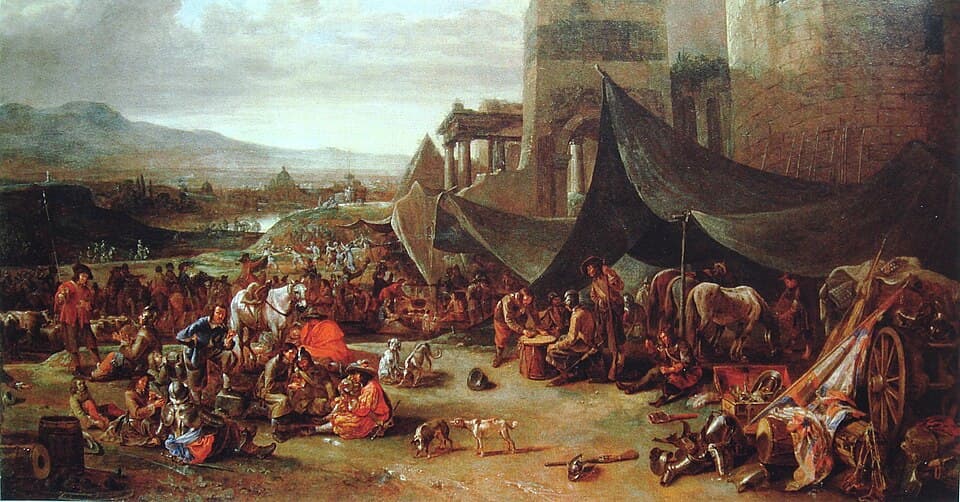
The sack of Rome in May 1527 was the worst disaster to befall the city since the invasions of the barbarian armies a thousand years earlier. It was also the reason Castel Sant'Angelo still stands today in something close to its current form. For seven months the cylindrical fortress on the right bank of the Tiber functioned as the headquarters of a government in exile, the refuge of a pope, and the last scrap of defended ground in a ruined capital. When Clement VII finally emerged in December to negotiate his surrender, the castle had earned its place in Roman memory not as a mausoleum, not as a prison, but as the building that had saved the papacy from extinction.
The event is unusually well documented for a sixteenth-century catastrophe. Benvenuto Cellini, present in the castle during the siege and later imprisoned in it himself, described the sack in his autobiography. The humanist Luigi Guicciardini wrote the first full history of the event within months. Papal secretaries, ambassadors, soldiers, and survivors left letters, diaries, and apologias that historians have been sorting through ever since. What follows is the outline of what happened, and what it meant for the castle.
The context: the League of Cognac
The root cause of the sack lay in the rivalry between two men who between them controlled most of Western Europe. Francis I, King of France, and Charles V, Holy Roman Emperor and King of Spain, had been at war on and off since 1521. In 1525 Charles won a decisive victory at Pavia, capturing Francis himself and forcing humiliating terms on him. On his release, Francis immediately repudiated the treaty, and in May 1526 he organised an alliance against the emperor. This alliance, known as the League of Cognac, drew together France, Venice, Milan, Florence, and — fatefully — the papacy.
Pope Clement VII, born Giulio de' Medici, had come to the throne in 1523. His decision to join the League of Cognac was a calculated attempt to check imperial power in Italy. It was also, by his own later admission, a mistake. Charles V responded by dispatching an army into northern Italy under the command of Charles III, Duke of Bourbon, a French aristocrat who had defected to the imperial side. The army was large, but its pay was months in arrears, and by the spring of 1527 it had effectively ceased to obey its officers. When no money arrived from Madrid, Bourbon turned it south, toward Rome.
The imperial army marches on Rome
The force that approached Rome in early May 1527 was composed of approximately 14,000 German Landsknechte, 6,000 Spanish infantry, and an uncertain number of Italian mercenaries — perhaps 20,000 fighting men in total, swollen by camp followers and deserters from other armies. Many of the Germans were recent converts to Lutheranism, and their hatred of Rome was theological as well as financial. The Spanish were Catholic but equally unpaid and equally determined to take by force what their emperor had not provided.
Bourbon himself seems to have lost effective control of the army weeks before it reached Rome. In a message to Clement VII from Arezzo, he wrote that he could not prevent his soldiers from marching on the city, that he was "dragged along with it more like a prisoner than a free man." Whether this was literally true or a convenient excuse, the result was the same: by 5 May the army was camped outside the walls of Rome, and the pope's last attempts at negotiation had failed.
Rome itself was poorly defended. The papal forces consisted of roughly 5,000 militiamen under Renzo da Ceri, 189 Swiss Guards, and a small contingent of the Bande Nere, the Florentine professional infantry. The Aurelian Walls were massive but old, and the army lacked artillery. What it had was numerical superiority of perhaps four to one.
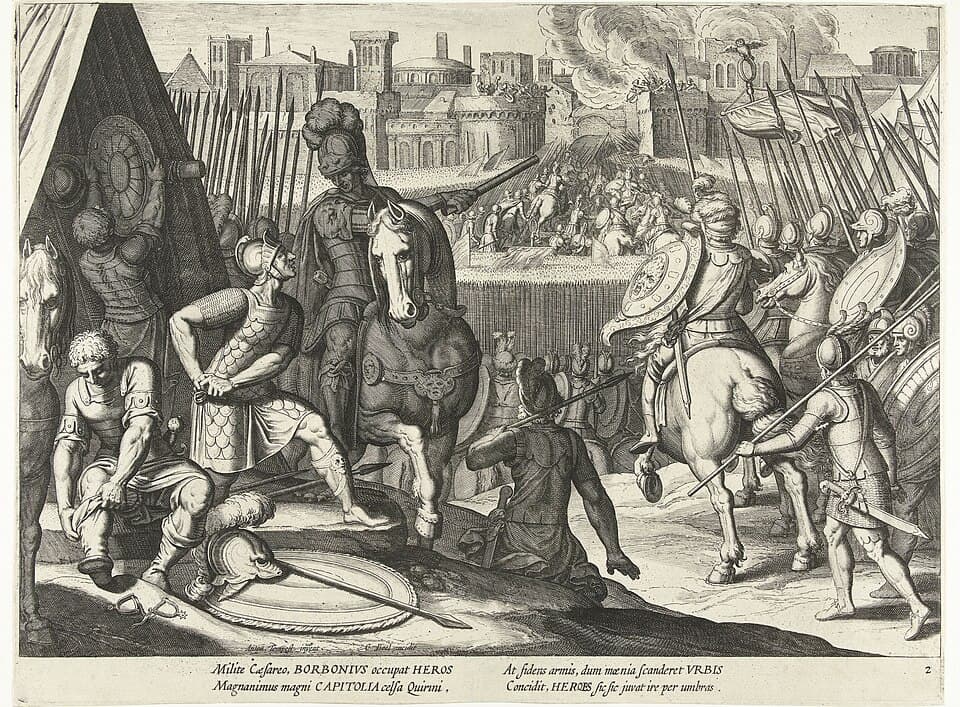
Dawn, 6 May 1527
The assault began before dawn, concentrated on the Gianicolo and Vatican hills — the weakest point of the walls, where the Borgo district rose behind the basilica of St Peter's. A thick fog favoured the attackers. At some point in the first hour of fighting, the Duke of Bourbon was shot and killed while climbing a scaling ladder. Benvenuto Cellini, firing an arquebus from the ramparts of Castel Sant'Angelo, later claimed the fatal shot, though he was one of many who did so.
Bourbon's death, which in any orderly army would have paralysed the attack, had the opposite effect here. His successor Philibert of Orange had no authority to rein in the troops, and with the leader who might have imposed discipline gone, the Germans and Spaniards swarmed the walls. By mid-morning they had broken through into the Borgo. By noon they had taken the basilica of St Peter's itself.
The Swiss Guard at St Peter's
The episode that has entered the collective memory of the Vatican took place on the steps of the old basilica. The 189 Swiss Guards, under their captain Kaspar Rüst, held their ground in a rear-guard action to allow Clement VII and his court time to reach the castle. Of the 189, 147 died on the spot. The 42 survivors covered the pope's retreat and withdrew into the castle behind him.
Every year on 6 May, new recruits to the Swiss Guard are sworn in at the Vatican in commemoration of that action. The date was chosen for no other reason. It is the single most famous act of battlefield sacrifice in papal history, and it is the reason the line that begins in 1506 and continues to the present day has never been broken.
Clement VII's escape through the Passetto
While the Swiss Guard fought on the steps of the basilica, Clement VII was being hurried through the elevated corridor that runs from the papal apartments of the Vatican to Castel Sant'Angelo. The Passetto di Borgo — also known in Roman dialect as er Corridore — had been built in 1277 by Pope Nicholas III as an escape route for exactly this kind of emergency. It had been used once before, in 1494, when Pope Alexander VI had retreated down it during the invasion of Charles VIII of France. In May 1527 it was used in earnest.
The corridor is about 800 metres long, runs at first-floor height above the street, and is enclosed for most of its length. Clement, wrapped in a plain cloak to avoid attracting arquebus fire from below, walked the distance in perhaps a quarter of an hour, accompanied by a small group of cardinals and papal officials. He reached the castle unharmed as the Germans were beginning to break into the Borgo behind him.
The Passetto did what it had been designed to do 250 years earlier. Without it, the pope would almost certainly have been captured or killed that morning. The course of European religious history would have been different: no Medici pope for the annulment of Henry VIII's marriage in 1533, no Counter-Reformation under Medici patronage, no Trent as it actually unfolded.
Eight days of sack
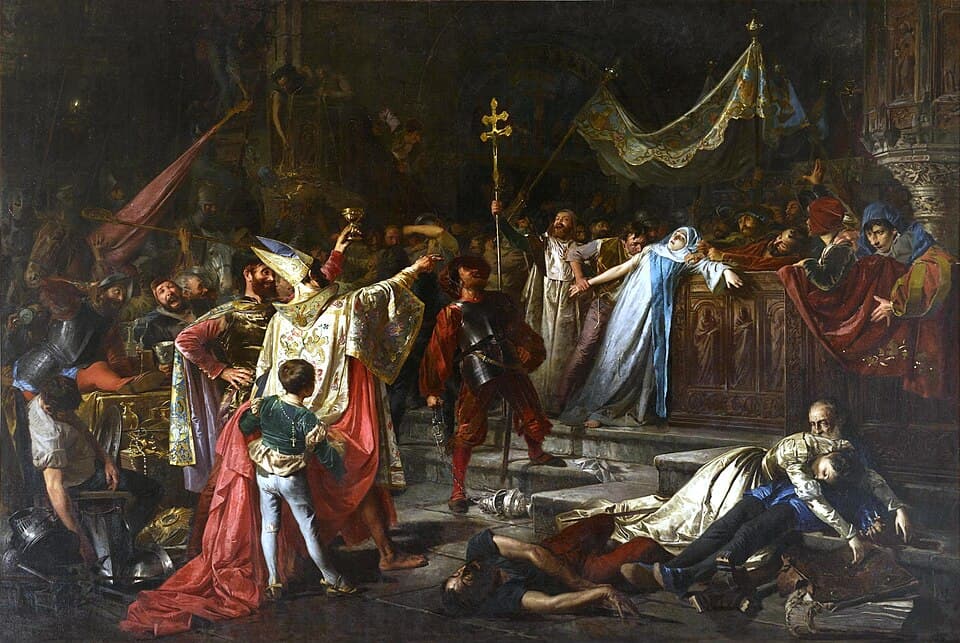
What followed in the city has been described in detail by contemporary witnesses and has little in common with the polite warfare of modern memory. For eight days — from 6 to 14 May — the imperial troops looted, killed, and extorted. Churches and monasteries were stripped of their gold. Cardinals were held for ransom. The great libraries of Rome, including much of the Vatican's, were looted or burned. Graffiti left by Landsknecht troops can still be seen today on the walls of the Stanza della Segnatura, carved into Raphael's frescoes with the tip of a bayonet.
The death toll has been debated for five centuries. Contemporary Venetian ambassadors spoke of twelve thousand dead; modern historians tend to settle on six to eight thousand as the probable figure for the immediate violence, with several thousand more dying in the months that followed from plague and starvation. The population of the city, which had been perhaps 55,000 before the sack, fell below 10,000 by the autumn. Rome would not return to its 1527 population level for a century.
Eight days of open pillage were followed by nine months of occupation, during which the troops remained in the city, extorting what they could from the remaining population and fighting each other over the spoils. Plague broke out among them in July and killed as many imperial soldiers as the defenders had managed to kill in the initial assault.
The pope as prisoner in Castel Sant'Angelo
While the sack unfolded outside, Clement VII and his court held out inside the castle. Approximately 3,000 people had taken refuge there — cardinals, their households, soldiers, papal secretaries, and an assortment of Roman notables who had reached the gates in time. The water cisterns were full, the granaries were stocked, and the Tiber ran at the foot of the walls. The castle's defences were designed precisely for this scenario: it could sustain a long siege.
What it could not sustain was indefinite supply. By the end of May the pope was negotiating. On 5 June he formally surrendered to the imperial commanders and agreed in principle to a ransom of 400,000 ducats, the cession of several fortress cities to Charles V, and the recognition of the emperor's authority on terms more favourable than any previous peace. The pope and his court remained technically prisoners in the castle through the summer and into the winter as the ransom was raised from Church lands across Europe.
During those months, Cellini describes walking the ramparts of the castle, still firing at enemy soldiers from the parapet when opportunity offered. The papal apartments on the upper levels, decorated only a few years earlier for Leo X and refurbished for Clement, became the temporary seat of papal government. Petitions, appointments, and diplomatic correspondence continued to flow out of the castle as though nothing had happened outside.
The ransom and the aftermath
Clement finally escaped in disguise on the night of 6 December 1527, reportedly dressed as a peddler. He reached Orvieto, where he remained in exile for most of the following two years. The imperial army, broken by plague and unpaid mutiny, finally withdrew from Rome in February 1528, taking with them what they had not already destroyed or sold.
The political consequences were immense. Clement, broken in finance and in confidence, could no longer oppose Charles V in any meaningful sense. He recognised the emperor's primacy in Italy, crowned him in Bologna in 1530, and for the rest of his pontificate adjusted papal policy to imperial preference. The League of Cognac collapsed. France abandoned Italy for a generation. The independent city-states of the peninsula, which had been the cultural engine of the Renaissance, passed one by one into foreign hands.
Within Rome, the cultural damage was equally lasting. Tens of thousands of manuscripts, paintings, and objects of devotion had been destroyed or carried off. Artists and scholars fled to Florence, Venice, and Ferrara, taking with them the networks of patronage that had made Rome the capital of the High Renaissance. Historians conventionally treat the sack as the event that closed that era and opened the period that would become the Counter-Reformation.
Witnesses: Cellini, Guicciardini, and the survivors
The sack was one of the most thoroughly documented disasters of the sixteenth century. Benvenuto Cellini's autobiography contains an extended account of his own role in the defence of the castle, including the claim — impossible to verify — that he personally shot the Duke of Bourbon and later the Prince of Orange. Luigi Guicciardini, brother of the more famous Francesco, wrote a full history of the event that remains the most detailed contemporary narrative. Papal secretaries, ambassadors from Venice and Ferrara, and the German chronicler Martin Heemskerck all produced accounts. The material on which modern historians draw is unusually rich.
What the witnesses agree on, beyond the chronology, is the scale of the psychological shock. The idea that Rome — the city of the apostles, of the emperors, of the Church itself — could be sacked by a mutinous army of its own coreligionists had seemed almost inconceivable before it happened. Once it had, it could not be unthought. The sack became a standing reminder, for the next two centuries, of what could befall a papacy that pursued the wrong policy too far.
Traces of 1527 today
Several sites in Rome and the Vatican still bear visible marks of the sack:
- Castel Sant'Angelo, the papal apartments and the ramparts. The rooms that sheltered Clement VII — the Sala Paolina, the Sala di Perseo, the Cagliostra — are part of the standard visit. Many of them were redecorated after 1527 but retain the general layout as the pope knew them. The ramparts from which Cellini fired his arquebus can be walked today, with views across the Tiber to St Peter's.
- The Passetto di Borgo. The corridor along which Clement escaped is still standing. A short section can be visited on guided tours of the castle, with access to the upper walkway and an explanation of how the route was used in 1494 and 1527.
- The Stanza della Segnatura, Vatican Museums. On the lower portions of Raphael's frescoes, Landsknecht graffiti from May 1527 is still visible to close inspection — names, dates, and short imprecations carved into the plaster.
- The Swiss Guard barracks, Vatican City. Every year on 6 May new recruits are sworn in at a ceremony in the Cortile San Damaso, in direct commemoration of the guards who died on the steps of St Peter's.
- St Peter's Basilica. The basilica that was sacked in 1527 was the old fourth-century building, already partly demolished at that date to make way for the new one. The structure visitors see today is the seventeenth-century replacement. Almost nothing of the church that the Landsknechte entered still stands, which is itself part of the legacy of the sack.
Frequently asked questions
What was the Sack of Rome in 1527?
On 6 May 1527, an imperial army of around 20,000 unpaid soldiers loyal to Emperor Charles V broke through the walls of Rome and sacked the city. The pillage lasted eight days, followed by nine months of occupation. It is conventionally cited as the event that ended the High Renaissance in Italy.
How many people died in the Sack of Rome?
Contemporary Venetian ambassadors spoke of twelve thousand dead; modern historians tend to settle on six to eight thousand killed in the immediate violence, with several thousand more dying from plague and starvation in the months that followed. Rome's population fell from around 55,000 to below 10,000 by the autumn of 1527.
How did Pope Clement VII escape during the Sack of Rome?
Clement VII escaped from the Vatican through the Passetto di Borgo, the 800-metre elevated corridor built in 1277 as a papal escape route. Wrapped in a plain cloak to avoid arquebus fire, he walked the distance in about fifteen minutes and reached Castel Sant'Angelo, where he remained besieged for seven months.
Who sacked Rome in 1527?
The army belonged to Holy Roman Emperor Charles V and was led by Charles III, Duke of Bourbon, who was killed in the first hour of the assault. It consisted of roughly 14,000 German Landsknechte, many of them Lutheran, 6,000 Spanish infantry, and Italian mercenaries — all months unpaid and effectively beyond command.
Why are Swiss Guards sworn in on 6 May?
Of the 189 Swiss Guards who held the steps of St Peter's to cover the pope's escape on 6 May 1527, 147 died on the spot. Every year on that date, new recruits to the Swiss Guard are sworn in at the Vatican in direct commemoration of that sacrifice.
Can you visit the places of the Sack of Rome today?
Yes. The papal apartments and ramparts that sheltered Clement VII are part of the standard visit to Castel Sant'Angelo, and a section of the Passetto di Borgo can be walked on specific guided tours. In the Vatican Museums, Landsknecht graffiti from May 1527 is still visible on the lower portions of Raphael's frescoes in the Stanza della Segnatura.