Explore · Level 1 · Highlight
Cortile dell'Angelo
The Courtyard of the Original Angel — Marble by Montelupo, 1544
Quick answer: The Cortile dell'Angelo is the open rectangular courtyard at the heart of the upper levels of Castel Sant'Angelo, formed in the first half of the sixteenth century between the pontificates of Leo X and Paul III Farnese. At its centre stands the original 1544 marble statue of Saint Michael by Raffaello da Montelupo, which crowned the castle for over two hundred years before being replaced on the rooftop by Verschaffelt's bronze in 1753. The courtyard is one of the six rooms marked as a highlight in the official Direzione Musei Nazionali di Roma brochure, and access is included in the standard museum ticket.
You arrive at the Cortile dell'Angelo after a long climb in semi-darkness.
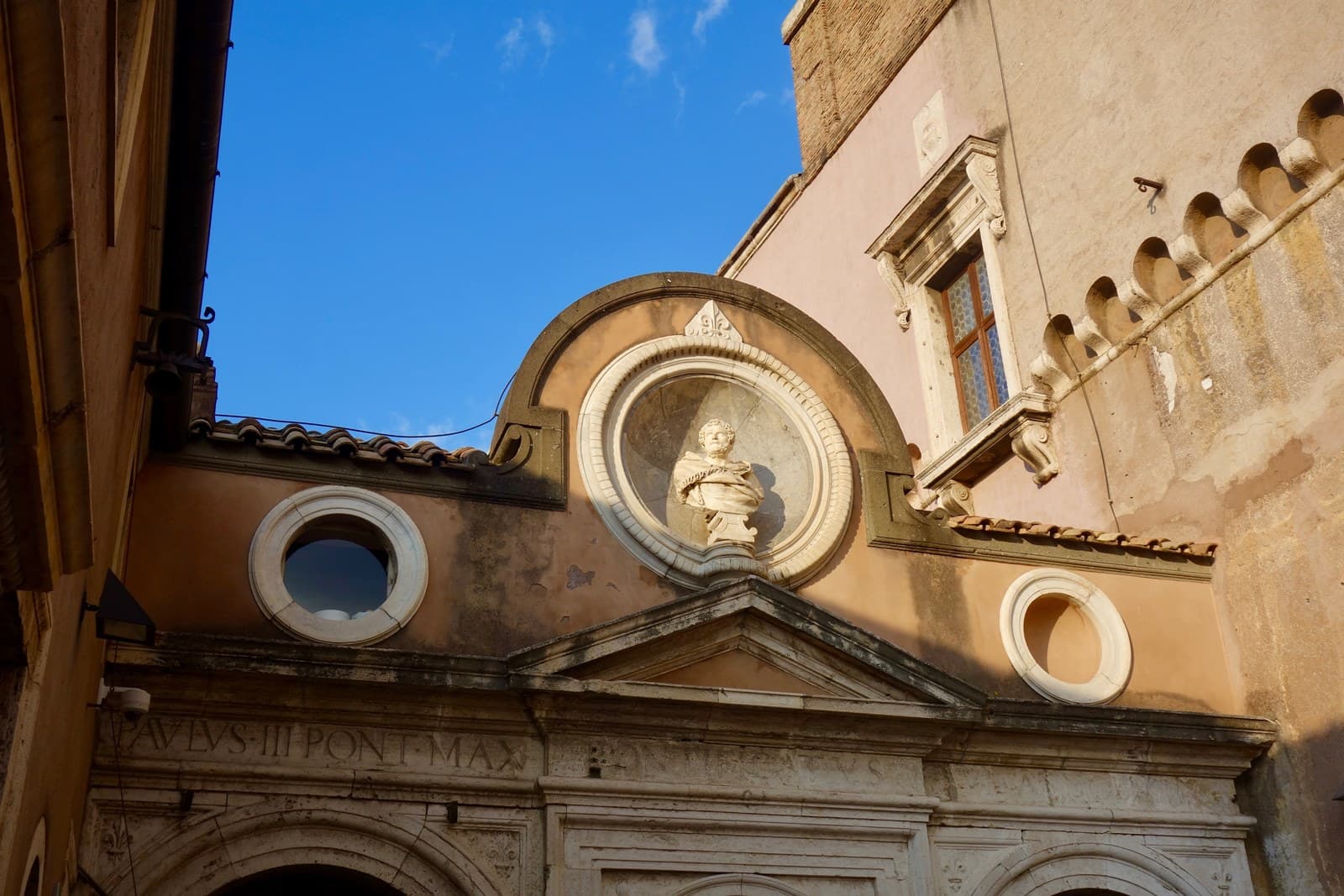
From the entrance gate of the castle, the route takes you through the Roman Dromos, up the helical ramp of Hadrian's mausoleum, and across the diametral ramp through the burial chamber. You finally emerge into a wide, sunlit, open-air space in the middle of the upper levels of the building. Walls of brick and travertine on three sides; the Renaissance facade of the papal apartments on the fourth.
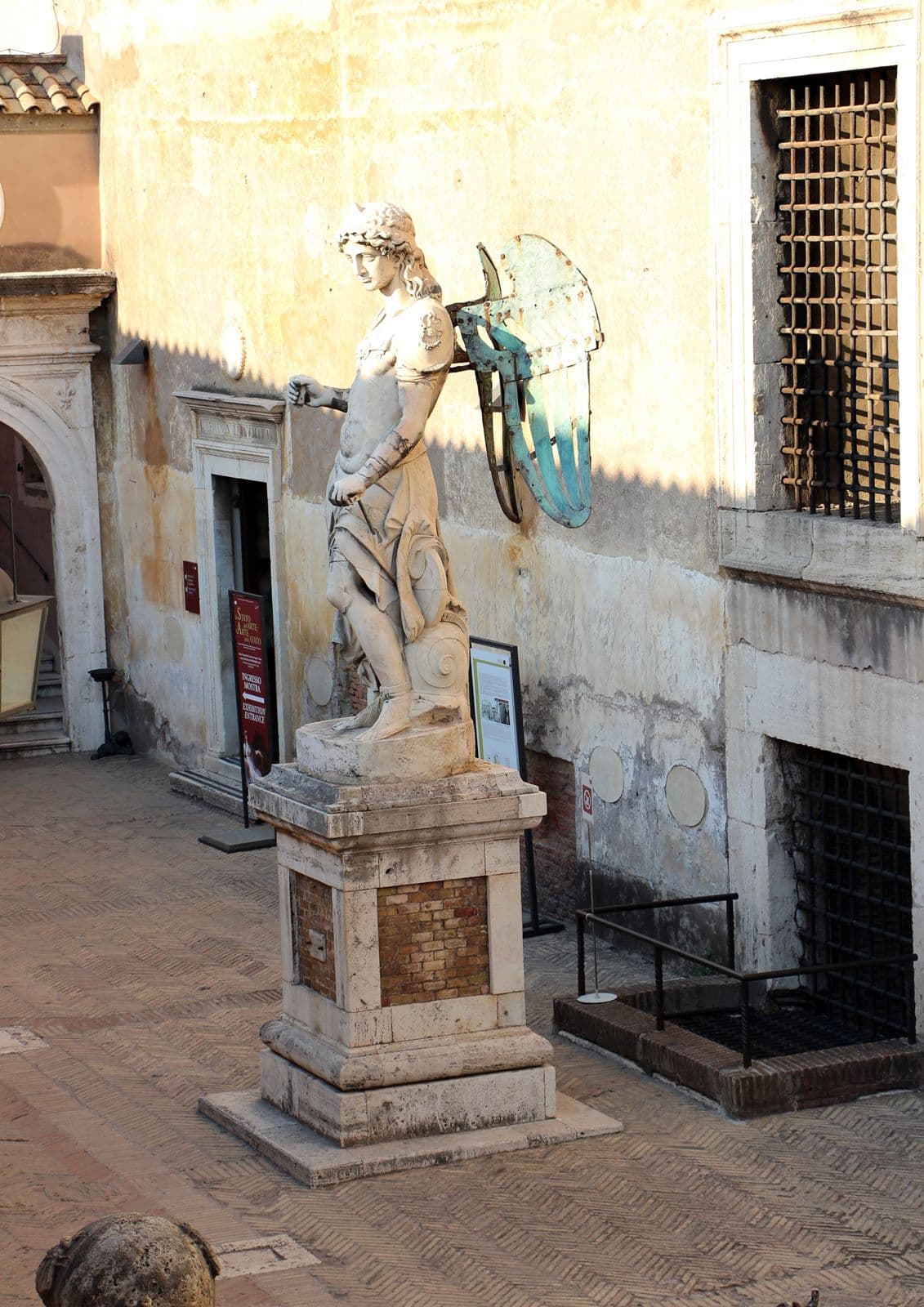
At the centre of this courtyard, on a stone pedestal, stands the marble figure of Saint Michael the Archangel sheathing his sword. This is, in a sense, the statue that gave the castle its name in 590 AD — or rather, the fifth in a series of statues that has stood on this site over fifteen centuries. The current marble version was sculpted by Raffaello da Montelupo in 1544 and stood at the very top of the building until 1747, when it was removed and replaced by the bronze you see on the rooftop today.
The courtyard takes its name from the moment this statue was finally moved here, in 1910. Before that, it was simply called the Cortile d'Onore — the Courtyard of Honour.
Why it is called the Angel's Courtyard
For most of its existence, this courtyard did not have an angel in it.
It was originally just the open central space of the upper papal residence — the entry point to the apartments of Leo X, Paul III, and the popes who succeeded them. It was called simply the Cortile d'Onore, the “Courtyard of Honour”, because it was the first ceremonial space a visitor reached after climbing up from the mausoleum below.
The statue at its centre arrived only in 1910. After Verschaffelt's bronze replaced it on the rooftop in 1753, the marble Archangel by Montelupo had been moved first to a niche in the Stairs of Paul III, and only later to its current position in the courtyard. From 1910 onwards, the space took the angel's name and kept it.
For visitors today the renaming makes intuitive sense. The marble Michael is the most prominent and most photographed object in the courtyard, and it ties the space directly to the building's identity — the angel that gave the castle its name in 590 AD.
The six angels of Castel Sant'Angelo
The Archangel Michael has crowned this building, in one form or another, since the late sixth century.
According to tradition, in 590 AD during a plague that struck Rome, Pope Gregory the Great led a procession to St Peter's and saw the archangel sheathing his sword above the mausoleum. The vision was read as a sign that the plague would end. From that moment, the building was understood to be under the angel's protection, and a statue was placed at the summit to mark the spot.
That first statue did not survive. Nor did the next four. The current bronze on the rooftop is the sixth in the series:
- A wooden figure, eventually lost to rot.
- A marble statue destroyed during a siege in 1379.
- A marble figure with bronze wings, installed in 1453 and destroyed by a lightning strike in 1497 that ignited the castle's gunpowder magazine.
- A gilded bronze figure, melted down in 1527 during the Sack of Rome to cast cannons for the castle's defence.
- The marble figure by Raffaello da Montelupo (1544), which is the one now standing in the centre of this courtyard.
- The bronze figure by Peter Anton von Verschaffelt (1753), which is the angel you see today on the terrace at the top of the castle.
Of the six pre-modern statues, Montelupo's is the only one that still exists. The four earlier figures are all lost — to rot, to weapons, to lightning, to the foundry. The Cortile dell'Angelo is, in this sense, a survival.
The marble Archangel of Raffaello da Montelupo
Raffaello da Montelupo (1504–1566) was a Tuscan sculptor who had trained in the Michelangelo workshop and worked across the major papal commissions of the 1530s and 1540s. The angel was his most exposed work — literally. It was designed to stand at the highest point of the building, visible from across the city.
The statue is carved in antique marble reused from an earlier block. Montelupo did not start from a fresh stone. The reuse left visible imperfections, and is partly responsible for the figure's slightly compressed proportions.
A figure designed to be seen from below
Two details look strange at courtyard level and become deliberate when you understand the original setting.
First, the head is disproportionately large for the body. At the rooftop, more than thirty metres above the ground, this corrected the foreshortening that the viewer's upward gaze imposed. The figure was sculpted to read correctly when seen from far below, not when standing next to it.
Second, the wings were originally gilded metal and perforated with openwork to reduce wind resistance. A solid pair of wings on top of an exposed terrace would have caught storms; the perforations let air pass through. Today the wings are bronze and visibly worn.
The figure wears a long tunic and is shown in the act of sheathing his sword — the gesture of Gregory's vision, the moment the plague ends. The armour is held by straps decorated with the Farnese lily, the personal device of Paul III, who commissioned the work.
What else is in the courtyard
The courtyard is rectangular and bounded on its long sides by the lower armouries on the right and the surviving wall of Hadrian's mausoleum on the left. The two short ends carry most of the architectural detail.
The chapel of Leo X (Michelangelo)
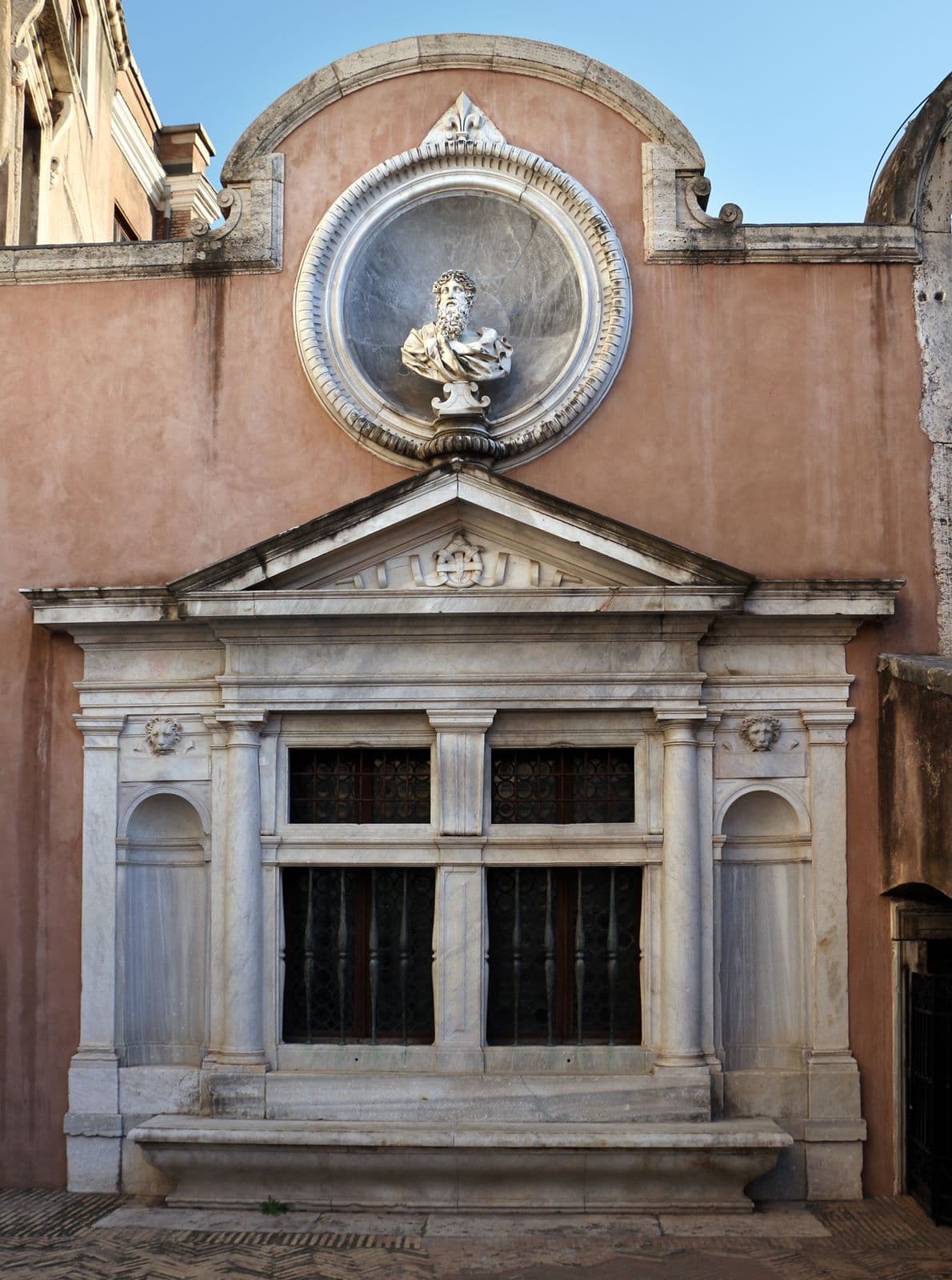
Opposite the entrance to the courtyard, an aedicular facade in travertine marks the small Chapel of Saints Cosmas and Damian, built for Pope Leo X in the early sixteenth century. The exterior aedicula is attributed to Michelangelo Buonarroti on documentary grounds.
The chapel itself is small and currently not open to general visitors, but the facade alone is one of the very few surviving works on the castle attributable to Michelangelo's hand.
The double arch by Raffaello da Montelupo
The entrance facade to the courtyard is articulated by a double arch with a central niche, commissioned by Paul III from Raffaello da Montelupo. The second archway frames a staircase leading to the patrol walk above. On either side, two smaller niches hold marble busts sculpted by Guglielmo della Porta in the mid-sixteenth century.
The wolf-mouth window
Below and behind the statue of Saint Michael, a large window with a sloped bocca di lupo (“wolf-mouth”) opening lights the burial chamber of Hadrian's mausoleum directly underneath. The window is a Renaissance addition that brought daylight into the original Roman tomb.
The Barberini bee
On the parapet to the left of the staircase that leads up from the courtyard, a small marble sphere is decorated with the three bees of the Barberini family in relief. The sphere commemorates renovation work commissioned in this part of the castle by Pope Urban VIII Barberini in the seventeenth century.
Where the courtyard leads
The Cortile dell'Angelo is a hub. From it, four routes lead onwards:
- The staircase next to the entrance leads up to the Loggia of Paul III and to the Giretto of Alexander VII on the upper level.
- To the right of the entrance is the access to the Lower Armouries, which today host an exhibition of prints, paintings and three-dimensional models tracing the architectural evolution of Castel Sant'Angelo.
- To the left of the entrance are the Sala di Clemente VIII, the Sala della Giustizia and the Sala di Apollo — the medieval halls of Level 1.
- Next to the Chapel of Leo X, a large cordonata staircase designed by Raffaello da Montelupo connects the courtyard with the Loggia overlooking the Tiber, and from there to the Sala Paolina of the papal apartments on Level 2.
In practice, the Cortile dell'Angelo is the moment in the standard visitor route where the castle changes register: behind you, the Roman mausoleum; ahead, the Renaissance papal apartments. The marble angel at the centre is the hinge between the two.
How to find the Cortile dell'Angelo
The courtyard is on Level 1 of the castle, directly above Hadrian's burial chamber. There is essentially one way to reach it from the entrance:
- Through the Dromos and the Atrium at ground level.
- Up the helical ramp of Hadrian.
- Across the diametral ramp that cuts through the cylinder.
- Past the Sala delle Urne and up the final flight of stairs.
You emerge directly into the Cortile dell'Angelo. There are no detours.
Visitors with reduced mobility can request the use of the museum's private lift by contacting the on-site staff.
Opening hours
The Cortile dell'Angelo follows the general opening hours of the National Museum of Castel Sant'Angelo: Tuesday to Sunday, 9:00 to 19:30, with last admission at 18:00. Closed on Mondays, 1 January and 25 December.
Because it is one of the central nodes of the visitor route, the Cortile is almost always open. Routine maintenance work very occasionally restricts access, but unlike the Cagliostra or the Passetto di Borgo, full closures are rare.
For the current status before your visit, see the opening hours page or check the official Direzione Musei Nazionali di Roma and CoopCulture websites.
Frequently asked
What is the Cortile dell'Angelo at Castel Sant'Angelo?
The Cortile dell'Angelo is the open rectangular courtyard at the centre of the upper levels of Castel Sant'Angelo. It is the gateway to the papal apartments and one of the six rooms marked as a highlight in the official Direzione Musei Nazionali di Roma brochure. At its centre stands the original 1544 marble statue of Saint Michael by Raffaello da Montelupo.
Why is it called the Angel's Courtyard?
The name comes from the marble statue of Saint Michael at its centre, which gave the entire castle its name in 590 AD according to the legend of Pope Gregory the Great. The statue was moved to the courtyard in 1910 after spending more than two centuries on the rooftop and another century and a half in the staircase of Paul III. Before 1910 the courtyard was called Cortile d'Onore (Courtyard of Honour).
Who sculpted the angel statue in the courtyard?
The marble statue was sculpted by Raffaello da Montelupo (1504–1566) in 1544 on commission from Pope Paul III Farnese. It is carved in reused antique marble, with bronze openwork wings designed to reduce wind resistance on the original rooftop position. It stood at the top of the castle until 1747, when it was replaced by the current bronze figure by Peter Anton von Verschaffelt (1753).
How many statues of Saint Michael have stood on Castel Sant'Angelo?
Six. The first was a wooden figure that decayed; the second was a marble statue destroyed in a siege in 1379; the third, marble with bronze wings, was destroyed by a lightning strike in 1497; the fourth, gilded bronze, was melted down in 1527 to cast cannons during the Sack of Rome; the fifth is Montelupo's 1544 marble, now in this courtyard; the sixth is Verschaffelt's 1753 bronze, currently on the rooftop.
Is the Cortile dell'Angelo included in the standard ticket?
Yes. The Cortile is part of the standard museum route and the standard museum ticket gives access. No separate booking and no official guide are required. The courtyard is normally open during all museum hours, with very rare closures for maintenance work.
How do you get to the Cortile dell'Angelo inside the castle?
From the entrance, follow the standard route: through the Dromos and Atrium, up the helical ramp of Hadrian, across the diametral ramp through the burial chamber, past the Sala delle Urne, and up the final flight of stairs. You emerge directly into the Cortile dell'Angelo. The route is linear and well signposted.