Cagliostro in Castel Sant'Angelo — The Alchemist's Cell
Quick answer: Count Alessandro di Cagliostro — the alias of the Sicilian adventurer Giuseppe Balsamo (1743–1795) — was arrested by the Roman Inquisition on 27 December 1789. Charged with heresy and Freemasonry, he was held in Castel Sant'Angelo for roughly a year in a set of small apartments on the north side of the papal residence. In 1791 his death sentence was commuted to life imprisonment. He was transferred to the remote mountain fortress of San Leo, where he died in a windowless cell on 26 August 1795. The rooms where he was held in the castle are still pointed out to visitors today as la Cagliostra.
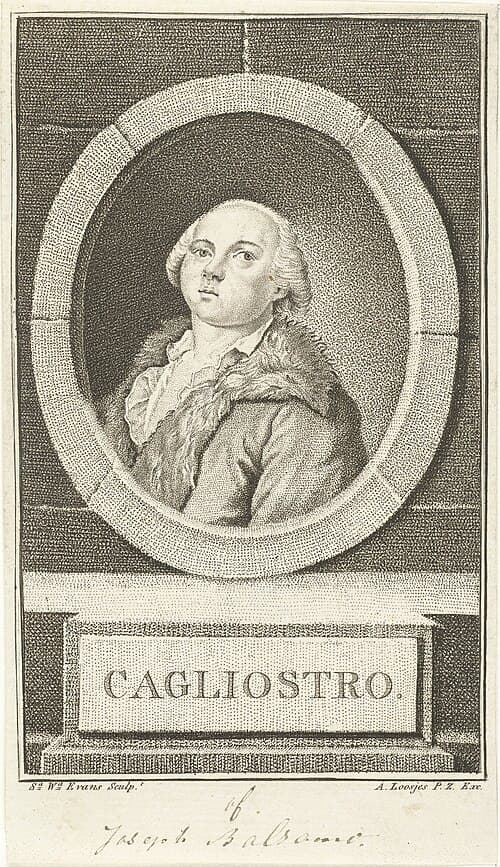
The name on the cell was not, strictly speaking, the name of the prisoner.
Giuseppe Balsamo was born in a poor quarter of Palermo in 1743. Briefly educated by a religious order — from which he was expelled — he disappeared into the freelance economy of eighteenth-century Europe, and resurfaced in the late 1770s under a new identity: Count Alessandro di Cagliostro.
Self-styled aristocrat. Self-styled physician. Self-styled grand master of an Egyptian rite of Freemasonry. For a decade he moved between the courts of Paris, Saint Petersburg, Warsaw, London, and a dozen cities in between.
When he reached Rome in May 1789, he was one of the most talked-about figures in Europe. Six months later, he was in a papal prison. Twelve months after that, he was sentenced to death.
What happened in between — and why it ended in a cell in the north wing of Castel Sant'Angelo — is worth unpacking.
Before Rome: the Count across Europe
By the late 1780s, the figure of Cagliostro was instantly recognisable in fashionable Europe.
He claimed to transmute metals. To heal incurable diseases. To communicate with spirits through scrying bowls. He claimed to have travelled as a boy to Medina, Mecca, and Cairo under the tutelage of an Armenian mystic named Althotas. He claimed descent from the Byzantine imperial family.
None of it was verifiable. Much of it was improvised.
The theatre of the séance
He also had an unmistakable gift for theatre. His séances were elaborately staged: incense, mirrors, Latin invocations, a young female medium drawn from the audience.
His Egyptian rite of Freemasonry added to the conventional Masonic ritual a layer of Egyptianising symbolism, the admission of women as full participants, and a promise of physical and spiritual regeneration.
In Strasbourg, Paris, and Warsaw he attracted prominent adherents. In London and Saint Petersburg he was run out of town.
The Diamond Necklace affair
The episode that made him infamous was not fraud but a case of mistaken association. In 1785, the Affair of the Diamond Necklace implicated him alongside Marie Antoinette and Cardinal de Rohan. He spent nine months in the Bastille before being cleared.
The French court eventually acquitted him, but his reputation never quite recovered. By 1789 his European welcome had worn thin.
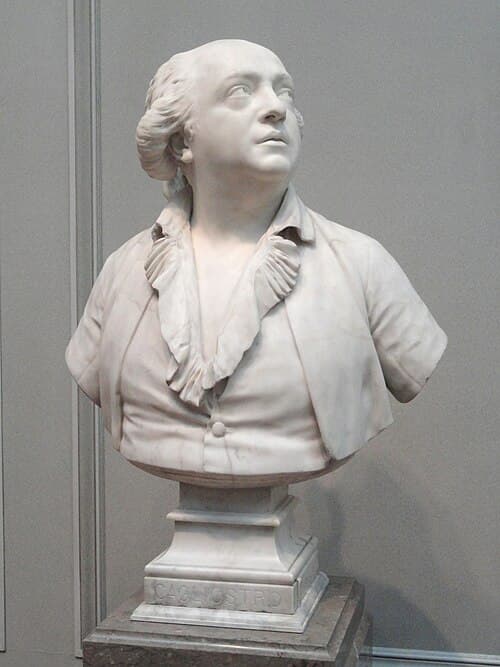
Rome, 1789: an unlikely refuge
Rome was, on the face of it, an unlikely refuge for a publicly professed Freemason.
The papacy had issued multiple bulls condemning Freemasonry as heresy since 1738. The Holy Office had been active against it in the Papal States for fifty years.
Cagliostro appears to have believed that his personal reputation would carry him through. For several months, it did. He received visitors in a rented apartment near Piazza di Spagna. He practised private medicine. He attempted to win over members of the cardinalate.
The betrayal
What he did not anticipate was the betrayal.
His wife Lorenza Feliciani — exhausted by two decades of itinerant marriage, and increasingly frightened of the Inquisition — denounced him.
On the evening of 27 December 1789, agents of the Holy Office arrived at the apartment and arrested both of them. Cagliostro was taken directly to Castel Sant'Angelo. Lorenza was sent to a convent prison, where she is reported to have died in 1794.
Eighteen months of interrogation
The trial was long even by Inquisitorial standards.
Over eighteen months, from early 1790 until April 1791, Cagliostro was questioned repeatedly by a commission of cardinals. The records of the interrogation are preserved in the Vatican archives.
They show a man who talked freely about his Egyptian rite. About his travels. About his alleged meetings with the Comte de Saint-Germain and other figures of the European occult.
But who avoided the specific charge that would most damage him: that his lodges were agents of sedition.
The Inquisition's biography
The trial produced, at the Inquisition's instruction, an official biography of Cagliostro by a Dominican named Marcello Marini.
The Compendio della vita e delle gesta di Giuseppe Balsamo was published in 1791 and distributed widely across Catholic Europe.
It identified Cagliostro unambiguously as Giuseppe Balsamo of Palermo. It catalogued his frauds and escapes. It painted a picture of a charlatan whose Masonic rituals were a cover for confidence-tricks.
It is the source of most of what is commonly known about his early life — and it has to be read with the caution due to a document produced by his prosecutors.
Sentence and commutation
On 7 April 1791, the Holy Office sentenced Cagliostro to death by strangulation.
Pope Pius VI — for reasons never made entirely public, though clemency toward a high-profile prisoner was not uncommon — commuted the sentence to life imprisonment.
La Cagliostra: a prison for privileged prisoners
During the eighteen months of his trial, Cagliostro was held in a set of three connected rooms on the north side of the papal apartments, at the upper level of the castle.
The apartment originally had open arches facing the Borgo. These had been walled up in the early eighteenth century to convert the space into a secure cell.
The layout of the cell
The central room was modest but not uncomfortable. Two smaller rooms flanked it, named for the heraldic emblems frescoed on their ceilings:
- Gabinet of the Stork
- Gabinet of the Dolphin and the Salamander
The interior walls carried Renaissance grotesques signed by the painters Luzio Luzi and Perin del Vaga, from the reign of Pope Paul III two and a half centuries earlier.
Not an ordinary cell
This was not an ordinary prison cell.
The Cagliostra was reserved for prisoners whose status — noble, clerical, or diplomatically sensitive — made harsher conditions politically awkward. Prisoners held there were fed from the papal kitchens, permitted regular confession, and given materials to read and write.
Cagliostro's year in this apartment was a form of comfortable detention, not torture. The cell became known informally as la Cagliostra during his residence. The name stuck long after he was gone.
The failed escape
On one occasion during his time there, he attempted to escape.
Requesting a confessor, he tried to overpower the friar who arrived and take his robes. The friar proved physically stronger. Cagliostro was restrained without difficulty. The incident was added to the trial record.
The Cagliostra still exists today, and is part of the standard visit route when the cell is open to the public.
Transfer to San Leo: the real prison
After the sentence was commuted, the authorities moved Cagliostro out of Rome altogether.
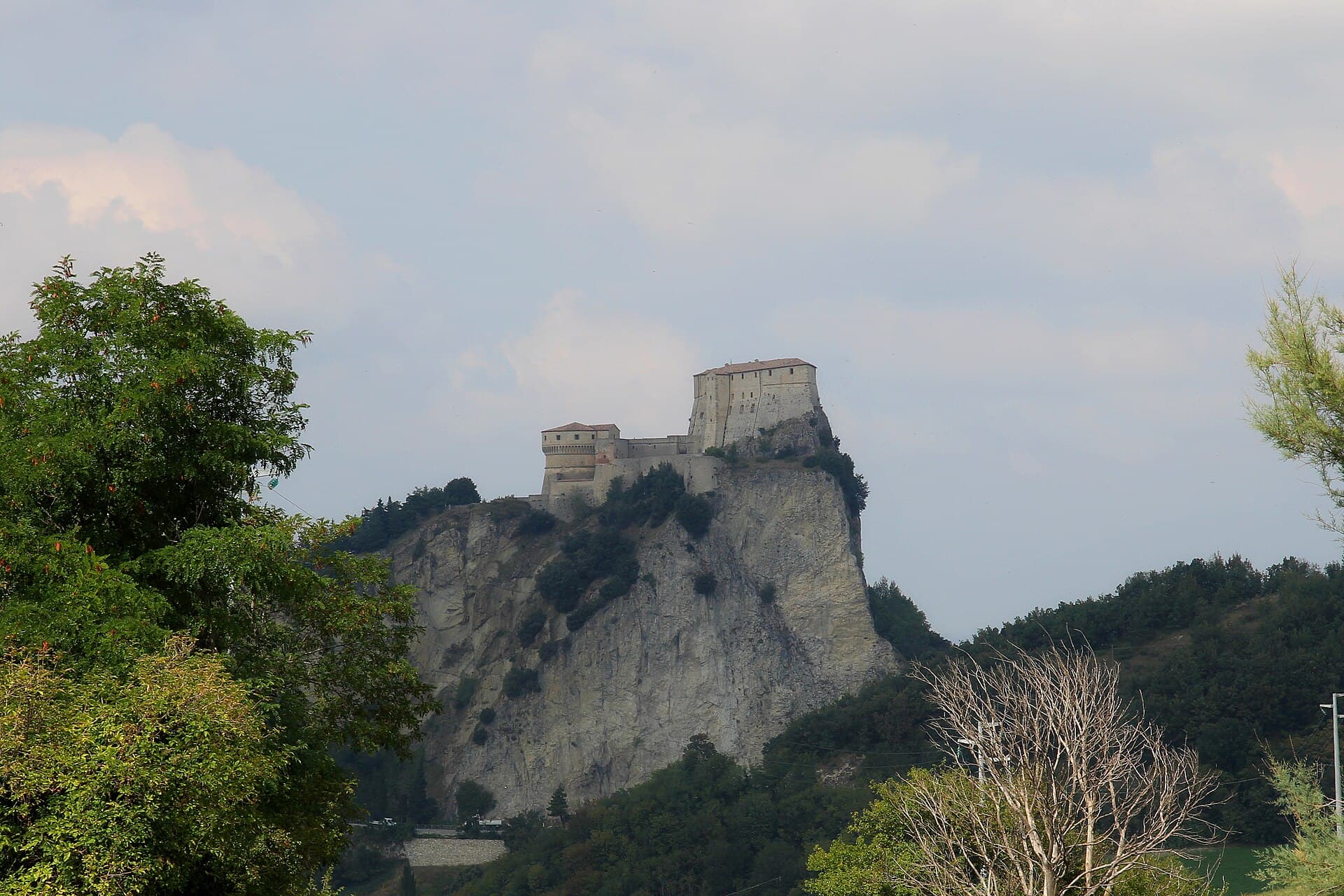
In April 1791 he was taken under guard to the Rocca di San Leo, a medieval fortress perched on a vertical crag in the Apennines of what is now the Marche region.
San Leo was the maximum-security papal prison of the eighteenth century. Inaccessible. Weather-beaten. Administered by a small military garrison with no connection to the intellectual life of Rome.
The Pozzetto: a cell without a door
The cell was called il Pozzetto — "the little well." It was the opposite of the Cagliostra in every respect.
A small stone chamber with no door. The prisoner was lowered in through a hatch in the ceiling. A single narrow slit provided light and air.
No desk. No correspondence. No reading.
The purpose of the Pozzetto was to erase its occupant from public memory. The papacy had decided that a martyred Cagliostro would be more dangerous than a forgotten one.
Death in the cell
He survived there for four years.
On 26 August 1795, the prison chaplain found him dead in his cell. The cause of death is officially listed as a stroke.
Unofficial accounts at the time mentioned mistreatment, suicide, or slow starvation. No inquiry was made. He was buried in unconsecrated ground near the fortress.
Later that year — according to one persistent story — Polish troops allied with the advancing French army briefly occupied the fortress, released the remaining prisoners, dug up Cagliostro's grave, and used his skull as a drinking cup. The story is almost certainly false. It has proved impossible to extinguish.
The afterlife of the Count
Cagliostro proved harder to erase than Pius VI had hoped.
Schiller drafted a novel about him (Der Geisterseher, unfinished, 1786–1789). Goethe travelled to Palermo specifically to interview the Balsamo family and write about what he found. Alexandre Dumas built the entire cycle Joseph Balsamo / Mémoires d'un médecin around him in the 1840s.
In the twentieth century he returned as a figure of occult revival. His Egyptian rite of Freemasonry was revived in Italy under the name Rito di Misraïm, and its modern successor still operates. In popular culture he has been the subject of silent films (Richard Oswald, 1929), a Japanese anime feature (The Castle of Cagliostro, 1979, Miyazaki's first film as director), and a Rai television drama in 2017.
The pattern is consistent. Each generation that encounters Cagliostro decides anew whether he was a visionary or a fraud, a victim of the Inquisition or its deserved target. The records leave room for both readings.
Traces of Cagliostro in Rome and beyond
Three sites in Italy preserve the physical memory of the case:
- The Cagliostra, Castel Sant'Angelo. The three-room apartment on the north side of the papal residence where Cagliostro was held during his trial. It can be visited when the cell is included in the route; access depends on the day and on which guided tour you take. Standard entry to the castle is the prerequisite.
- Rocca di San Leo, Marche region. The mountain fortress where Cagliostro died. Now a museum, with the Pozzetto cell preserved and interpreted. Roughly a four-hour drive from Rome; more realistically, a day trip from Rimini or Urbino.
- Piazza di Spagna, Rome. The neighbourhood of Cagliostro's rented apartment during the last months before his arrest. The specific building is not identified in the surviving records, but the area would have been familiar to him in the autumn of 1789.
The case in the history of the castle
The Cagliostra is one of the best-preserved prison spaces in Castel Sant'Angelo, and Cagliostro is the only prisoner whose name has stuck to his cell.
But he was far from the only notable figure held there. Two and a half centuries earlier the sculptor Benvenuto Cellini had escaped from the castle by descending its outer wall on knotted sheets.
The noblewoman Beatrice Cenci was held here during the investigation that led to her execution in 1599. The philosopher Giordano Bruno was held here before his burning on the Campo de' Fiori in 1600.
The castle's role as a papal prison lasted from the late Middle Ages until the unification of Italy in 1870. The Cagliostra, and its unusually intact Renaissance decoration, is one of the clearest windows into what that role actually looked like.