Benvenuto Cellini's Escape from Castel Sant'Angelo (1538)
Quick answer: In 1538, the Florentine sculptor and goldsmith Benvenuto Cellini was imprisoned at Castel Sant'Angelo on a charge — which he always denied — of stealing papal jewels during the Sack of Rome. On the night of Corpus Christi, he forced the door of his cell with a pair of pincers taken from his jailer, lowered himself down the San Giovanni bastion on a rope of knotted bed-sheets, and broke his leg on landing. He dragged himself to the house of Cardinal Cornaro, who handed him back to the pope. Cellini was returned to a darker cell, survived an attempted poisoning, and was finally released in December 1539 through the intercession of Cardinal Ippolito II d'Este. He wrote the entire story down in his autobiography, the Vita.

Of the many prisoners the papal government sent to Castel Sant'Angelo over the centuries, only one is reliably said to have escaped. His name was Benvenuto Cellini, and the reason we know the story in such detail is that he wrote it down himself, many years later, in the autobiography that Goethe would eventually translate and Oscar Wilde would describe as one of the few books worth rereading.
The Vita di Benvenuto Cellini is a difficult source. Cellini composed it as a defence, a boast, and a settling of scores, and modern historians treat much of it with caution. But the outlines of his imprisonment and escape are confirmed by other documents — court records, correspondence between cardinals, the account books of the Castel Sant'Angelo itself — and the story that emerges is one of the most vivid windows we have into the workings of a papal prison in the middle of the sixteenth century.
Benvenuto Cellini, the Renaissance artist
Cellini was born in Florence on 3 November 1500, the second son of a musician who had hoped his boy would take up the flute. He was apprenticed instead to a goldsmith, and by the time he was in his early twenties he was already considered one of the finest metalworkers of his generation. He moved to Rome in 1519, worked on commissions for Clement VII, and served at the papal mint as a maker of medals and coin dies.
His temperament was famously difficult. The Vita is full of duels, feuds, flights from justice, and reconciliations brokered by patrons who valued his art enough to overlook the rest. He fought in the defence of Rome during the Sack of 1527 — claiming, in the Vita, to have personally shot the Constable of Bourbon — and later killed the man who had murdered his brother, a crime for which he was absolved by the same Pope Clement VII who had commissioned his medals.
By 1538, when the events of this article begin, Cellini had just returned to Rome from a short visit to the court of Francis I of France. He was thirty-seven years old, at the height of his reputation, and had just made a new and powerful enemy: Pier Luigi Farnese, son of the reigning pope Paul III.
The arrest of 1538
The charge was that during the Sack of Rome eleven years earlier, while nominally defending the papal treasury as an officer of the mint, Cellini had pocketed a quantity of unset gems belonging to the papal tiara. It was the kind of accusation that could have been laid against almost any official present during the chaos of 1527, and Cellini insisted in the Vita that the claim was fabricated by Pier Luigi Farnese as a pretext. Modern historians generally agree that the evidence was thin.
Thin or not, it was enough. Cellini was arrested, brought to Castel Sant'Angelo, and placed in one of the cells on the lower levels reserved for prisoners of rank. In the Vita he is at pains to distinguish these cells from the notorious Sammalò — the small, windowless dungeon at the back of the San Marco bastion, into which the condemned were lowered from above and could not stand, sit, or lie down. Cellini's first cell was more humane, but it was still a cell, and he was held there without trial for months.
The castellan who oversaw his imprisonment was a man who appears in the Vita under the name of the Castellan — a figure described as swinging between lucidity and delusion. At one point, Cellini writes, the Castellan confided to him that he was convinced he could turn into a bat, and that if Cellini ever tried to escape, the Castellan would simply fly out and bring him back. Modern readers are free to decide how much of this is invention and how much is an accurate report of what a prisoner under great stress observed in a man under similar stress.
The first escape — Corpus Christi, 1538
The escape took place on the feast of Corpus Christi. The castle was distracted by the religious celebration, the guards were fewer than usual, and Cellini had spent weeks preparing. He had stolen a pair of iron pincers from one of his jailers and hidden them. He had cut his bedsheets into strips, knotted them into a rope, and concealed the rope in the straw of his mattress. He had identified the point from which to descend: the corner bastion dedicated to Saint John the Evangelist, on the side of the castle furthest from the guardhouse.
After dark, he forced the hinges of his cell door with the pincers — a task for which his years as a goldsmith had given him uncommon competence — and made his way up through the corridors of the castle to the roof. From the parapet of the San Giovanni bastion, he attached one end of his rope of sheets to an anchor point and began to lower himself down the outside wall.
The wall of Castel Sant'Angelo on that side is more than thirty metres high. The rope ran out before Cellini reached the ground. He fell the remaining distance and broke his leg. In the Vita he describes the sound of the bone snapping and the long minutes he lay in the darkness, certain he was about to be discovered, until he found that he could still drag himself across the grass on his elbows.
He crawled, by his own account, as far as the house of Cardinal Cornaro, a patron for whom he had worked in better days. The cardinal took him in. For a few hours, Cellini seems to have believed he was safe.
The handover
Cornaro was in a difficult position. Sheltering an escaped prisoner of the papal state was a serious matter, and Cornaro's own political standing depended on the goodwill of Pope Paul III. Within hours, messengers from the pope arrived at the cardinal's palace. Cornaro handed Cellini over.
Cellini's account of the moment is bitter. He had been, he writes, a fool to trust a cardinal; the lesson of his life was that protection at the top of Roman society was always conditional. Whether Cornaro in fact had much choice is another question. The surviving correspondence suggests that the pope had made it clear that sheltering Cellini would be treated as complicity.
The second imprisonment
Cellini was returned to Castel Sant'Angelo and placed in a different cell. This one was smaller, darker, and cut so deep into the wall that the only natural light came through a narrow slit near the ceiling for about half an hour each day. His broken leg was set, badly, by the castle physician, and for weeks he could not stand.
It was in this cell that the most celebrated episode of the Vita unfolds. Cellini writes that his confinement — the darkness, the pain, the solitary reading of the Bible during the single half-hour of light — induced a series of visions. An angel, he says, appeared in his cell and showed him the figure of the risen Christ. When the angel departed, Cellini found himself still capable of drawing, and over the weeks that followed he scratched an image of the risen Christ onto one of the cell walls.
A drawing of a risen Christ remains on a wall inside Castel Sant'Angelo to this day, protected behind a pane of glass, visible on tours that include access to the historic prisons. Whether it is in fact the work Cellini describes has been the subject of scholarly debate for more than two centuries. What is not disputed is that a drawing exists, and that it has been associated with his cell since at least the early eighteenth century.
During the same period, an attempt was made to poison him. Cellini writes that his food was found to contain diamond dust — a substance believed in the sixteenth century to cause fatal internal injury. He survived, he says, because the dust turned out not to be diamond but a softer stone substituted by a would-be poisoner who had pocketed the real gem. Historians have treated this episode with scepticism, but poisoning attempts against valuable prisoners were sufficiently common in the period that the core of the story is not implausible.
Release, December 1539
Cellini was finally released in December 1539, after approximately a year and a half of total imprisonment. The intercession that freed him came from two directions at once. Cardinal Ippolito II d'Este of Ferrara, who wanted Cellini to work for him, approached Pope Paul III and — according to the Vita and to other contemporary accounts — secured the release over a particularly long dinner involving a great deal of wine. At roughly the same time, pressure came from Francis I of France, who had his own designs on Cellini's services and was prepared to make the request at a diplomatic level.
The pope granted the release but, according to one later source, regretted it the next morning. Cellini was free, and within a few months he had left Rome for Fontainebleau, never to be imprisoned in the papal states again.
The artistic legacy
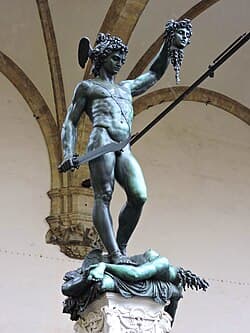
The years that followed were the most productive of Cellini's career. In France he completed the famous gold saltcellar for Francis I, now in the Kunsthistorisches Museum in Vienna and widely regarded as one of the greatest surviving examples of Renaissance goldsmithing. Returning to Florence in 1545, he began work on the bronze Perseus with the Head of Medusa, which still stands in the Loggia dei Lanzi on the Piazza della Signoria. The story of its difficult casting — in which, Cellini writes, he threw all his household pewter into the furnace to keep the bronze flowing — is one of the best-known passages in the Vita.
The Vita itself, written between 1558 and 1562, was not published in Cellini's lifetime. It appeared in print for the first time in Naples in 1728, was translated into English by Thomas Nugent in 1771, and became one of the foundational texts of what would eventually be called the Romantic movement. Shelley mentioned it; Goethe translated large portions of it into German; Stendhal referred to it as "the Iliad of a single soul."
The escape from Castel Sant'Angelo has also had an afterlife in music: in 1838, Hector Berlioz composed an opera titled Benvenuto Cellini, based loosely on the Vita, with a libretto by Léon de Wailly and Auguste Barbier. The opera was a failure at its premiere in Paris but has been revived in the modern repertoire.
Cellini's traces today
Four sites in Italy carry his memory directly:
- Castel Sant'Angelo, the Historic Prisons. The cell traditionally identified as Cellini's, and the drawing of the risen Christ protected behind glass, are both visible on the standard visit, on the second level of the castle. The route also passes the San Giovanni bastion from which the escape was made.
- The Bargello, Florence. The Museo Nazionale del Bargello holds the single greatest collection of Cellini's work: the bronze bust of Cosimo I, the Narcissus, the Apollo and Hyacinth, and the small preparatory bronzes for the Perseus.
- Loggia dei Lanzi, Piazza della Signoria, Florence. The Perseus with the Head of Medusa, Cellini's greatest sculpture, still stands in the open air on the Piazza della Signoria where it was installed in 1554.
- Kunsthistorisches Museum, Vienna. The gold saltcellar of Francis I, the finest surviving object Cellini ever made, is held in the museum's Kunstkammer.