Castel Sant'Angelo: a complete guide to the castle
Six levels from Hadrian's mausoleum (139 AD) to the Angel's Terrace, papal apartments, historic prisons, the Passetto di Borgo, and one of the widest panoramic views of Rome. Verified against the official floor plan of the Direzione Musei Nazionali di Roma.
Three ways to explore
Floor plan
All 31 named rooms across the six levels, with the official colour code, numbering, and access notes.
Open the floor plan →Highlights
Editor's room-by-room walkthrough with the must-see rooms, recommended itinerary (45/90 min/3 hs), and what most visitors miss.
See the highlights →Historical timeline
The official 24-milestone chronology of the castle from Hadrian's ashes (139 AD) to the National Museum (1925).
See the timeline →Featured rooms
Each room of the castle has its own story, its own decoration and its own place in the visiting route. We are publishing dedicated pages for the rooms most visitors ask about — starting with the most decorated of them all.
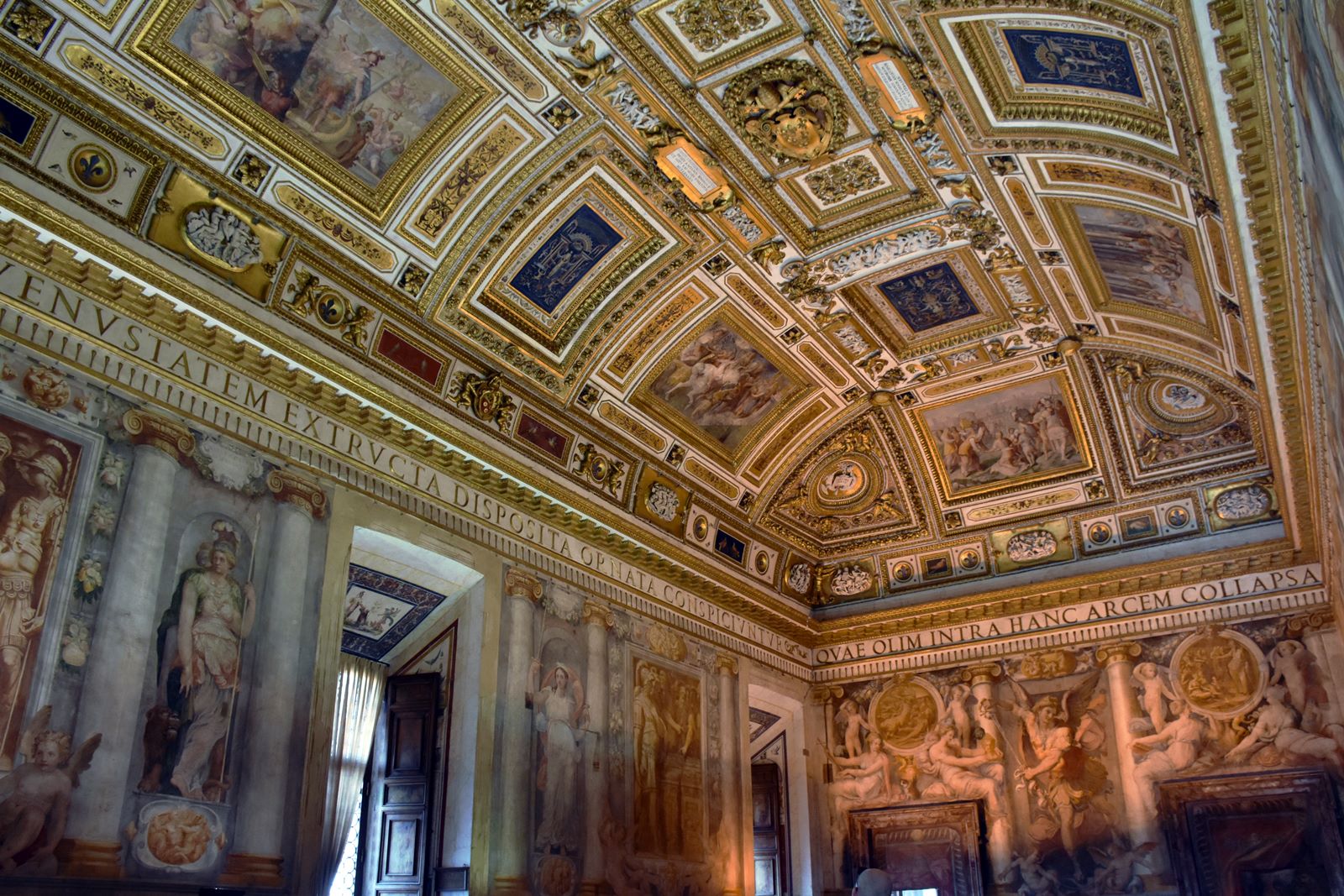
Level 2 · Papal apartments
The Sala Paolina
The grand audience hall of Pope Paul III. Frescoed 1545–1547 by Perin del Vaga, with the famous trompe-l'œil door by Pellegrino Tibaldi.
Read about the Sala Paolina →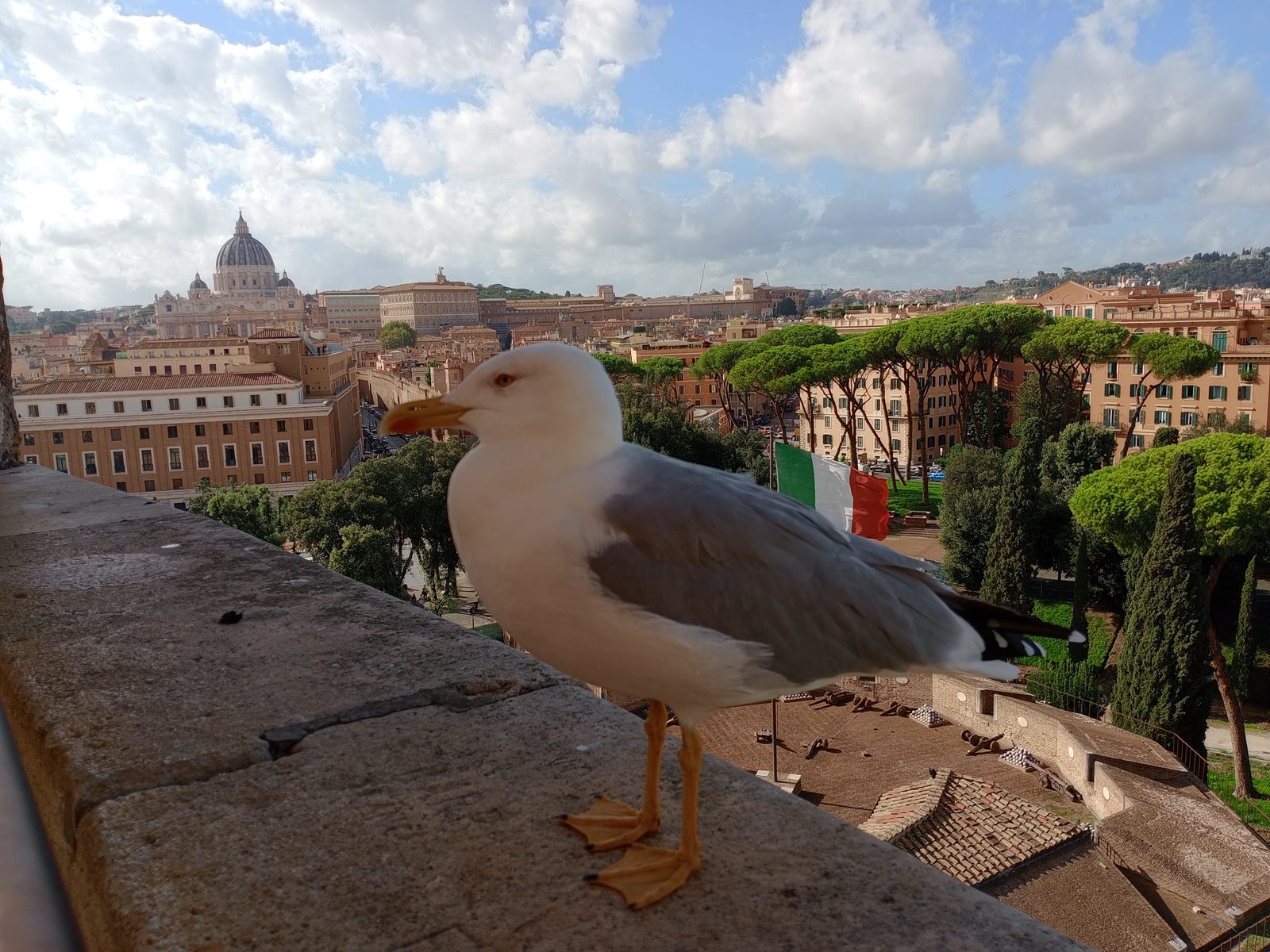
Level 4 · Open-air terrace
Terrazza dell'Angelo
The roof of the castle. Verschaffelt's bronze archangel (1752), 360° views of Rome and the setting of Tosca's leap.
Read about the Terrazza →The most layered building in Rome
Few buildings in Rome have lived as many lives as Castel Sant'Angelo. What began in 139 AD as the imperial mausoleum of Emperor Hadrian has been, in turn, a Roman fortress, a medieval stronghold, a Renaissance papal residence, a feared prison, a military barracks, and finally a national museum. Its cylindrical core, raised on the right bank of the Tiber just downstream from St Peter's, still preserves the original Roman concrete of Hadrian's tomb beneath the later layers of stone.
Visitors today move through six levels connected by the original Roman helical ramp — one of the oldest architectural elements preserved in the building — climbing from the ancient funerary chambers up to the open-air Terrazza dell'Angelo, crowned by Peter Anton Verschaffelt's bronze archangel (1752). On the way, the route passes through the richly frescoed papal apartments of the Borgias and the Farnese, the arms collection, the prisons where Beatrice Cenci, Benvenuto Cellini, and Alessandro Cagliostro were once held, and the ramparts from which the castle was defended during the Sack of Rome in 1527.
Above the city's rooftops, the terrace offers one of the widest and most immediate panoramas of Rome: St Peter's dome to the west, the medieval roofline of the Borgo below, and the Tiber curving southward across Ponte Sant'Angelo toward the historic centre. The available tours range from a self-guided entry with audio app to small-group guided experiences, and a select group includes access to the Passetto di Borgo — the 800-metre elevated passageway that once linked the castle to the Vatican.
The six levels at a glance
The official visitor route, set by the Direzione Musei Nazionali di Roma, follows a logical ascent from the entrance hall to the terrace. Each level tells a different chapter of the castle's history. For the complete room-by-room layout including the 31 named rooms, see the full floor plan.
Ground level: entrance and the helical ramp
The entrance level, occupying the original Roman core. The Roman entrance corridor (Dromos), the helical ramp climbing through the cylinder, and Hadrian's burial chamber (Sala delle Urne) are all on this floor. The walls still show original Roman concrete and brickwork.
See all rooms on this level →Medieval halls and the Cortile dell’Angelo
The medieval level, where the building's transition from imperial tomb to papal fortress becomes visible. The Cortile dell'Angelo — named after the marble Archangel Michael by Raffaello da Montelupo (1544) — sits at the heart. The lower armoury, the Sala della Giustizia (where papal sentences were pronounced), and several Clemente VIII halls open onto the courtyard.
See all rooms on this level →Renaissance papal residence
The most decorated level. The Sala Paolina, frescoed by Perin del Vaga's team between 1545 and 1547, is the centrepiece — the most lavish Renaissance interior in the castle. Adjoining rooms (Perseo, Amore e Psiche, Pompeian Corridor) extend the cycle. The Cortile di Alessandro VI Borgia, the upper armoury, and Bramante's Loggia di Giulio II facing the river complete the level.
See all rooms on this level →Library, treasury and the Cagliostra cell
The papal library and treasury level. The Sala della Biblioteca was the great library of the popes. Adjoining it, the Cagliostra — the cell where the alchemist Cagliostro was imprisoned in 1789 — takes its name from him. The Sala del Tesoro housed the Vatican treasury and the Archivio Segreto Pontificio (Secret Vatican Archives) from the mid-15th century.
See all rooms on this level →Panoramic terrace beneath the bronze Angel
The summit and the climax of the visit. The Sala della Rotonda was the medieval chapel of the Archangel Michael. The Sala delle Colonne, decorated by Duilio Cambellotti, leads onto the Terrazza dell'Angelo — directly beneath the bronze Angel sculpted by Peter Anton Verschaffelt in 1752. The terrace was the stage for the famous Girandole pyrotechnic spectacles and offers one of the great panoramas of Rome.
See all rooms on this level →The pentagonal Renaissance fortifications
The outer pentagonal walls, built between 1492 and 1561 under successive popes. The walking route follows the parapets between four corner bastions named after the Evangelists — San Marco, San Luca, San Matteo, and San Giovanni. The Passetto di Borgo, the elevated corridor connecting the castle to the Vatican Palace, departs from this level.
See all rooms on this level →Recommended route through the castle
A full visit takes 90 minutes to two hours. The official short route highlights the essential rooms in the following sequence:
- The Helical Ramp (Rampa Elicoidale) on Livello 0 — the original Roman access passage that still structures the visit today.
- The Sala delle Urne on Livello 0 — Hadrian's original burial chamber at the heart of the mausoleum.
- The Cortile dell'Angelo on Livello 1 — the open courtyard with Raffaello da Montelupo's marble Archangel (1544).
- The historic prisons on Livello 2 — the cells of Beatrice Cenci and Cellini.
- The Sala Paolina on Livello 2 — the most spectacular fresco cycle in the castle, by Perin del Vaga (1545–47).
- The papal apartments and the Cagliostra cell on Livello 3 — where Count Cagliostro was imprisoned in 1789.
- The Terrazza dell'Angelo on Livello 4 — the summit, with Verschaffelt's bronze angel and the panorama over Rome.
- The Passetto di Borgo from Livello Bastioni (when included in the ticket) — the 800-metre escape corridor to the Vatican.
For more detail and the editor's recommendations on what most visitors miss, see our highlights guide.
Frequently asked questions
How many levels does Castel Sant'Angelo have?▾
How long does a full visit take?▾
What is the most important room in the castle?▾
Where is Hadrian's tomb inside the castle?▾
Where were the historic prisons located?▾
Is the Passetto di Borgo accessible?▾
Is the castle accessible by elevator?▾
Plan your visit
To make the most of Castel Sant'Angelo, arrive with a clear plan. Opening hours, ticket options, accessibility, and walking routes are covered in the practical section of this site.
Sources and editorial method
The numbering, naming, and layout of the rooms on this page follow the official visitors' floor plan distributed by the Direzione Musei Nazionali di Romaat the entrance of Castel Sant'Angelo. Historical context has been cross-checked against the official dmnrm brochure Visita al Castello, the Italian Ministry of Culture archives, CoopCulture interpretive materials, and the long-form stories on this site (each linked from the relevant room or person).
Edited by Gabriel — Google Local Guide Level 8, with on-site visits to Castel Sant'Angelo in 2025 and 2026.