Castel Sant'Angelo

Things to do near Castel Sant'Angelo

Three half-day walking routes from the castle, with seven nearby highlights verified on the ground. Pair Castel Sant'Angelo with the Pantheon, with St Peter's, or with the historic centre at sunset.

Quick answer

Castel Sant'Angelo sits between the Vatican to the west and the historic centre to the east. The most natural pairings are the Pantheon (12 min walk through Centro Storico), St Peter's Basilica (12 min along Via della Conciliazione), or Piazza Navona (8 min). Skip the Vatican Museums, the Coliseum and Trastevere on the same day — each needs its own afternoon.

Three half-day routes

Most travellers spend 90 minutes to two hours inside the castle, then have a half day free. The three routes below are the most common and well-balanced pairings, in order of how often we recommend them.

EDITOR'S ROUTEA

The east bank route

From the castle, across the Tiber, to the Pantheon

Duration
Half day (3–4 hours)
Best for
Travellers visiting Castel Sant’Angelo as their first major Rome sight, with the rest of the afternoon free.

This is the most natural pairing for the castle: cross Ponte Sant'Angelo, eat near the bridge, then walk fifteen minutes through the Centro Storico to the Pantheon. The whole route is under a kilometre of walking and links three of Rome's most iconic monuments without crossing any major roads.

The route, in order:

  1. 1Castel Sant'Angelo (90 min–2 hours inside)
  2. 2Ponte Sant'Angelo (10–15 min crossing)
  3. 3Lunch on Lungotevere Castello or Via del Banco di Santo Spirito
  4. 4Walk through Via dei Coronari (10 min)
  5. 5Pantheon and Piazza della Rotonda (45 min)
Editor's note

This is the route we walked on our visit. We were inside the castle from 14:09 to 15:53, paused for lunch at Biblio Bar Roma on the Tiber embankment, then reached the Pantheon by 16:55 — in time to see the late afternoon light hitting the obelisk on Piazza della Rotonda. Total walking time, end to end: about 25 minutes spread across the afternoon.
PAPAL ROMEB

The Vatican route

From the castle to St Peter's Basilica

Duration
Half day (3–4 hours)
Best for
Travellers prioritising religious and historical sights over Roman ones, or those who want to see St Peter’s without committing a full day to the Vatican Museums.

A direct twelve-minute walk along Via della Conciliazione takes you from the castle to St Peter's Square, with the dome growing larger at every step. Skip the Vatican Museums on this day — they need a half day on their own and would push the total walk over six hours. The basilica alone, with the Pietà, the bronze baldacchino, and the optional dome climb, is enough for a full afternoon.

The route, in order:

  1. 1Castel Sant'Angelo (90 min–2 hours inside)
  2. 2Ponte Sant'Angelo or Via della Conciliazione (10 min walk)
  3. 3Optional detour through Borgo Pio (15 min)
  4. 4St Peter's Square (30 min)
  5. 5St Peter's Basilica (90 min–2 hours)
FOR SUNSETC

The historic centre loop

A reverse route, from the Pantheon to the castle

Duration
Half day (3–4 hours)
Best for
Travellers who started their day around the Trevi Fountain or Spanish Steps and want to end with Castel Sant’Angelo at sunset.

The same monuments as Route A, walked in reverse. This works particularly well if you want to see the castle at sunset — the terrace view of St Peter’s in late-afternoon light is one of the best panoramas in Rome. Mind the last entry time (typically 18:30) and arrive at the ticket office no later than 18:00.

The route, in order:

  1. 1Pantheon (45 min)
  2. 2Piazza Navona (20–30 min)
  3. 3Walk through Via dei Coronari (10 min)
  4. 4Ponte Sant'Angelo at golden hour
  5. 5Castel Sant'Angelo (last entry usually 18:30)

Nearby highlights

Seven attractions within walking distance — details, hours, and prices verified for April 28, 2026.

AT THE DOORSTEP

Ponte Sant'Angelo

Ancient pedestrian bridge·1 min walk · Directly in front of the castle entrance

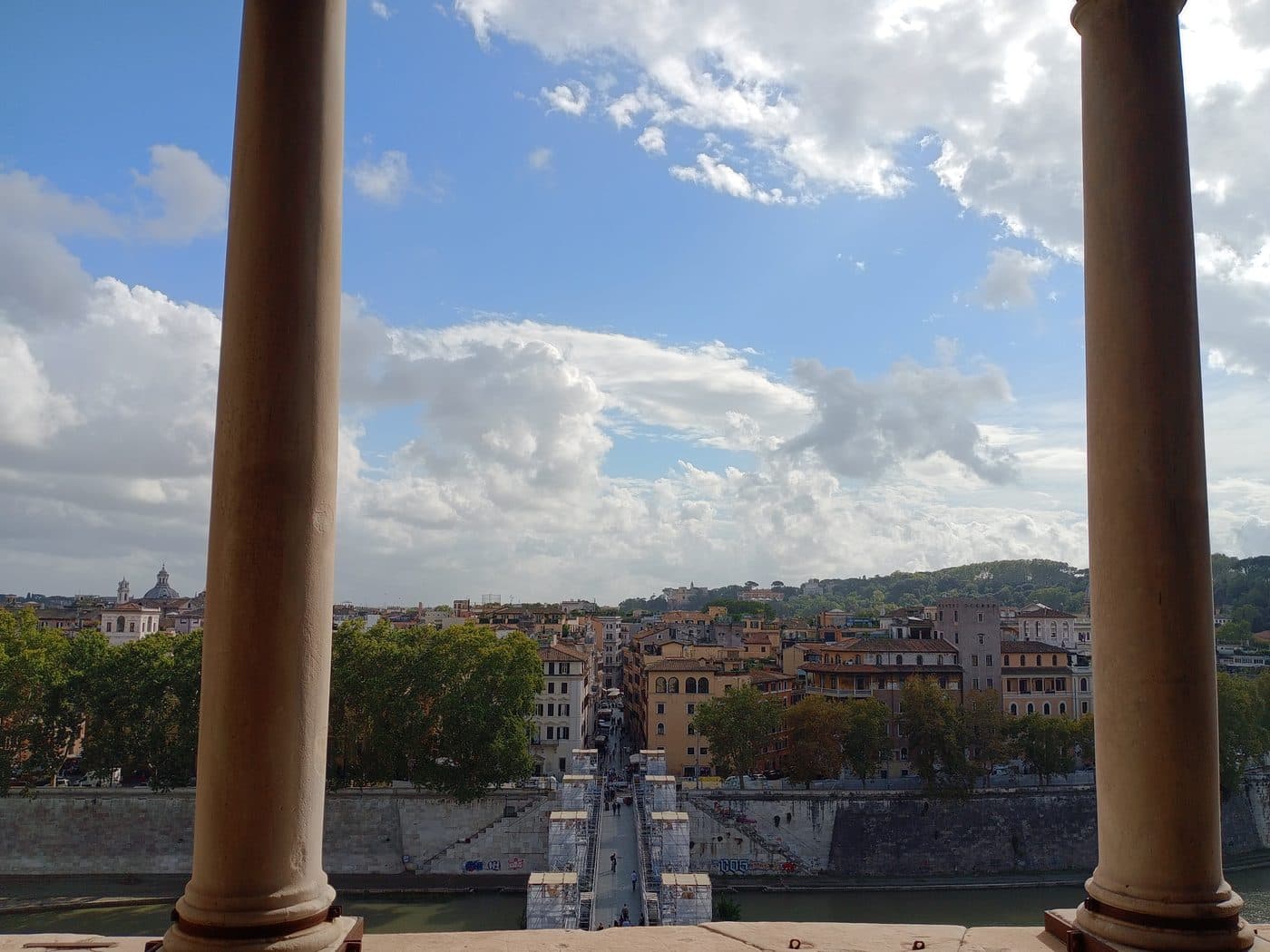
The bridge that has framed the approach to the castle since 134 AD. Built by Emperor Hadrian to connect the city centre with his mausoleum, it kept its central three Roman arches and gained ten Baroque angel statues designed by Gian Lorenzo Bernini in 1669, each holding an instrument of the Passion. Bernini personally sculpted only two of the originals — the Angel with the Superscription and the Angel with the Crown of Thorns — which were considered too beautiful to leave outdoors and now sit in the church of Sant'Andrea delle Fratte. The replacements on the bridge are by his pupils. Pedestrian-only and free, the bridge offers the most photographed view of Castel Sant'Angelo. The full restoration completed for the 2025 Jubilee left the travertine looking close to its 19th-century state.

Ponte Sant'Angelo seen from inside Castel Sant'Angelo, framed between the columns of the Loggia di Giulio II, with the bridge under restoration scaffolding for the 2025 Jubilee
Ponte Sant’Angelo seen from inside the castle, framed by the columns of the Loggia di Giulio II. The bridge was under full restoration for the 2025 Jubilee at the time of our visit. · Photo by Gabriel G, 2025
Visit duration
15–20 minutes
Entry price
Free
Category
Bridge

Practical: Pedestrian-only · No tickets needed · Open 24 hours · Best light at sunset and after dark when illuminated.

View on Google Maps →
VATICAN

St Peter's Basilica

Papal basilica & Vatican square·12 min walk · 12 minutes along Via della Conciliazione

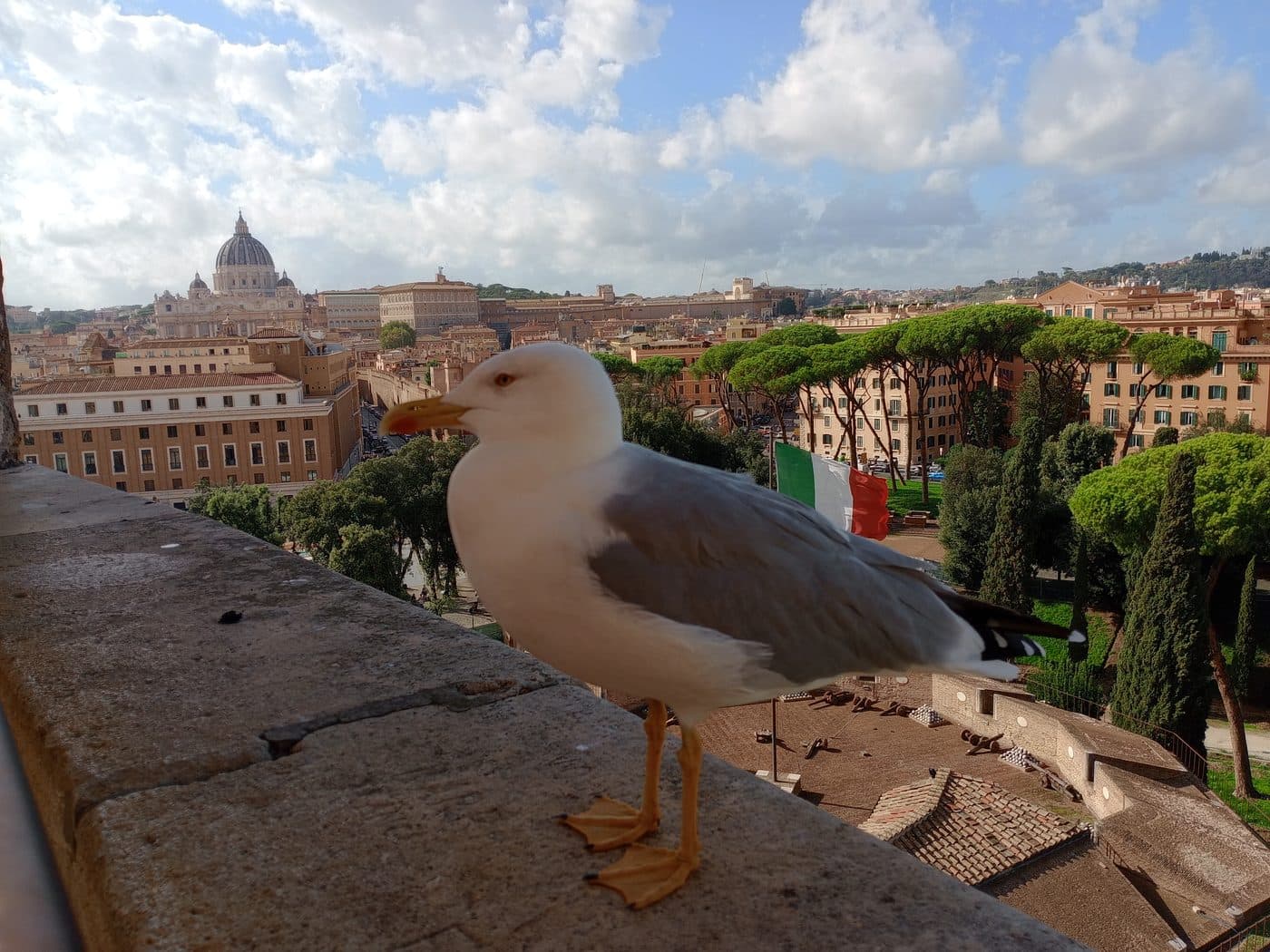
The largest church in the world and the spiritual heart of Catholicism, designed across more than a century by Bramante, Michelangelo, Maderno and Bernini. The basilica is free to enter, but expect a 30 to 90-minute security queue at peak hours. Inside: Michelangelo's Pietà (1499) is on the right as you enter, behind glass since the 1972 attack; Bernini's bronze baldacchino sits above the papal altar; the papal tombs are in the Vatican Grottoes below. The dome climb (extra ticket) gives the best aerial view of Rome short of a helicopter. The basilica alone takes a full afternoon — leave the Vatican Museums for a separate day.

Yellow-legged gull on the parapet of Castel Sant'Angelo with the dome of St Peter's Basilica and the Italian flag visible behind, photographed from the upper terrace
St Peter’s Basilica from the terrace of Castel Sant’Angelo — the closest panoramic view of the Vatican that doesn’t require entering it. · Photo by Gabriel G, 2025
Six-second pan from the castle terrace toward St Peter’s. · Video by Gabriel G, 2025
Visit duration
2–3 hours
Entry price
Free (basilica) / €8–10 (dome)
Category
Monument

Practical: Basilica free · Dome climb €8 stairs / €10 with elevator · Open daily 7:00 AM–7:00 PM (winter until 6:30 PM) · Modest dress required (covered shoulders and knees) · Tight security — no large bags.

View on Google Maps →
MUST-SEE

Pantheon

Ancient Roman temple & church·12 min walk · 12 minutes through the historic centre

The best-preserved building from ancient Rome, completed under Emperor Hadrian around 126 AD on the site of an earlier temple by Marcus Agrippa (whose inscription remains on the pediment). The dome is still the world's largest unreinforced concrete dome — a feat that took nineteen centuries to surpass. The oculus, the 9-metre opening at the dome's centre, is the only source of natural light and remains open to the sky in all weather; on rainy days, the slightly convex floor channels water through 22 small drains. Converted to a Christian church in 609 AD, which is what saved it from the systematic stripping that destroyed most other Roman monuments. The square outside, Piazza della Rotonda, has a fountain by Giacomo della Porta (1575) topped by an Egyptian obelisk added in 1711.

Visit duration
30–45 minutes
Entry price
€5
Category
Monument

Practical: €5 entry (free for EU residents under 18 and over 65) · Open Mon–Sat 9:00 AM–7:00 PM, Sun 9:00 AM–6:00 PM · Free admission during Sunday mass · Booking online recommended to skip the queue.

View on Google Maps →
BAROQUE ROME

Piazza Navona

Baroque square·8 min walk · 8 minutes through Via dei Coronari

Rome's most theatrical square, built on the foundations of Domitian's Stadium from 86 AD — the elongated oval shape preserves the original racetrack outline. Three fountains anchor the piazza: Bernini's Fountain of the Four Rivers (1651) at the centre, with personifications of the Nile, Danube, Ganges and Río de la Plata around an Egyptian obelisk; the Fountain of the Moor (Della Porta, modified by Bernini) at the south end; and the Fountain of Neptune at the north end. The Baroque church of Sant'Agnese in Agone, by Bernini's rival Borromini, faces the central fountain. Free to walk through, lively at all hours, packed with street artists, restaurants, and the predictable tourist crowd. The walk to Piazza Navona from the castle takes you through Via dei Coronari, one of the prettiest pedestrian streets in central Rome.

Visit duration
20–30 minutes
Entry price
Free
Category
Square

Practical: Open square, no tickets · Best in the early morning before crowds, or after dark when the fountains are lit · Restaurants on the square charge a heavy premium for the location.

View on Google Maps →
CAFE VIEWS

Piazza della Rotonda

The Pantheon's square·12 min walk · 12 minutes (in front of the Pantheon)

The square that frames the Pantheon, named for the temple's circular shape. The fountain at its centre, designed by Giacomo della Porta in 1575, was modified in 1711 by Pope Clement XI to support an Egyptian obelisk — the Macuteo obelisk, originally from the Iseum Campense in Rome — which still tops it today. The piazza is one of the few places in central Rome where you can sit at a cafe and watch one of the great Roman monuments without paying museum prices, although the cafes themselves charge a steep premium for the view. Worth pausing here for the perspective the square offers on the Pantheon's portico, which most visitors miss while rushing inside.

Visit duration
10–15 minutes
Entry price
Free
Category
Square

Practical: Open square · No tickets · Best in the late afternoon when the Pantheon facade catches warm light · Cafes on the square are tourist-priced — walk one block away for normal Roman cafe prices.

View on Google Maps →
POSTCARD VIEW

Ponte Vittorio Emanuele II

Belle Époque bridge·5 min walk · 5 minutes south along the Tiber

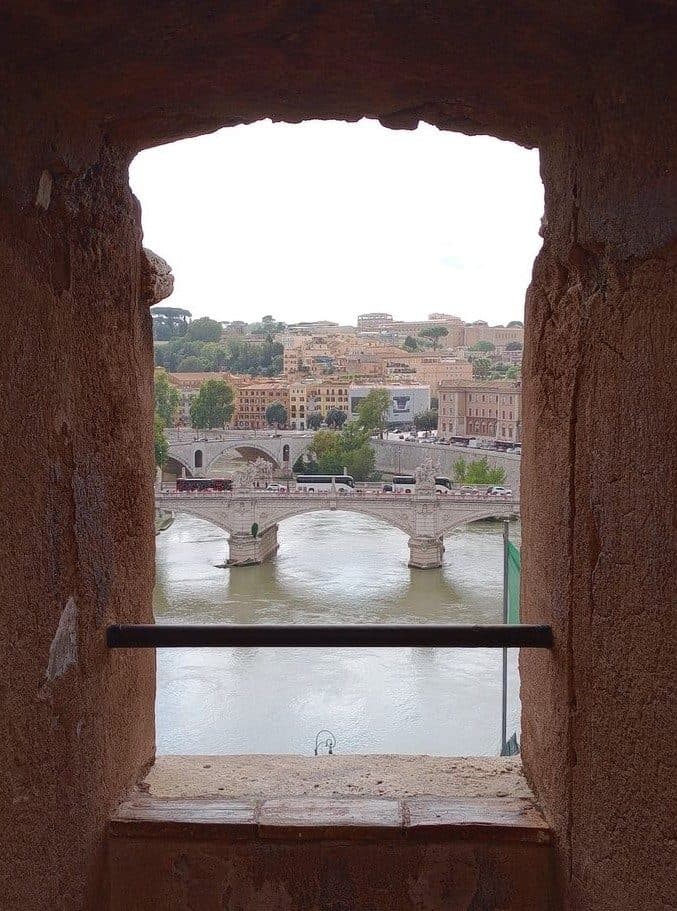
Inaugurated in 1911 to mark the 50th anniversary of Italian unification, this is the bridge most photographers use to capture the classic postcard shot: Castel Sant'Angelo in the foreground, the dome of St Peter's rising behind it. Three travertine arches, large winged Victories at each end, and bronze sculptural groups representing the political virtues of the Italian state. The bridge appears in dozens of films set in Rome, most famously in Roman Holiday (1953). Worth the short detour from Ponte Sant'Angelo for the angle alone.

Ponte Vittorio Emanuele II seen from a stone embrasure in the Bastioni of Castel Sant'Angelo, with the Tiber river and the Janiculum hill visible beyond
Ponte Vittorio Emanuele II framed by one of the embrasures in the castle’s Renaissance Bastioni — a perspective only visible from inside the fortress. · Photo by Gabriel G, 2025
Visit duration
10–15 minutes
Entry price
Free
Category
Bridge

Practical: Pedestrian and vehicle bridge · Sidewalks on both sides · Best photo angle from the south side, looking north toward the castle.

View on Google Maps →
OFF THE MAIN ROUTE

Borgo Pio

Pedestrian Vatican neighbourhood·7 min walk · 7 minutes toward the Vatican

The most evocative pedestrian street between the castle and the Vatican, lined with low ochre buildings, small trattorias, religious supply shops, and the kind of traffic-free quiet that disappeared from most of central Rome decades ago. Walking Borgo Pio is the slow way to reach St Peter's from Castel Sant'Angelo — it adds maybe ten minutes versus the direct route along Via della Conciliazione, and it shows you a side of papal Rome that the wider boulevard erased. Two of our recommended restaurants (Borghiciana and Rione XIV Bistrot) sit on this street.

Visit duration
20–30 minutes
Entry price
Free
Category
Neighbourhood

Practical: Pedestrian-only · Best mid-morning or early evening for the local atmosphere · Avoid Sundays when many shops close.

View on Google Maps →

What needs its own day

Three places that travellers often try to combine with Castel Sant'Angelo but really shouldn't. Each one is enough for a full afternoon on its own, and pairing them with the castle means rushing both.

  • Vatican Museums and Sistine Chapel. The museums alone need three to four hours, plus a security and ticket queue that can run another ninety minutes at peak season. Combining them with St Peter's Basilica already fills a full day; adding the castle is unrealistic.
  • The Coliseum and Roman Forum. A 25-minute walk from Castel Sant'Angelo, but the visit itself takes three hours minimum (Coliseum, Forum, Palatine Hill share a single ticket). Plan a separate morning.
  • Trastevere in the evening. Trastevere is at its best after dark, when the restaurants fill and the alleys come alive. Pairing it with a castle visit means either rushing the castle or arriving at Trastevere exhausted. Better as a standalone evening.

Pair the castle with a guided tour

A guided visit of Castel Sant'Angelo before lunch leaves the rest of the afternoon free for any of the three routes above. We list fifteen tours with verified ratings and prices, ordered by review-weighted score.

Browse all tours and tickets →

Frequently asked questions

What can I do near Castel Sant'Angelo in two hours?
Two hours after leaving the castle is enough time to cross Ponte Sant'Angelo, walk fifteen minutes to the Pantheon (with a quick stop at Piazza Navona along the way), spend half an hour inside the Pantheon, and return. If you prefer the Vatican direction, two hours covers a walk through Borgo Pio to St Peter's Square — but not the basilica itself, which needs at least 90 minutes inside.
Is the Vatican walking distance from Castel Sant'Angelo?
Yes. St Peter's Square is a twelve-minute walk along Via della Conciliazione, the wide boulevard that runs straight from the castle to the Vatican. The Vatican Museums entrance, however, is fifteen to twenty minutes on foot around the Vatican walls and is best treated as a separate visit.
Should I visit the Pantheon before or after Castel Sant'Angelo?
Either order works, but afternoon at the castle and late afternoon at the Pantheon is the most rewarding sequence: the castle's terrace catches the best light from 14:00 onwards, and the Pantheon at golden hour, with sunlight angling through the oculus, is one of the most evocative experiences in Rome. If you start at the Pantheon, plan to reach Castel Sant'Angelo no later than 16:30 to allow at least 90 minutes inside before the last entry. See our castle highlights guide for what to prioritise inside.
Can I walk from Castel Sant'Angelo to the Trevi Fountain?
Yes — it is about a 20-minute walk through the Centro Storico, passing close to Piazza Navona and the Pantheon. The Trevi Fountain is best paired with the historic centre route (Route C above) rather than treated as a direct extension of the castle visit, because the walk goes through the most crowded part of central Rome.
Where can I eat near Castel Sant'Angelo?
We curate seven options on our restaurants page, covering casual lunches, classic Roman trattorias, and standout dining — all within an eight-minute walk of the castle. Our editor’s pick is Biblio Bar Roma, a cafe-and-cocktail bar on the Tiber embankment with an outdoor library and a direct view of the castle walls.
What is the best photo spot near Castel Sant'Angelo?
Three options. Ponte Sant'Angelo itself, looking back at the castle, is the most iconic but also the most crowded. Ponte Vittorio Emanuele II, five minutes south along the Tiber, gives you the postcard angle with St Peter's dome rising behind the castle. For the cleanest shot, the Tiber embankment between the two bridges (Lungotevere Castello) lets you frame the castle without bridge railings in the foreground. All three are best at sunset or just after dark, when the castle is illuminated.
Is Trastevere walking distance from Castel Sant'Angelo?
Trastevere is technically walkable — about 25 minutes through Centro Storico and across Ponte Sisto — but it is best treated as a separate evening rather than an extension of a castle visit. The neighbourhood comes alive after dark, with most travellers arriving for dinner around 20:00 and staying for a long evening of restaurants and bars. Pairing it with Castel Sant'Angelo on the same day means rushing both.
Should I take a Tiber boat tour after visiting Castel Sant'Angelo?
It pairs well, although we did the boat tour on a separate day rather than combining it with the castle. The standard one-hour Tiber cruises depart from the embankment near Ponte Sant'Angelo and offer the only river-level view of the castle's cylindrical mass — a perspective Hadrian's architects designed into the original mausoleum. Recommended timing: a 16:00 boat after a midday castle visit, ending with sunset over the river.

How we built this guide

The three routes on this page reflect the most common ways travellers pair Castel Sant'Angelo with other Rome sights, ordered by how often we recommend them. Walking times are measured on Google Maps from the castle's main entrance and verified on foot. Entry prices and opening hours are cross-checked against each monument's official website. The editor's note on Route A reflects an actual visit on a specific afternoon, with the times taken from photo timestamps rather than estimates.

Edited by Gabriel — Google Local Guide Level 8, with on-site visits to Rome in 2025 and 2026.

Last verified: April 28, 2026.