Ponte Sant'Angelo: 1,900 years of the Bridge of Angels
From Hadrian's Roman bridge in 134 AD to Bernini's Baroque masterpiece, the 1450 Jubilee tragedy, Cellini firing cannons from the castle, papal executions, and the 2025 restoration — the complete history of the bridge that has framed Castel Sant'Angelo for nineteen centuries.
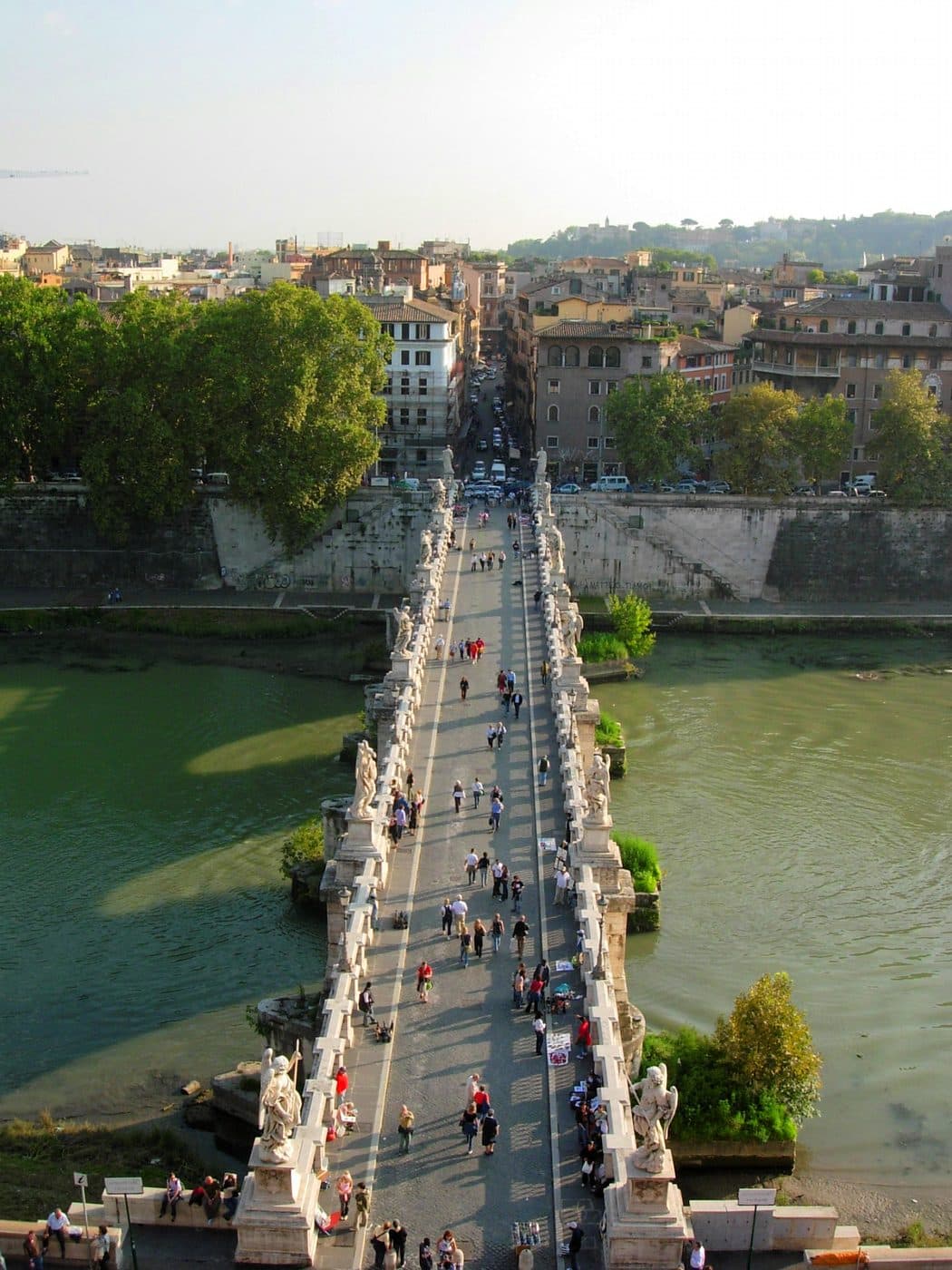
The bridge that came before the castle
In 134 AD, Emperor Publius Aelius Hadrianus — better known as Hadrian — completed a new bridge across the Tiber. Its purpose was specific: to provide monumental access to the mausoleum he was building on the river's right bank, a massive cylindrical tomb intended for himself and his successors.
The bridge was originally called Pons Aelius, after Hadrian's family name. It had five arches, three of which still survive. The travertine marble facing, the proportions, and the engineering were designed to match the scale of the mausoleum across the river. The two structures were built as a single architectural ensemble.
When Hadrian died in 138 AD, his ashes were placed inside the mausoleum, followed by those of his wife, his successor Antoninus Pius, and a long list of emperors through Caracalla. The bridge was the only formal approach. For most of the next four centuries, it was simply the bridge to the imperial tomb.
Roman engineering: how the bridge was built
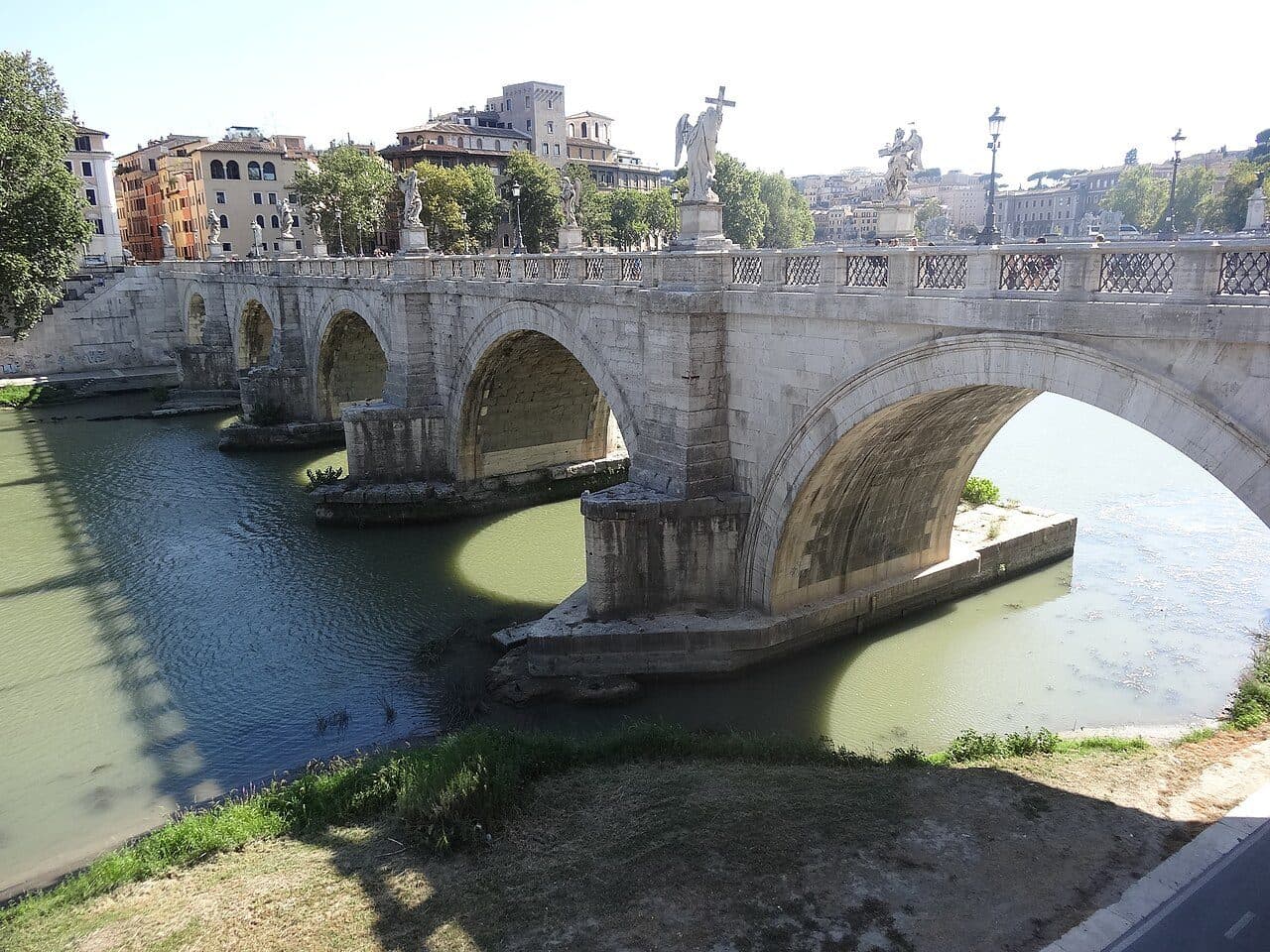
Building a bridge across the Tiber in the second century was a substantial engineering challenge. The river is wide at this point, the current strong, and the bed soft. Roman engineers solved the problem with a technique they had perfected over the previous two centuries: the cofferdam.
For each pier, workers drove a ring of long oak piles into the riverbed and packed the gaps with clay until the enclosure became watertight. The water inside was then bailed or pumped out, leaving a dry workspace at the bottom of the river. The pier was built from the riverbed up using opus caementicium (Roman concrete made with volcanic ash), faced with rectangular travertine blocks. When complete, the cofferdam was dismantled and the river closed around the new pier.
The five-arch span used semicircular arches, the standard Roman geometry, with the three central arches taking the deepest section of the river. Each arch was built over a wooden centring frame that supported the voussoirs (wedge-shaped stones) until the keystone locked them in place. The frames were then removed and reused for the next arch.
What you cross today is in part exactly what Hadrian's engineers built. The three central arches are original Roman work, with the travertine facing still in place. The two end arches were rebuilt in the late 19th century, when the construction of the Lungotevere embankments forced changes to the bridge's approaches. The new arches were designed to match the Roman ones, but to a trained eye the masonry differs.
From Bridge of Saint Peter to Bridge of Angels
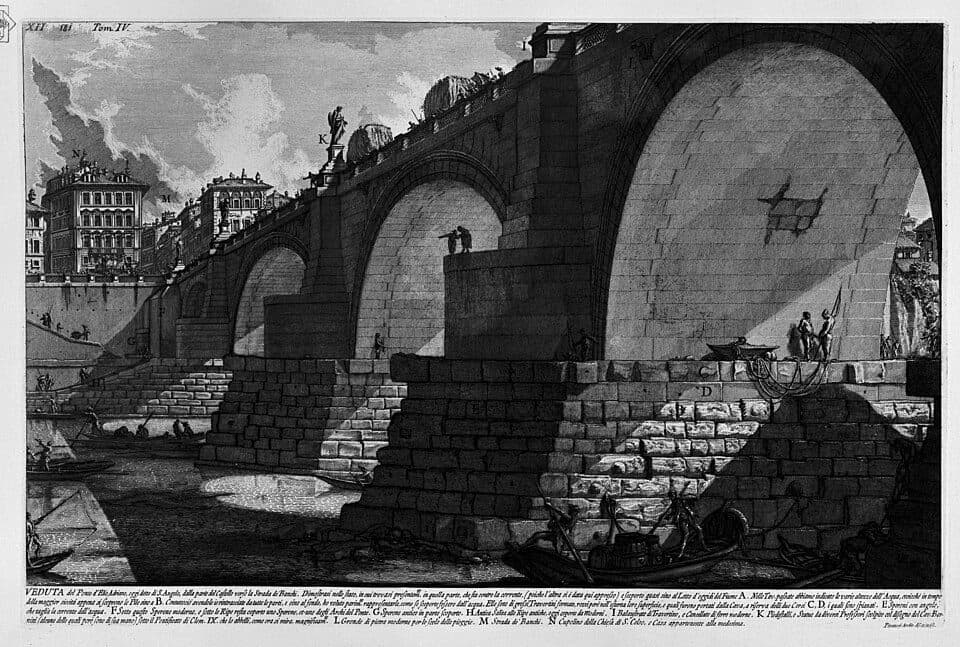
By the early Middle Ages, the original Roman name had been forgotten. After the collapse of Nero's nearby bridge, pilgrims travelling to St Peter's Basilica were forced to use the Pons Aelius. It became known as the pons Sancti Petri — the Bridge of Saint Peter.
The current name comes from a 6th-century event. In 590 AD, Rome was devastated by a plague. Pope Gregory I led a penitential procession through the city, praying for the plague to end. According to tradition, as the procession crossed the bridge, the pope saw the Archangel Michael appear on top of the old mausoleum, sheathing his sword to signal divine forgiveness. The plague ended. The mausoleum and the bridge both took the name Sant'Angelo.
Whether or not the vision happened, the renaming was permanent. By the medieval period, both structures were known as Sant'Angelo, and the bridge had become a spiritual route as well as a physical one.
The bridge today, seen from inside the castle
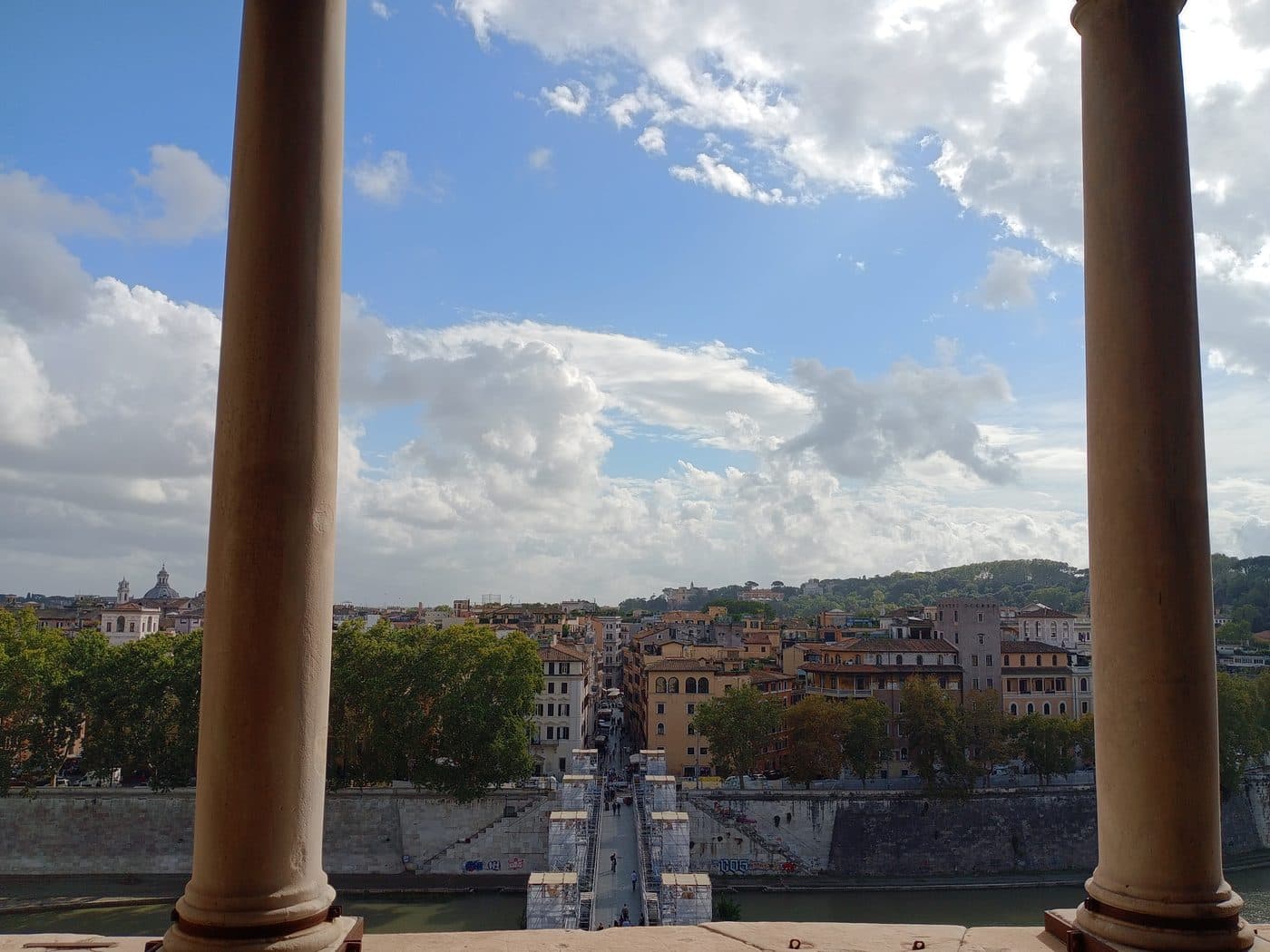
When we visited in late 2025, the bridge was almost entirely covered by white restoration scaffolding. From the upper terraces of Castel Sant'Angelo, the view along the bridge axis — one of the most famous in Rome — was framed instead by builders' canvases and metal frames. The work was part of the extensive preparation for the 2025 Jubilee, the Holy Year that brings several million additional pilgrims to Rome.
The restoration cleaned the travertine of more than a century of pollution and reinforced the structure where the river had eroded it. The angel statues were restored individually. By the time the Holy Year opened in December 2024, the bridge had been returned to something close to its 19th-century appearance, with the travertine bright and the Baroque angels readable again.
The 1450 tragedy
The bridge has not always been kind to its pilgrims. The Jubilee of 1450 was one of the largest in medieval history, drawing tens of thousands of pilgrims to Rome to visit the tombs of the apostles. The narrow Pons Aelius was the only bridge connecting the city to St Peter's, and on certain days it was packed shoulder to shoulder in both directions.
On 19 December 1450, according to chroniclers, a frightened horse or mule started a panic in the crowd. Pilgrims pushed against the wooden balustrades, which collapsed under the weight. Roughly two hundred people fell into the Tiber and drowned. It remains one of the worst disasters in the history of Rome's pilgrim economy.
The response came from Pope Nicholas V. He ordered the construction of two small chapels at the bridge head, one dedicated to Saint Mary Magdalene and the other to the Holy Innocents. He also widened the approach by demolishing surrounding buildings, including a Roman triumphal arch that had stood there for over a thousand years.
The two chapels lasted less than a century. In 1535, Pope Clement VII replaced them with marble statues of Saints Peter and Paul, sculpted by Lorenzetto and Paolo Romano using funds raised from bridge tolls. The two apostles still stand at the bridge entrance, on the side that faces the Centro Storico.
The Sack of Rome: when Cellini fired from the castle
The bridge played a strategic role in May 1527, during the catastrophic Sack of Rome. The mutinous troops of Holy Roman Emperor Charles V — mostly unpaid German Landsknechte and Spanish soldiers — arrived at the walls of Rome on 6 May, led by Charles III, Duke of Bourbon. Pope Clement VII fled across Ponte Sant'Angelo and into the castle, using the Passetto di Borgo when the bridge itself became unsafe.
Inside the castle, defending the pope, was the Florentine goldsmith Benvenuto Cellini. In his autobiography, written decades later, Cellini described how he personally manned a cannon on the upper terrace of Castel Sant'Angelo and fired at the imperial troops crossing the bridge and gathering on the right bank. He claimed that one of his shots killed the Duke of Bourbon himself.
The Duke of Bourbon was indeed killed early in the siege by a shot from the castle walls. Whether Cellini fired the fatal round is impossible to verify — he was a famously vivid and self-aggrandising narrator — but the story has been retold for five hundred years because it sits at the intersection of three Roman icons: the bridge, the castle, and one of the most colourful artists of the Renaissance.
The siege ended with Pope Clement VII held prisoner in the castle for seven months while imperial troops pillaged Rome below. Tens of thousands of citizens died, and the Renaissance city was permanently scarred. Ponte Sant'Angelo, throughout, was the choke point between besieged and besiegers.
Bernini's ten angels
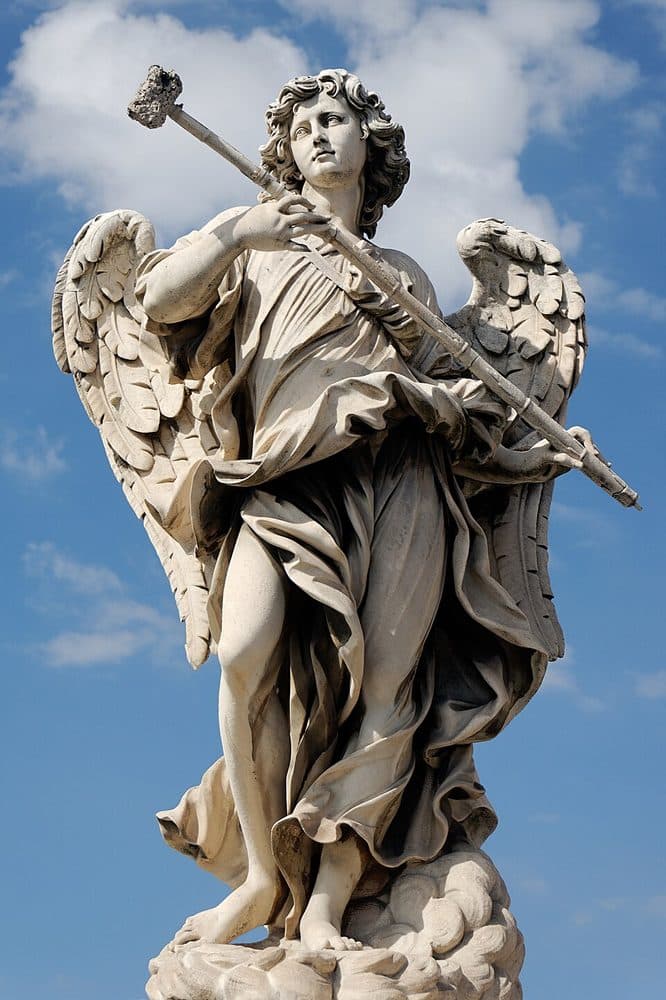
In 1667, Pope Clement IX commissioned the most ambitious sculptural intervention in the bridge's history. He asked Gian Lorenzo Bernini, then the most celebrated sculptor in Europe, to design a series of ten angels to stand on the bridge balustrades, each carrying an instrument of the Passion of Christ.
The concept was theological as much as decorative. Pilgrims walking from the city toward St Peter's would pass each instrument of the Passion in sequence — the column, the scourges, the crown of thorns, the nails, the cross, the superscription, the lance, the sponge, the sudarium, the dice. The walk became a meditation on the suffering of Christ, designed to prepare the pilgrim spiritually before reaching the basilica.
Bernini was sixty-nine years old. He designed all ten figures and supervised the project, but only carved two of the angels with his own hand: the Angel with the Crown of Thorns and the Angel with the Superscription (the inscription INRI from the cross). The remaining eight were executed by his workshop and trusted pupils, including Ercole Ferrata, Antonio Raggi, and Cosimo Fancelli.
Pope Clement IX considered the two originals carved by Bernini personally to be too beautiful to be exposed to the elements. He ordered copies to be placed on the bridge instead, and kept the originals in Bernini's studio. They remained in the family for several generations. In 1729, the Bernini heirs donated both originals to the church of Sant'Andrea delle Fratte, near Piazza di Spagna, where they have been displayed ever since on either side of the main altar.
The angels you see on Ponte Sant'Angelo today are therefore: two copies of Bernini's originals, and eight by his workshop. Visiting Sant'Andrea delle Fratte to see the originals is a natural extension of any visit to the bridge — the church is a 25-minute walk from Castel Sant'Angelo, and there is no entry fee.
Capital justice on the bridge
Alongside its spiritual function, the bridge had a darker public role. From the 16th century into the 19th, Piazza di Ponte — the small square at the bridge's eastern end — was the principal location for public executions in papal Rome. Hangings, beheadings, and quartering were carried out in public view, and the bodies were displayed on the bridge itself for hours or days afterward as a warning to the population.
The most famous of the executions held nearby was that of Beatrice Cenci, a young Roman noblewoman beheaded on 11 September 1599. Convicted of conspiring to murder her abusive father, her case became a symbol of injustice that inspired Shelley's tragedy The Cenci, Stendhal's essay Les Cenci, and Antonin Artaud's 1935 play. Local Roman tradition holds that her ghost walks Ponte Sant'Angelo every September 11, the anniversary of her execution. Read her full story.
Other notable figures executed at Piazza di Ponte include political conspirators against various popes, religious dissidents, and common criminals. The alchemist Cagliostro was imprisoned in Castel Sant'Angelo itself before being transferred elsewhere. The contrast — Bernini's angels of the Passion above, public executions below — was not lost on the chroniclers and travel writers of the time. For three centuries, Ponte Sant'Angelo was simultaneously one of the most beautiful and one of the most feared places in Rome.
Mastro Titta, the papal executioner
The longest career in the bridge's grim history of executions belonged to Giovanni Battista Bugatti, known to all of papal Rome as Mastro Titta. Between 1796 and 1864 — sixty-eight years — he carried out 514 executions, the vast majority of them on Piazza di Ponte at the eastern end of Ponte Sant'Angelo. (His diary listed 516 names, but historians subtract two: one prisoner was shot in jail before sentencing, and another was hanged and quartered by his assistant.)
The role of papal executioner came with a peculiar set of restrictions. Mastro Titta was forbidden from crossing Ponte Sant'Angelo into the city of Rome proper except on the days he was scheduled to carry out an execution. The bridge was the symbolic boundary between his role and the rest of papal society. On execution days, he wore a red cape — a colour that became, for generations of Roman families, the public signal that someone was about to die. Roman parents would tell their children, on seeing him: Mastro Titta passa il ponte — Mastro Titta is crossing the bridge.
He kept a meticulous diary of his executions for sixty years, eventually published posthumously as Memorie di un carnefice scritte da lui stesso — Memoirs of an executioner, written by himself. The diary, which historians consider one of the key documents on papal justice, lists each execution by date, name, and offence. Most were beheadings; the rest were hangings or, in serious cases, quartering.
Bugatti retired in 1864 at the age of 85, and was succeeded briefly by his assistant. Public executions in the Papal States ended in 1870, with the unification of Italy and the dissolution of papal civil authority. The red cape Mastro Titta wore is on display in Rome's Museo Criminologico.
The Spina di Borgo and the modern embankments
The bridge you see today is set in a landscape transformed by two great urban interventions, separated by sixty years.
The first was the construction of the Lungotevere embankments, launched in 1876 in response to the catastrophic Tiber flood of 1870, when water rose 17 metres above its normal level and submerged most of central Rome. The embankments raised the river walls and confined the Tiber to a fixed channel. The intervention required demolishing the original Roman ramps that connected Ponte Sant'Angelo to the riverbank, and replacing them with two new arches at each end of the bridge. The new arches were built to imitate the Roman ones, but the original 134 AD bridge was effectively shortened.
The second intervention came under the Fascist regime. In 1936, Mussolini ordered the demolition of the Spina di Borgo — the dense medieval neighbourhood between Castel Sant'Angelo and St Peter's Basilica. For more than a thousand years, pilgrims approaching the basilica from the bridge had walked through narrow streets that opened suddenly onto the colonnade of St Peter's Square, an intentional architectural surprise designed by Bernini.
Mussolini's engineers cut a wide axial boulevard — Via della Conciliazione — straight from the bridge to the basilica, demolishing dozens of buildings, two churches, and the entire fabric of the medieval Borgo. The street opened in 1950, just in time for the Holy Year. The view from Ponte Sant'Angelo of the dome of St Peter's, framed by the new boulevard, became one of the most iconic urban perspectives in Rome — but it came at the cost of erasing the historic neighbourhood that pilgrims had been walking through since the Middle Ages.
Both interventions are still controversial among historians of the city. The Lungotevere protected Rome from flooding but cut the river off from the neighbourhoods that had lived alongside it for two thousand years. Via della Conciliazione gave the world the postcard view of the Vatican but destroyed an irreplaceable medieval quarter. Ponte Sant'Angelo sits at the seam of both decisions.
Visiting Ponte Sant'Angelo today
The bridge has been pedestrian-only since the construction of the Lungotevere embankments at the end of the 19th century. It is open 24 hours a day, free to cross, and connects the Centro Storico (Ponte rione) with Borgo (Vatican rione).
Best times to visit
The bridge is busiest between 11:00 AM and 5:00 PM, when most tour groups cross between the historic centre and the Vatican. For clean photographs and a quieter experience, the early morning before 9:00 AM is the best moment. Late afternoon gives warm light on the angel statues. After dark, the bridge and the castle are illuminated and the reflection on the Tiber is one of the most photographed scenes in the city.
What to look for
- The three central arches are the original Roman structure from 134 AD. The two end arches were rebuilt in the late 19th century to match.
- The ten angels are arranged in sequence, beginning with the column and ending with the dice. Each holds an instrument of the Passion. Look for the small Latin inscriptions on each base.
- The statues of Saints Peter and Paul at the eastern entrance, holding the keys and a sword respectively, are by Lorenzetto and Paolo Romano (1535).
- The water level marks on the bridge piers record historical Tiber floods, including the catastrophic 1870 flood that triggered the construction of the Lungotevere walls.
- The view down Via della Conciliazione toward the dome of St Peter's is the result of Mussolini's 1936 demolition of the medieval Spina di Borgo.
Pair the bridge with the castle
Ponte Sant'Angelo and Castel Sant'Angelo were built as a single architectural ensemble, and the most rewarding way to experience either one is to visit both. From the upper terraces of the castle, you get the elevated view of the bridge along its axis. From the bridge itself, you get the view Hadrian's architects designed — the cylindrical mausoleum rising directly above the river.
Frequently asked questions
How old is Ponte Sant'Angelo?▾
Who designed the angels on Ponte Sant'Angelo?▾
Why is it called the Bridge of Angels?▾
Is Ponte Sant'Angelo open to the public?▾
Was the bridge restored for the 2025 Jubilee?▾
What happened on Ponte Sant'Angelo in 1450?▾
Were public executions held on Ponte Sant'Angelo?▾
Did Cellini really fire a cannon from the castle during the Sack of Rome?▾
Who was Mastro Titta?▾
Can you walk from Ponte Sant'Angelo to St Peter's Basilica?▾
Related stories
- Beatrice Cenci: the noblewoman executed near the bridge in 1599 →
- The Passetto di Borgo: secret papal escape route between the castle and the Vatican →
- The Sack of Rome 1527: when the bridge separated besieged from besiegers →
- Benvenuto Cellini's escape from the castle →
- Cagliostro: the alchemist imprisoned in Castel Sant'Angelo →
Sources and editorial method
Historical facts on this page are cross-checked against the official documentation of the Direzione Musei Nazionali di Roma (Ministero della Cultura), the Wikipedia entries for Ponte Sant'Angelo and the individual angel statues, the Kimbell Art Museum catalogue entries on Bernini's original works, the chronicles of the 1450 Jubilee tragedy preserved in the Archivio Segreto Vaticano, Cellini's autobiography La Vita, and the published diary of Mastro Titta (Memorie di un carnefice). Dates and attributions have been verified against multiple independent sources. The own photograph of the bridge under restoration was taken from inside Castel Sant'Angelo during a personal visit in 2025. Other images are from Wikimedia Commons under public domain or Creative Commons licences.
Edited by Gabriel — Google Local Guide Level 8, with on-site visits to Castel Sant'Angelo in 2025 and 2026.