Explore · Level 3
The Cagliostra
The Luxury Cell of the Inquisition — Frescoes 1545
Quick answer: The Cagliostra is a small three-room apartment on Level 3 of Castel Sant'Angelo, built in 1543 as the upper floor of the Loggia of Paul III and frescoed in 1545 by Luzio Luzi with grotesque decoration. Its open arches were walled up in the eighteenth century to convert it into a luxury cell for high-ranking prisoners. It takes its name from Count Alessandro di Cagliostro, the Italian alchemist held here by the Inquisition in 1789 for almost a year before being transferred to San Leo. Access is included in the standard museum ticket when the room is open.
The room was not built to be a prison.
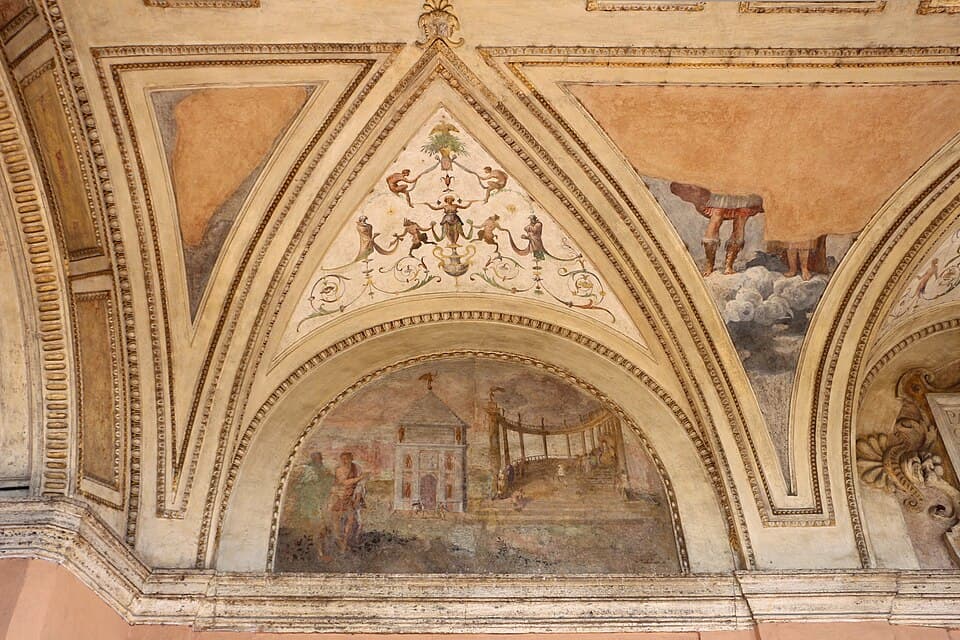
When Pope Paul III Farnese commissioned the upper levels of the castle in the 1540s, what is now the Cagliostra was an elegant covered loggia: five arches open to the north, looking out over the Borgo di Prati and the Roman countryside beyond. The walls and vault were frescoed by Luzio Luzi da Todi between 1544 and 1545, with the same grotesque-style decoration that runs through the Sala Paolina, the Library and the Hall of the Festoons.
Two centuries later the arches were bricked in. The luminous Renaissance loggia became a closed apartment of three rooms, fitted out as a discreet jail for prisoners the papal authorities did not want to put with common convicts. The frescoes stayed where they were, on the walls behind the new masonry.
That is the room Cagliostro entered on 27 December 1789, escorted by officers of the Inquisition. He stayed almost a year. The cell took his name and never lost it.
Why this room exists
Paul III had two needs that did not look obviously compatible.
He wanted a Renaissance residence on top of an old papal fortress — comfortable, decorated, dignified. He also wanted, on the same floors, the practical infrastructure of a working castle: armouries, archives, a treasury, and a place to confine high-status prisoners without parading them through the city.
The Cagliostra solved part of that second problem before it ever became a cell. The space was originally a small loggia perched above the larger Loggia of Paul III, designed by Raffaello da Montelupo. Its three rooms — one central hall and two side cabinets — gave the pope a private, well-lit retreat at the top of his apartment, looking north away from the city.
The conversion to a cell
By the early eighteenth century, Castel Sant'Angelo had been turned increasingly into the prison of the Papal States. The old defensive role was over; what mattered now was holding people.
For ordinary prisoners there were the prigioni storiche cut into the Roman concrete on the lower levels — cramped, dark, sometimes airless. For prisoners of conscience and high-ranking detainees, the Church wanted something less brutal but no less secure. The upper loggia was an obvious candidate: hard to escape from, easy to monitor, far from the public route through the castle. Its arches were bricked up. The frescoes were preserved behind the new walls.
The result was what Roman tradition came to call a cella di lusso — a luxury cell.
What the frescoes show
The decoration is the work of Luzio Luzi (also known as Luzio Romano), a painter from Todi who had trained alongside Perin del Vaga in Genoa and followed him to Rome.
Documentary records of payments to Luzi for stucco, painting and gilding work in this part of the castle are dated to May and December 1545. He worked here in parallel with the larger Farnese decorative project that was producing the Sala Paolina, the Sala dei Festoni, the Sala dell'Adrianeo and the Library.
The style is grottesche: the antique-inspired ornamental vocabulary that had become fashionable in Rome after the rediscovery of Nero's Domus Aurea in the late fifteenth century. Walls and vault are populated with mythological figures, putti, hybrid creatures and small Greco-Roman scenes set into delicate frameworks of foliage and architecture.
Three rooms, three names
The apartment is made up of:
- A central hall — the largest of the three, which is the room most visitors think of as “the Cagliostra”.
- The Gabinetto del Delfino e della Salamandra — the “Cabinet of the Dolphin and the Salamander”, named after the heraldic emblems of Paul III at the centre of its vault.
- The Gabinetto della Cicogna — the “Cabinet of the Stork”, named the same way.
The prisoner who gave the room its name
The Cagliostra was used by the Inquisition for several decades before it acquired its current name. None of those earlier prisoners stuck.
The one who did was an Italian adventurer, alchemist and self-described occultist born in Palermo in 1743 as Giuseppe Balsamo. By the time of his arrest he was operating across Europe under the assumed name Count Alessandro di Cagliostro, presenting himself as the founder of an “Egyptian” rite of Freemasonry.
His full story — the trial, the conviction for heresy and Freemasonry, the transfer to the Fortress of San Leo where he died in 1795 — is told in the dedicated article: Cagliostro at Castel Sant'Angelo.
A year in the cell
The arrest was ordered in December 1789 after a meeting between Pope Pius VI, the Secretary of State and several cardinals of the Roman Curia. Cagliostro was escorted into the cell on the night of the 27th.
The charges read out at the start of the proceedings were unusually long. The principal indictments were heresy, Freemasonry and blasphemy against God. To these the prosecution added exploitation of prostitution, fraud, document forgery, slander and obscene publications. The defence attempted to reframe him as a charlatan rather than a heretic, and his wife Lorenza as an immoral but not criminal accomplice.
He stayed inside the apartment for approximately a year while the trial proceedings unfolded. The conditions were comparatively mild: a heated room, daylight from the bricked-up arches, books, writing materials and visits. By the standards of the lower prisons of the castle, where Benvenuto Cellini had been chained two centuries earlier, the Cagliostra was a different category of confinement altogether.
He was sentenced in April 1791. The original sentence of death was commuted to life imprisonment after he formally abjured. He was transferred shortly afterwards to San Leo, in what is today the province of Rimini, where he was placed in a far harsher cell called the Pozzetto. He died there in 1795. His wife Lorenza was released.
The dialect that took the cell's name
The name did not stay confined to the room.
Within a generation of Cagliostro's imprisonment, Roman dialect (romanesco) had begun to use la cagliostra as a colloquial term for Castel Sant'Angelo as a whole. The metonymy is documented in nineteenth-century sources and survives in older Roman speech to this day.
For most of the eighteenth and nineteenth centuries, ordinary Romans had little interest in the Renaissance frescoes upstairs. What they associated with the building was the prison: the trials, the public executions on Ponte Sant'Angelo, and the famous prisoner whose name had become attached to the most spectacular cell. La cagliostra is the kind of name a city gives a building when it knows it as a place where people are held.
Other prisoners of the castle
The Cagliostra is the most famous cell of Castel Sant'Angelo, but it is not the only one. Most of the illustrious prisoners of the castle were held in the lower prigioni storiche, not in the upper apartment.
Among them:
- Benvenuto Cellini (1538) — the Florentine sculptor and goldsmith, held first in the lower prisons during the pontificate of Paul III, then transferred after his famous escape attempt to an even smaller and darker cell on the same level. His autobiography is the most detailed first-person account of imprisonment at Castel Sant'Angelo.
- Beatrice Cenci (1599) — held here before her execution on Ponte Sant'Angelo at the age of twenty-two. See Beatrice Cenci for the full case.
- Giordano Bruno — the Dominican philosopher, held in the castle for six years during his Inquisition trial before being burned at the stake at Campo de' Fiori in 1600.
- Cardinal Giovanni Battista Orsini — imprisoned by Alexander VI Borgia on charges of attempting to poison the pope.
- The humanists Platina and Pomponio Leto — held under Paul II in the fifteenth century.
- Italian patriots of the Risorgimento — political prisoners held during the last years of the Papal States in the nineteenth century.
How to find the Cagliostra
The Cagliostra is at the northern end of the papal apartments, on the same level as the Library and the Treasury Room.
From the entrance, the most direct route follows the standard visiting circuit:
- Through the Dromos and the Atrium at ground level.
- Up the helical ramp of Hadrian and across the diametral ramp.
- Past the Sala delle Urne, the original burial chamber.
- Up the stairs of the Cortile dell'Angelo to the Loggia of Julius II.
- Across the Sala Paolina and along the Pompeian Corridor.
- Into the Library Room. The entrance to the Cagliostra is on the right.
Opening hours
When accessible, the Cagliostra follows the general opening hours of the National Museum of Castel Sant'Angelo: Tuesday to Sunday, 9:00 to 19:30, with last admission at 18:00. Closed on Mondays, 1 January and 25 December.
The room is part of the standard museum route and the entrance ticket gives access — no separate booking is required, and unlike the Passetto di Borgo, no official guide is needed to enter.
In practice, however, the Cagliostra is frequently closed to visitors. CoopCulture, the official concessionaire of the museum, regularly lists the Cagliostra among the rooms not accessible during the reduced Monday openings and other special itineraries. Conservation work, staffing rotations and the room's position at the end of the route also lead to unannounced closures during the standard week.
For the current status before your visit, see the opening hours page or check the official Direzione Musei Nazionali di Roma and CoopCulture websites.
Frequently asked
What is the Cagliostra at Castel Sant'Angelo?
The Cagliostra is a small three-room apartment on Level 3 of Castel Sant'Angelo, built in 1543 as the upper floor of the Loggia of Paul III. Originally a Renaissance loggia frescoed by Luzio Luzi in 1545, its arches were walled up in the eighteenth century to convert it into a luxury cell for high-ranking prisoners of the Inquisition.
Why is it called Cagliostra?
The room takes its name from Count Alessandro di Cagliostro, an Italian adventurer and alchemist held here by the Inquisition between 27 December 1789 and April 1791 on charges of heresy and Freemasonry. He was the most famous prisoner ever held in the cell, and the name stuck in Roman tradition.
Is the Cagliostra included in the standard ticket?
Yes. The Cagliostra is part of the standard museum route and the standard museum ticket gives access. No separate booking and no official guide are required. However, the room is frequently closed to visitors due to conservation work, reduced Monday openings, and staffing rotations.
Who painted the frescoes inside the Cagliostra?
The frescoes were painted by Luzio Luzi (also known as Luzio Romano) in 1544–1545, working with the same team that decorated the Sala Paolina, the Library and the Hall of the Festoons. The decorative style is grottesche, inspired by the antique frescoes of Nero's Domus Aurea.
How do you get to the Cagliostra inside the castle?
From the entrance, follow the standard route: through the Dromos and Atrium, up the helical ramp, past the Sala delle Urne, up the stairs of the Cortile dell'Angelo, across the Sala Paolina and along the Pompeian Corridor. The entrance to the Cagliostra is on the right side of the Library Room.
Were other famous prisoners held in the Cagliostra?
The Cagliostra was used as a luxury cell for high-status prisoners of the Inquisition for several decades, but Cagliostro is the only prisoner whose name is permanently associated with it. Other illustrious prisoners of Castel Sant'Angelo — Benvenuto Cellini, Beatrice Cenci, Giordano Bruno, Cardinal Orsini — were held in the lower prigioni storiche cut into the Roman concrete of the building, not in the upper papal apartment.