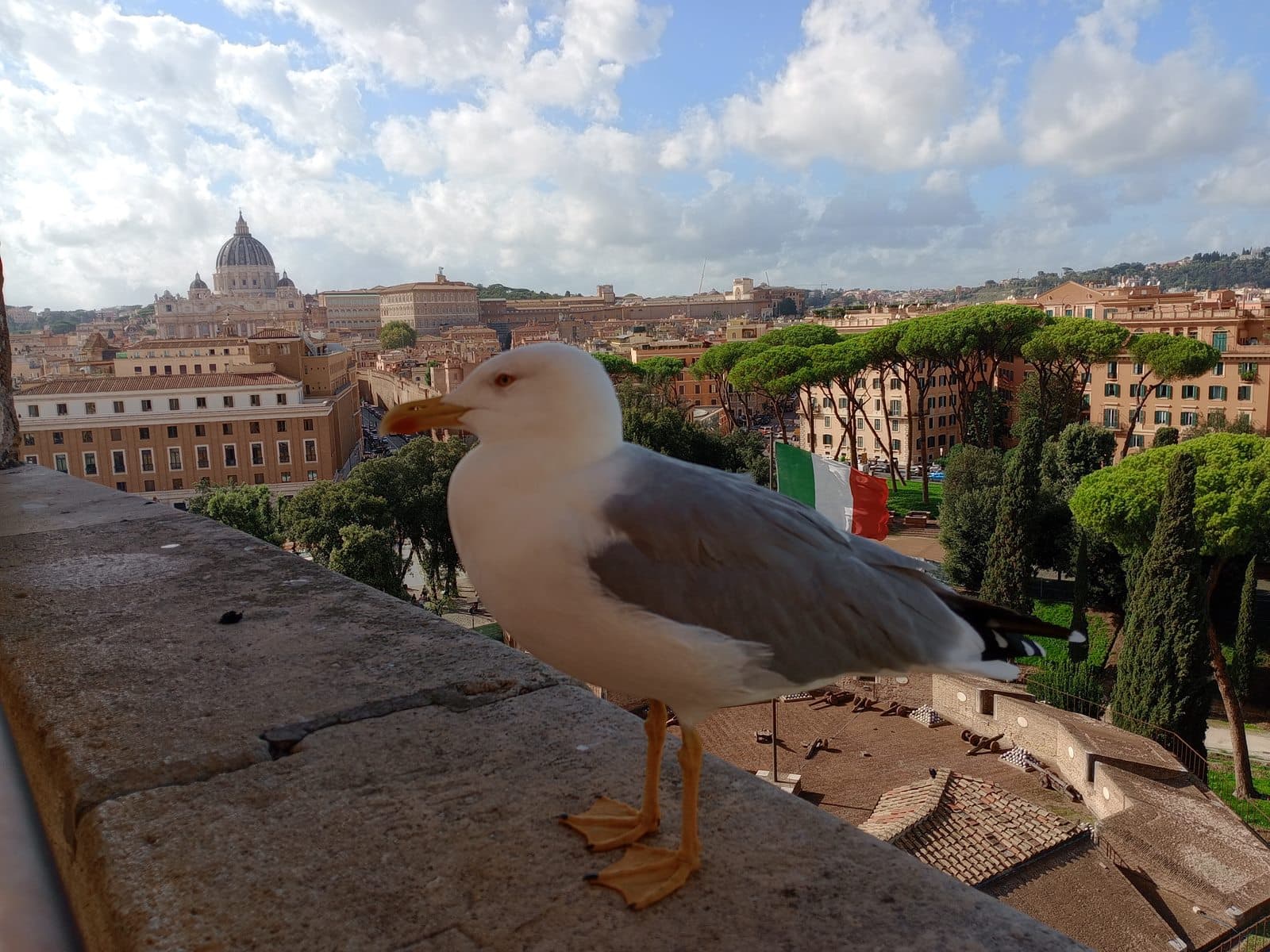
Explore · Level 4
Terrazza dell'Angelo
The Roof of Rome — Bronze Angel and 360° Views
Quick answer: The Terrazza dell'Angelo is the open-air terrace at the very top of Castel Sant'Angelo, on Level 4. It takes its name from the four-metre bronze statue of the Archangel Michael cast by Peter Anton von Verschaffelt in 1752. From the parapet you get a 360-degree panorama of Rome — from St Peter's Basilica to the Pantheon, the Altare della Patria and the Quirinale. Access is included in the standard museum ticket.
This is where the visit ends.
After the helical ramp built by Hadrian, the courtyards, the prison cells, the papal apartments and the Sala Paolina, the route opens onto a flat stone roof under open sky. There is the bronze angel, four metres tall with a five-metre wingspan, in the act of sheathing his sword. There is the city below.
The Terrazza dell'Angelo is the highest accessible point of the monument and one of the most complete viewpoints in the city. From here you can read Rome the way the popes read it: the basilica of St Peter's to the west, the dome of the Pantheon breaking the rooftops to the south-east, the white mass of the Altare della Patria further along, the Italian flag flying over the Quirinale Palace.
It is also the place where, since at least 1481, Rome has set off its most spectacular fireworks. And the place where, in the final act of Puccini's Tosca, the heroine throws herself into the void.
Why the terrace is here
The terrace is not original.
When Emperor Hadrian built the mausoleum between 134 and 139 AD, the top of the cylinder was crowned with a small earthen hill planted with cypresses, and on top of that a colossal bronze quadriga — a chariot drawn by four horses — with a statue of Hadrian himself. None of that survives. The structure was sacked, fortified, rebuilt, and gradually flattened across the centuries.
The terrace as we see it today took shape during the Renaissance, when the popes needed both an artillery platform and a viewpoint from which to keep an eye on Rome. The current layout, with its open paving and the central pedestal for the statue, is essentially the work of the sixteenth century, refined under Pope Gregory XIII and finalised in the eighteenth.
By that point the castle had stopped being primarily a military stronghold and become primarily a symbolic one. The terrace was where you stood the angel.
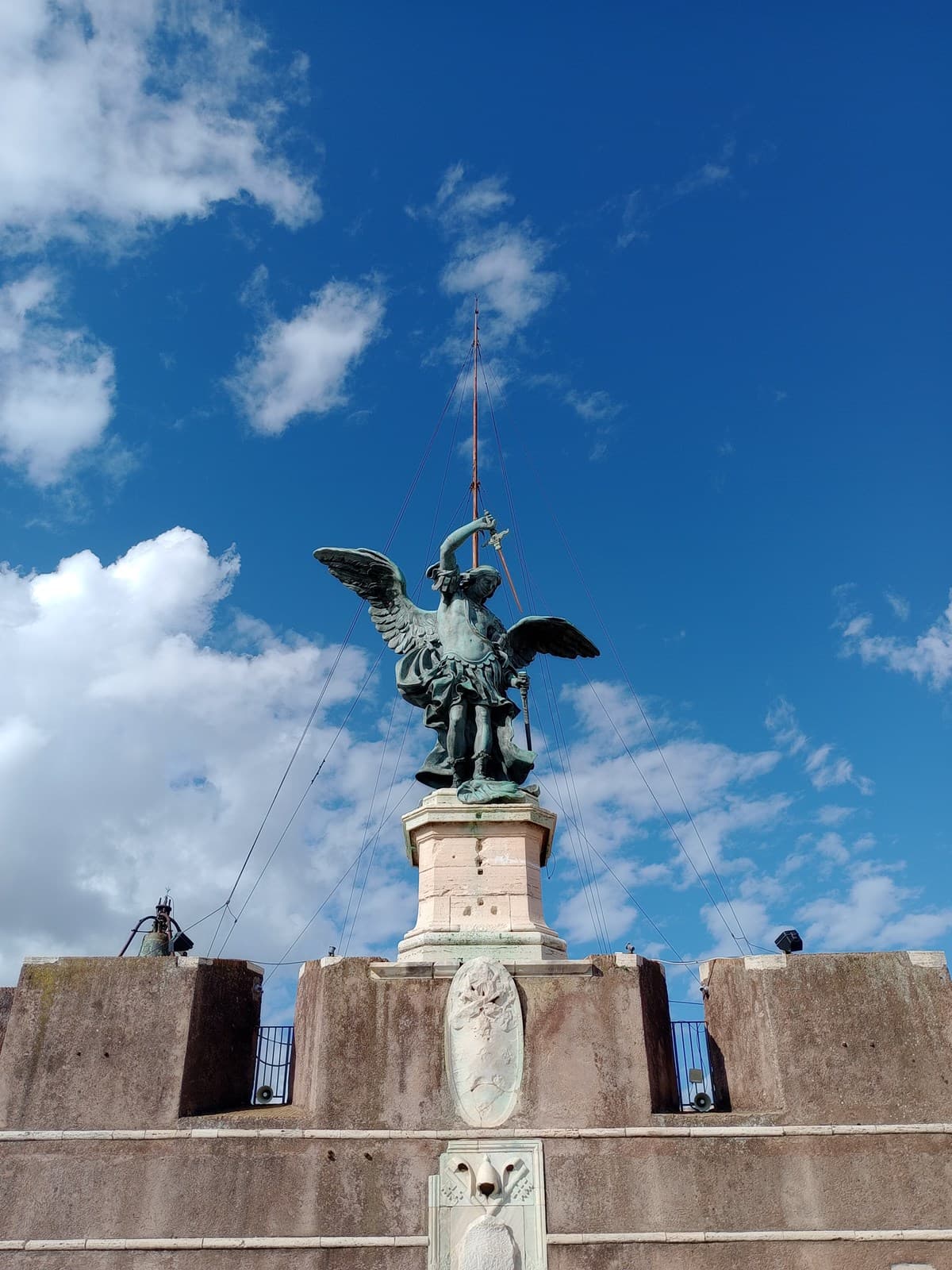
The bronze angel: seven statues, one terrace
The current statue is the seventh.
The legend behind every version is the same. In 590 AD, during a plague that was killing thousands of Romans every week, Pope Gregory the Great led a penitential procession across the Tiber. As the procession reached the top of the bridge, the pope saw an apparition above the old mausoleum: the Archangel Michael, sheathing his sword as a sign that the plague was ending. The plague did end. The mausoleum got a new name — Castel Sant'Angelo — and the top of the building got a statue.
The seven angels
Each statue lasted as long as the next disaster:
- 11th century — first version, in wood. Lost to weather.
- 14th century — second version, in marble. Destroyed during a riot in 1379.
- 15th century — third version, marble with bronze wings. Destroyed when lightning hit a gunpowder store in the castle and the explosion shattered it.
- 1497 — fourth version, in bronze. Melted down in 1527 during the Sack of Rome to make cannons.
- 1544 — fifth version, by Raffaello da Montelupo: marble with bronze wings. Today displayed in the Cortile dell'Angelo, two levels below.
- 1752 — sixth version (and current). The Flemish sculptor Peter Anton von Verschaffelt, working on commission from Pope Benedict XIV for the Holy Year of 1750, casts the bronze angel that still stands today.
The seventh count: in 1987 the original Verschaffelt statue was taken down for restoration and the metal armature inside was replaced. Some sources count this as a separate version; the bronze itself is the same.
What Verschaffelt actually made
The figure is approximately four metres tall, with a wingspan of about five metres. The archangel is shown in mid-gesture: the sword is on its way back into the scabbard, not drawn, not raised. It is the moment after the plague has ended, not the moment of battle.
The robes are sculpted to read at distance. From the Tiber, the Sant'Angelo bridge, even from St Peter's Square, the silhouette of the angel sheathing his sword is unmistakable. That was the point: the statue was made to be visible across half the city, not to be inspected up close.
For the visitor on the terrace, what is striking is the proximity. You stand within metres of a four-metre figure that for two and a half centuries has been seen only from far below.
The Misericordia Bell
Next to the angel, partly hidden, hangs a small bronze bell.
It was cast in 1758 and it is known as the Campana della Misericordia — the Mercy Bell — or the Campana dei Condannati, the Bell of the Condemned. Its purpose was singular: it rang at executions held in the courtyard below, the Cortile delle Fucilazioni, signalling to the city that a death sentence was being carried out.
The papal executioner who served from 1796 to 1864, Mastro Titta, carried out 514 executions in the course of his career. Many of them happened within sight of this bell.
What you can see from the parapet
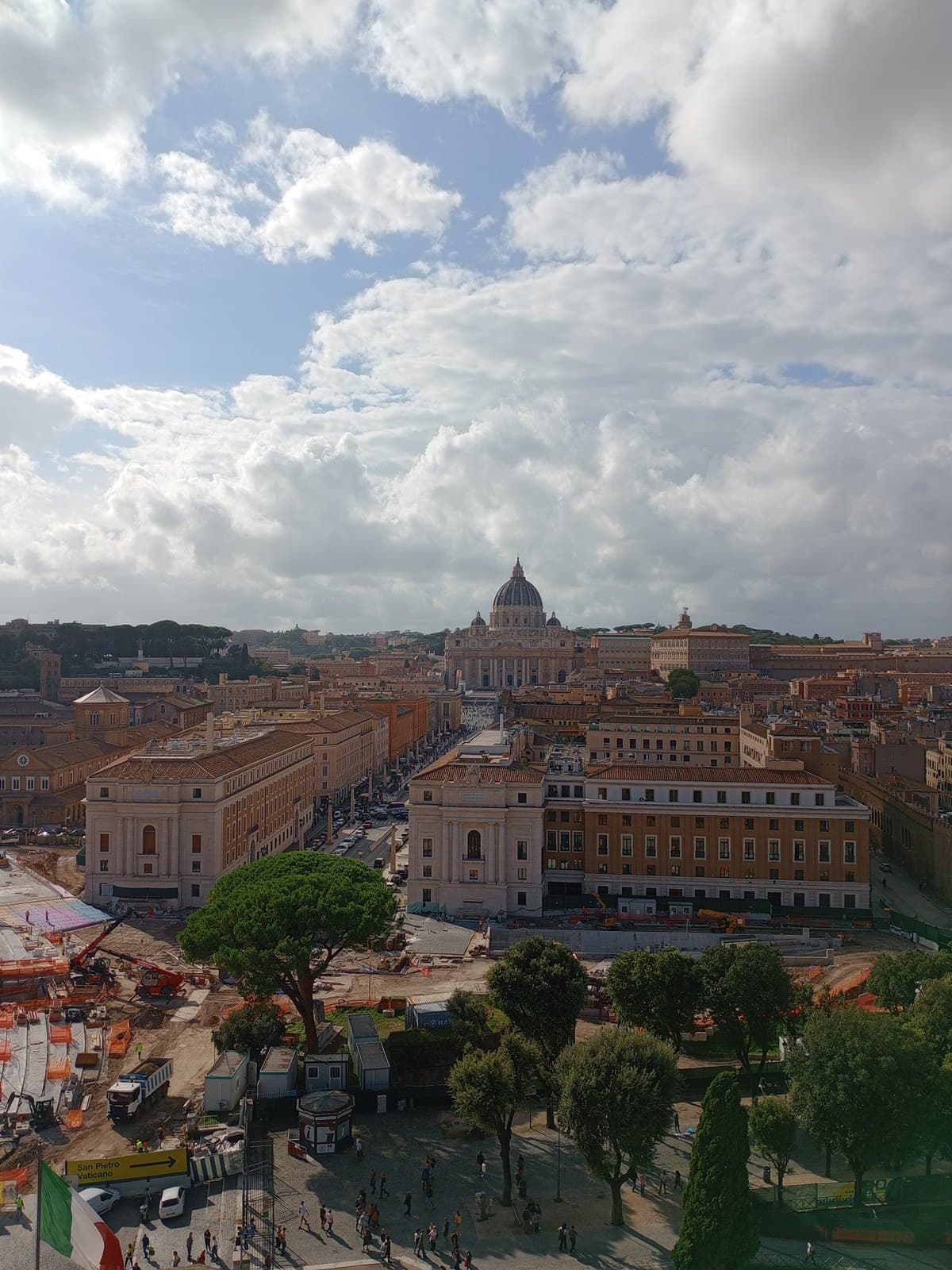
The terrace gives a 360-degree view, but each direction shows a different Rome. Walking around the parapet clockwise, starting from the side that faces the Vatican:
West — toward St Peter's
The dome of St Peter's Basilica, designed by Michelangelo, is the dominant landmark to the west. In front of it the dense rooftops of the Borgo neighbourhood, and the long monumental axis of Via della Conciliazione cut through to the Vatican by Mussolini in the 1930s.
Following the line of the wall on the right edge, you can pick out the Passetto di Borgo, the elevated fortified corridor — about 800 metres long — that connects the castle directly to the Vatican Palaces. This is the corridor Pope Clement VII used to escape the Sack of Rome in 1527.
South — toward Ponte Sant'Angelo and the historic centre
Directly below: Ponte Sant'Angelo with its ten Baroque statues of angels carrying instruments of the Passion, designed by Bernini and his workshop in the seventeenth century.
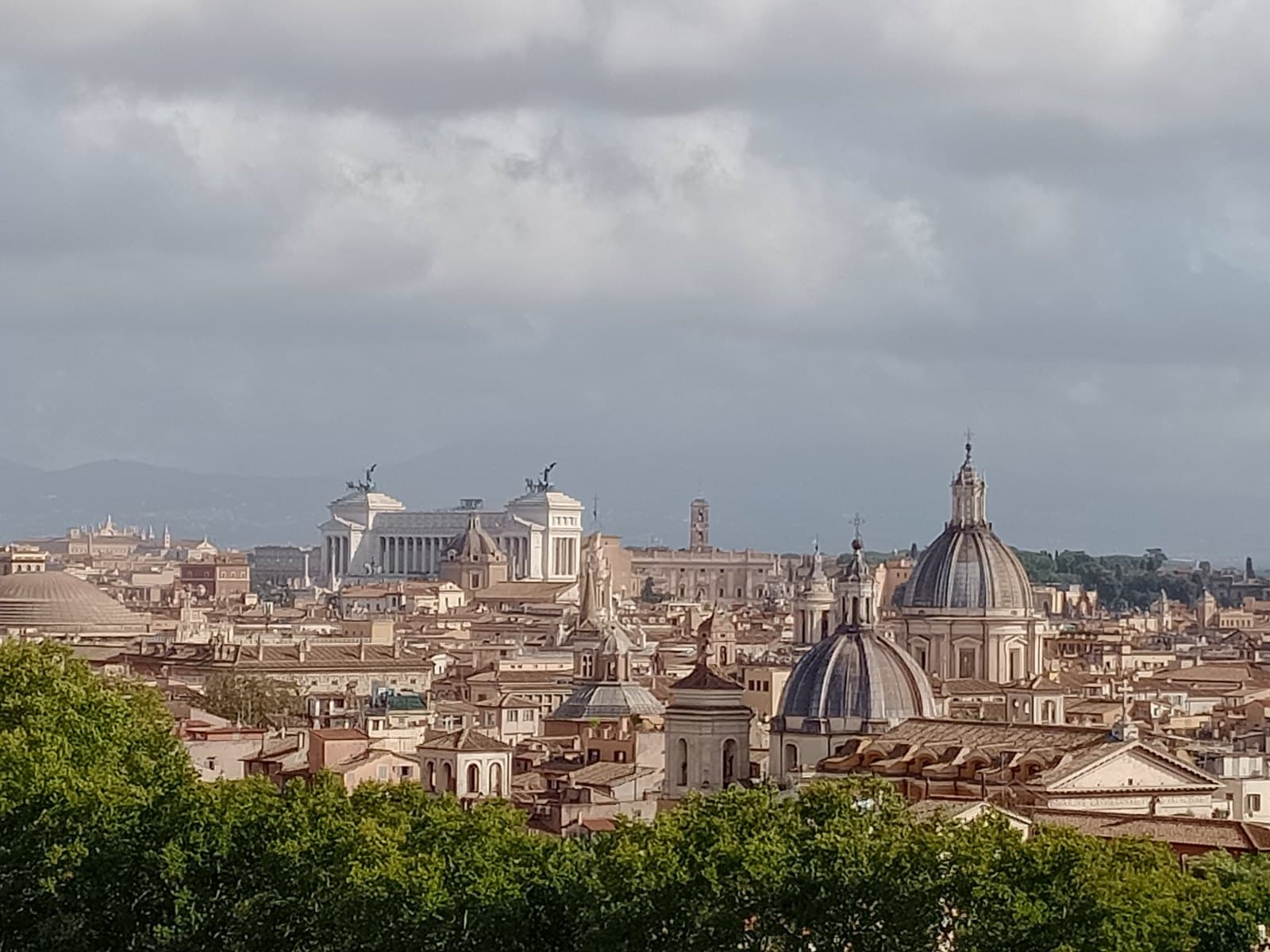
Beyond the bridge, the rooftops of the historic Parione district. Above them, you can spot the broad, low dome of the Pantheon breaking the line of houses. Further away on the same axis, the white marble of the Altare della Patria in Piazza Venezia — the monument to Vittorio Emanuele II finished in 1925.
South-east — the Quirinale
On clear days, you can see the Italian flag flying over the Quirinale Palace, the official residence of the President of the Italian Republic. The flag flies whenever the President is in Rome — a piece of contemporary information available from this Renaissance terrace.
East — the Prati district
To the east, across the modern grid of the Prati neighbourhood (laid out after Italian unification), the most prominent building is the imposing nineteenth-century Palace of Justice (Palazzo di Giustizia, also nicknamed Palazzaccio for its bulk). Behind it on a clear day you can see the green strip of Villa Borghese, Rome's biggest central park.
North — the Tiber
Looking upstream, the curve of the Tiber as it bends north of the castle, and the residential district that spreads beyond the bend.
The terrace as a fortress
For most of its history, the angel was not the point of the terrace. The cannons were.
The transformation began in 401 AD, when Emperor Honorius incorporated Hadrian's mausoleum into the new defensive walls of Rome. From that moment on, the building was no longer a tomb but a stronghold. By the early Middle Ages, the popes were already using it as a refuge in moments of crisis, and by the late thirteenth century, after Pope Nicholas III bought it formally for the papacy in 1277, the castle had become the last redoubt of the bishop of Rome.
The terrace, as the highest part of the structure, was the artillery platform. From the parapets and bastions one level below, papal gunners could cover the bridge, the river and the approaches to the Vatican.
Cellini at the cannons
The most famous gunner ever stationed on the upper levels of Castel Sant'Angelo was a sculptor and goldsmith, not a soldier.
In May 1527, when the unpaid imperial troops of Charles V broke into Rome and began the eight-day Sack of the city, Benvenuto Cellini was inside the castle alongside Pope Clement VII. He served on the bastions for the duration of the siege, firing at the besiegers below. By his own (almost certainly inflated) account in his autobiography, he claimed to have killed Charles, Duke of Bourbon, the leader of the imperial army — though the historical evidence puts that shot down to a different gunner.
The full story of those days, and Cellini's much more verifiable later imprisonment and escape from this same castle, are covered in our piece on Cellini's escape.
The Girandola: fireworks since 1481
The most spectacular event ever staged on the terrace had nothing to do with war.
Since at least 1481, papal Rome celebrated the feast of Saints Peter and Paul on 29 June with a fireworks display fired from the top of Castel Sant'Angelo. The display was called la Girandola — the pinwheel — and it was the largest pyrotechnic event in early modern Europe.
The popes commissioned the best designers available. Michelangelo is recorded as having worked on the staging at one point; Bernini did the same a century later. Eighteenth-century paintings of the event, like Adrien Manglard's 1750 view now in the National Gallery in Washington, show a wall of fire rising from the terrace and reflected in the Tiber below.
The Girandola continued, with interruptions, until the nineteenth century. It was revived in 2008 for the 250th anniversary of the Misericordia bell, and again on a few subsequent feast days. When it happens, the city stops to watch.
Tosca's leap
The terrace is also the setting for one of the most famous deaths in opera.
In the third act of Tosca, the opera that Giacomo Puccini premiered in Rome in 1900, the singer Floria Tosca arrives at Castel Sant'Angelo at dawn, expecting that her lover, the painter Mario Cavaradossi, has been granted a fake execution and is about to escape. The execution turns out to have been real. As the papal police rush onto the terrace to arrest her for the murder of the chief of police Scarpia, Tosca climbs the parapet and throws herself into the void.
The libretto by Giuseppe Giacosa and Luigi Illica places the leap explicitly on this terrace — Cavaradossi's execution happens in the courtyard below, the wall-walk where Tosca runs is identifiable, and the parapet she vaults over is the one you can lean on today.
The opera was based on a French play by Victorien Sardou from 1887, which Puccini saw in Florence in 1889 and immediately wanted to adapt. Sarah Bernhardt played Tosca on stage; Maria Callas became the most famous interpreter of the operatic version in the twentieth century. The terrace is now permanently associated with the role.
How to find it inside the castle
The Terrazza dell'Angelo is on Level 4, the topmost level of the castle.
The standard visiting route reaches it through the Renaissance papal apartments on Level 2 (including the Sala Paolina), then up through Level 3 with its library and treasury rooms, and finally up a narrow stone staircase that emerges directly onto the open terrace.
The staircase is dark and tight; the moment of stepping out into open sky and seeing the angel for the first time is, for most visitors, the climax of the visit.
For the full layout of the castle and the suggested route, see the castle floor plan or the Explore overview. To plan tickets and timing, see the Visit hub.
Practical tips for the terrace
Wind
The terrace has no shelter and is the highest point of the castle. Even on calm days at street level, the wind can be strong on top. A light jacket or shawl is worth carrying year-round.
Best time of day
The terrace catches sun all day. The two best photographic moments are mid-morning (St Peter's well lit) and the hour before sunset (the historic centre lit warm, the angel silhouetted against the sky). Direct midday sun is harsh.
The view changes character significantly with the light. If you have flexibility, an afternoon visit gives the most rewarding mix.
Crowds
The terrace is the last stop of the visit, so most groups arrive at the same time and leave at the same time. The quieter windows are early morning (within thirty minutes of opening) and the last 90 minutes before closing. The terrace clears noticeably in the final hour.
Time on the terrace
Allow at least 20 minutes on the terrace itself. Less than that and you will not have time to walk the full perimeter and identify the landmarks. Many visitors spend longer.
Closing time
The ticket office closes one hour before the monument closes. The internal route from the entrance to the terrace takes 45 to 60 minutes at a normal pace. Entering at the last minute means rushing through the rooms with little time on top — not what you want.
For exact opening hours, see the opening hours page.
Frequently asked
Is the Terrazza dell'Angelo included in the standard ticket?
Yes. Every ticket valid for entry to the National Museum of Castel Sant'Angelo gives access to the terrace. There is no separate fee. See the tickets and prices page for current rates.
Can you get up close to the bronze angel?
You can stand within a few metres of the pedestal but not climb on it. The statue is enclosed by a low railing. The detail is best appreciated from the level of the terrace floor and from the parapet on the north side, where you get the cleanest sky behind it.
Can you take photographs?
Yes, freely. There are no restrictions on personal photography on the terrace. Tripods are not permitted on the visiting route inside the rooms, but on the open terrace small handheld setups are tolerated.
Is the terrace accessible by lift?
The castle has internal lifts that cover most of the route, but the final section to the Terrazza dell'Angelo is by staircase only. Visitors with reduced mobility should check the accessibility page for the up-to-date situation, which can change with maintenance work.
Who made the statue and when?
The current bronze statue was cast by the Flemish sculptor Peter Anton von Verschaffelt in 1752, on commission from Pope Benedict XIV in preparation for the Holy Year of 1750. It is the seventh statue to crown the castle since the eleventh century.
Why is there an angel on top of the castle?
A statue of the Archangel Michael has stood on top of Castel Sant'Angelo since the eleventh century, commemorating a vision Pope Gregory the Great had during the plague of 590 AD: the archangel sheathing his sword above the building, signalling the end of the plague. The castle owes its current name to that legend.