History · 1277 onward
The Passetto di Borgo
The 800-metre fortified corridor that twice saved the papacy, and the engineering decision that quietly shaped five centuries of European history.
Quick answer: The Passetto di Borgo is an 800-metre elevated corridor built from 1277 onward by Pope Nicholas III, on top of the ninth-century Leonine Walls. It connects the Vatican Apostolic Palace to Castel Sant'Angelo. Popes used it to escape danger in 1494 (Alexander VI fleeing Charles VIII) and 1527 (Clement VII fleeing the Sack of Rome). After a major restoration (2018-2024) it reopened to the public in late 2024 with a new permanent visitor route, in time for the 2025 Jubilee.
A defensive idea, centuries in the making
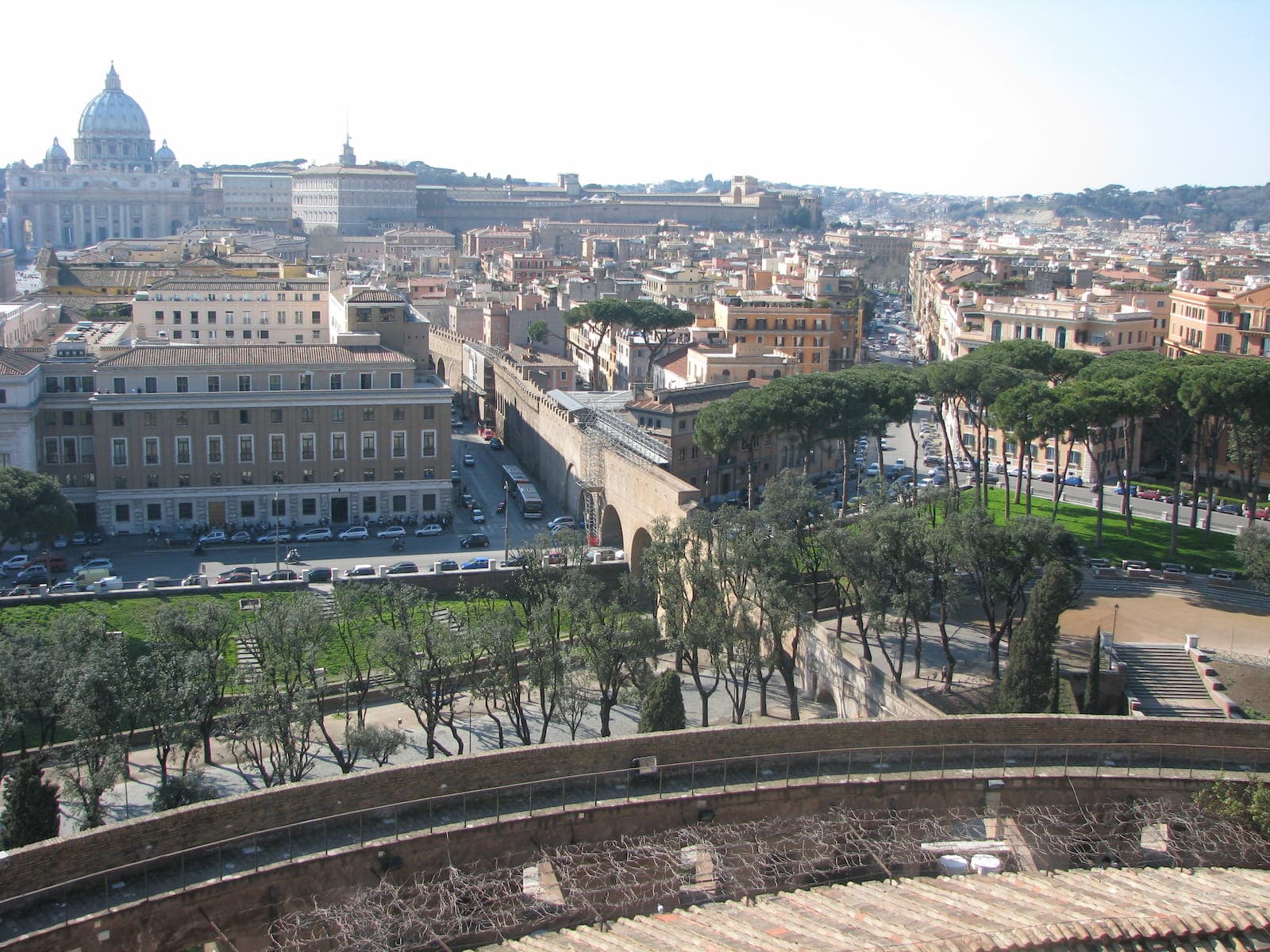
The Passetto did not appear from nothing. It was built on top of a wall that already had three centuries of history of its own.
The story begins around the year 550, during the Gothic War, when the Ostrogothic king Totila ordered the construction of a wall that would later support the Passetto. Three centuries later, in 852, after Saracen forces had sacked the basilica of St. Peter, Pope Leo IV ordered the massive fortifications now known as the Leonine Walls. Built by Saracen prisoners in a U-shaped layout, the walls began at Castel Sant'Angelo, surrounded the Vatican basilica, and descended back toward the Tiber.
For four hundred years that was the situation: a wall, but no covered corridor. Then, in 1277, Pope Nicholas III commissioned the construction of an elevated walkway and a fortified corridor on top of the existing Leonine Walls. The result was the Passetto. It stood roughly seven metres above the streets of Rome and ran unbroken between the Vatican Palace and the Castel Sant'Angelo.
The architectural rationale was simple. The pope needed a way to move between his residence in the Vatican and the most secure building in Rome — Castel Sant'Angelo, originally the mausoleum of Emperor Hadrian — without descending to street level, where political enemies, mercenaries, or invading armies could intercept him.
The Borgia upgrade
Two centuries after Nicholas III, the Passetto received its decisive expansion. Pope Alexander VI Borgia (1492-1503) ordered a major reinforcement of the corridor in the 1490s. The walls were raised, a second walkway was added on top, and the structure took on the form that survives today.
The timing was not coincidental. Alexander VI knew that invasions of Rome were a real possibility, and the decision to fortify the Passetto made him one of the first users of his own work — when Charles VIII of France invaded Italy with an army of thirty thousand men in August 1494, the pope used the corridor to retreat to Castel Sant'Angelo. He survived. The decision to invest in the Passetto paid off within two years of the project being completed.
The carved stone bearing the Borgia coat of arms — with the family bull — is still visible today on parts of the interior wall, alongside a Latin inscription dating the renovation to 1492.
The Sack of Rome, 1527 — the most dramatic moment
The Passetto's most consequential test came thirty-three years later. On May 6, 1527, the unpaid and mutinous imperial army of Charles V — roughly twenty thousand soldiers, including Lutheran Landsknechts who held the papacy in particular contempt — overran Rome.
Pope Clement VII was in the Vatican Apostolic Palace when the news arrived that the troops had broken through the walls. He had only minutes to decide. The Swiss Guard, his personal protection corps, took up positions on the steps of St. Peter's Basilica to give the pope time to escape. Of the original 189 Swiss Guards, more than 140 were killed in the defence — buying Clement the time he needed.
The pope crossed the Passetto on foot, through the same corridor Alexander VI had used thirty-three years earlier. He reached Castel Sant'Angelo and barricaded himself inside. The siege lasted seven months. During that period, the castle was the only ground in Rome still under papal control. Clement VII finally agreed to surrender terms in December 1527 and was held a prisoner inside the castle until June of the following year.
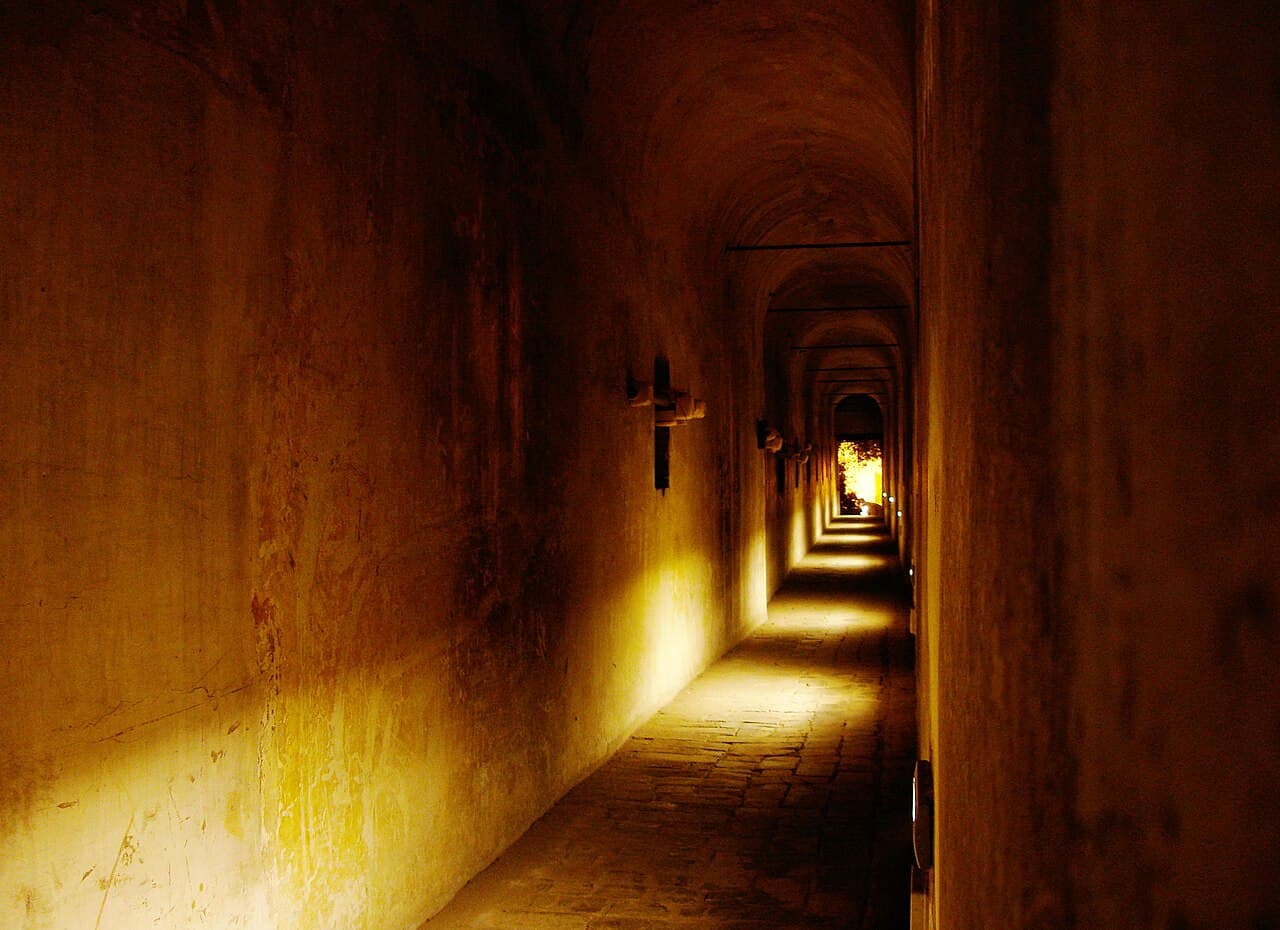
The marks of arquebus shots fired by the German mercenaries during the sack are still visible today on the walls of the Passetto. They are the most physical surviving evidence of the moment when the corridor justified its existence beyond any doubt.
Without the Passetto, the modern history of the papacy could plausibly have ended on that day in May 1527.
Decline, sovereignty, and the long silence
The Passetto's functional life as a papal escape route ended in 1870, when the newly unified Kingdom of Italy took possession of Castel Sant'Angelo from the Vatican. The pope no longer had a fortress to escape to, and the corridor lost its strategic purpose.
What followed was an unusual diplomatic gap. The Lateran Pacts of 1929 — the agreement that settled the long dispute between Italy and the Holy See and created Vatican City — did not mention the Passetto at all. Sovereignty over the corridor remained legally unresolved for sixty-two years. The structure deteriorated. Public access was forbidden. For most of the twentieth century, the Passetto was a ghost: a famous wall that nobody could enter.
The legal question was finally resolved on May 18, 1991, when Pope John Paul II formally recognised that the Passetto belonged to the Italian state — except for the first eighty metres from the Vatican side, which the Holy See retained under a symbolic rental agreement, primarily for security reasons.
The corridor was opened to the public for the first time on November 11, 1999, after a brief restoration timed for the 2000 Jubilee. But access was limited and seasonal. For most of the next two decades, visiting the Passetto remained a rare privilege.
The 2024 reopening — a permanent visit at last
In December 2018, a major restoration project was launched. Funded by the Italian state and directed by the Special Superintendence of Rome together with the Direzione Generale Musei, the project addressed structural reinforcement of the wall facing, restoration of the interior plaster and pavement, consolidation of the section near Porta Angelica, installation of a new lighting system with emergency illumination, and the removal of architectural barriers — including two new elevators and a mechanised hatch connecting the upper and lower levels of the corridor.
The works were completed in March 2024.
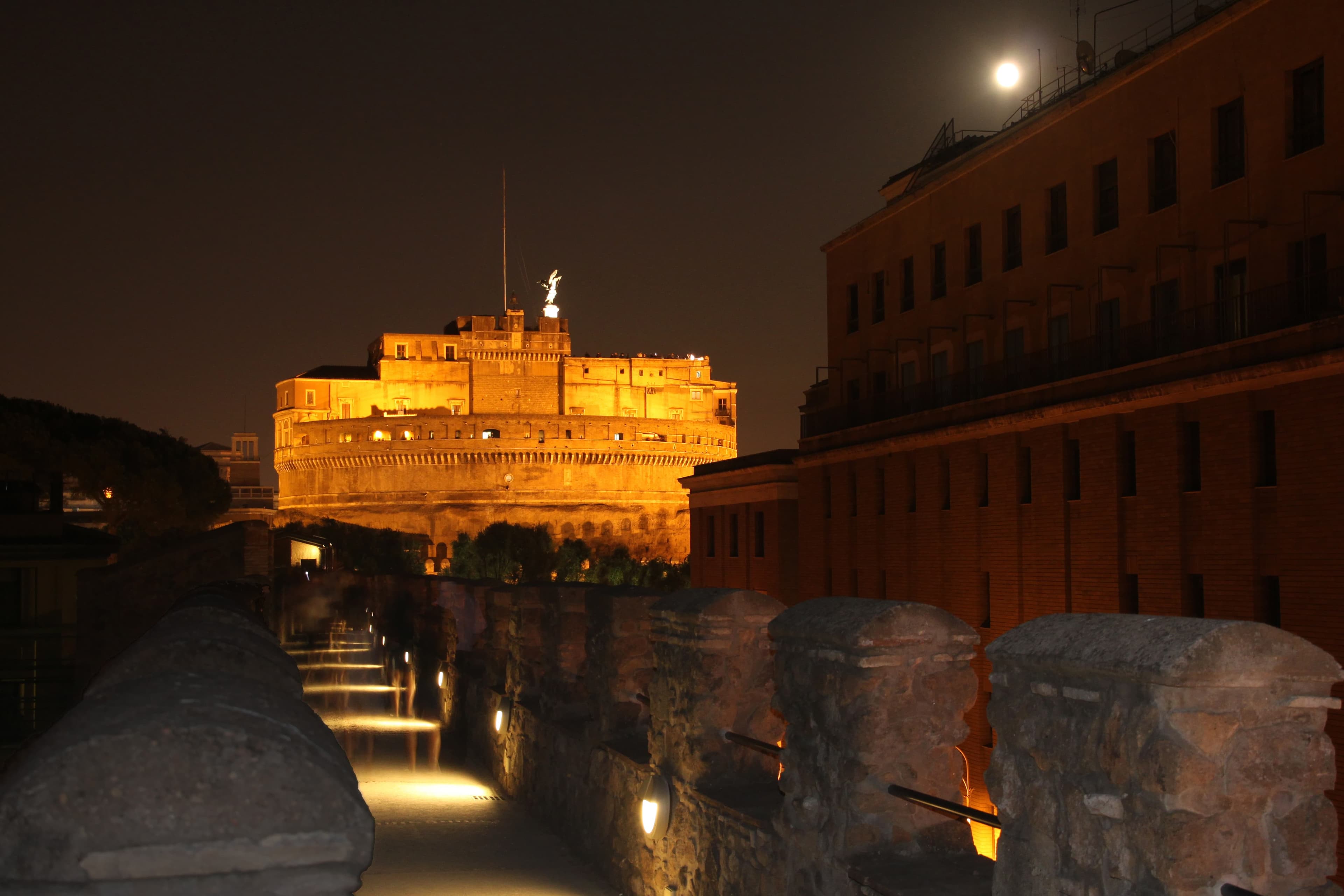
The Passetto reopened to the public in late 2024 with a new permanent visitor programme, on the eve of the 2025 Jubilee proclaimed by Pope Francis. The reopening was framed as one of the major cultural inaugurations of the Jubilee year.
The new route includes guided day tours, evening itineraries, and a permanent museum exhibit installed inside the Bastione San Marco — the corner bastion of Castel Sant'Angelo that connects directly to the Passetto. The exhibit displays artefacts including a sixteenth-century cannonball bearing the monogram of Crispo Tiberio Prefetto, castellan of the castle under Pope Paul III Farnese (1542-1545), and a bronze muzzle-loading cannon recalling the tradition of the daily noon shot fired from the castle from the nineteenth century onward.
The Passetto in popular culture
For a structure that spent most of the twentieth century inaccessible to the public, the Passetto has had a remarkable afterlife in fiction.
The corridor plays a key role in Dan Brown's novel Angels & Demons (2000) and the Ron Howard film adaptation (2009), where the antagonist uses the Passetto to transport four kidnapped cardinals to Castel Sant'Angelo. The protagonists, Robert Langdon and Vittoria Vetra, later use the same passage as a back entrance into the Vatican.
The corridor also appears in Mission: Impossible III (2006) as the route used to enter the Vatican in the film's infiltration sequence.
In video games, the Passetto is one of the recreated landmarks in Assassin's Creed Brotherhood (2010), set in early-sixteenth-century Rome under the Borgia papacy. The game places the corridor incorrectly along the banks of the Tiber rather than between the Vatican and the castle, but the structure itself is faithfully reproduced.
See it for yourself
Walking the Passetto is a different experience from reading about it. The corridor is roughly three and a half metres wide; the walls rise up to fourteen metres above street level in some sections; the noise of the city below disappears as soon as you are inside. Even with the new lighting and accessibility upgrades, the medieval scale of the structure is unmistakeable.
For tickets and the latest visitor information:
- Guided tour of the Passetto di Borgo and Castel Sant'Angelo — the dedicated guided experience that includes the full corridor and the museum exhibit at the Bastione San Marco.
- All tours of Castel Sant'Angelo — other tours that include or exclude Passetto access. Look for the word “Passetto” in the title.
- Tickets and prices — for the standard Castel Sant'Angelo entry, which does not include the Passetto.
- Accessibility — details on the elevators and access ramps installed in the 2024 restoration.
- Castle highlights — the other essential rooms and terraces of Castel Sant'Angelo.
And for the historical context, the dramatic episode that justified the corridor's existence is told in detail in our piece on the Sack of Rome of 1527.
Frequently asked questions
What is the Passetto di Borgo?▾
When was the Passetto built?▾
Did popes really escape through the Passetto?▾
Can I visit the Passetto di Borgo today?▾
How do I buy tickets for the Passetto?▾
How long is the Passetto and how long does it take to walk?▾
Does the Vatican still own part of the Passetto?▾
Does the Passetto appear in popular culture?▾
About this page
Edited by Gabriel G, a Google Maps Local Guide (Level 8) who has visited Castel Sant'Angelo on site and contributed reviews, photos, and corrections to Rome's cultural heritage sites over several years.
Historical and architectural content is verified against primary and institutional sources: the official brochure and timeline of the Direzione Musei Nazionali di Roma (dmnrm), the Italian Ministry of Culture, the Special Superintendence of Rome (which led the 2018-2024 restoration project), the Treccani encyclopedia for biographical entries, and the Wikipedia article on the Passetto di Borgo for secondary cross-checking. Images via Wikimedia Commons under CC BY-SA 3.0.